
Mustang Mach-E Battery Degradation: What 36,000 Cars Mean for Portugal Buyers
Published: 22/11/2026
92% after 5 years: what Ford measured across 36,000 batteries
Around 36,000 Ford Mustang Mach-E from the 2021 model year, more than five years on the road, and an average of 92% of usable capacity still there. That is the headline from the battery data Ford has just released, and it is the clearest answer yet on Mustang Mach-E battery degradation, the number one worry for anyone eyeing a second-hand EV.
If you're shopping for a used Mustang Mach-E in Portugal, this matters directly. The first cars reached Europe in late 2020, and 2021-2022 examples are exactly the ones now showing up in the classifieds with higher mileage and lower prices.
The figures come from telemetry on cars sold in the US and Canada, collected up to August 2026. The average Mach-E covered about 88,500 km (55,000 miles) over 5.2 years, and the fleet as a whole logged 3.2 billion km.
- 92% average battery state of health (SoH)
- 95% of cars sit between 87% and 97% SoH
- 2,000+ cars past 161,000 km average more than 91%
- 30+ cars past 322,000 km average 88%
- One 2022 Mach-E has passed 644,000 km on its original pack
The spread tells its own story. With 95% of the fleet inside a 10-point window, there's no long tail of failing packs dragging the average down.
How much range does a 5-year-old Mustang Mach-E lose
Roughly 40 km. Ford's own example is the 2021 top trim, rated at 305 EPA miles (about 490 km). At 92% capacity it would now be good for around 280 miles, or about 450 km.
Kevin Vander Laan, Ford's technical leader for high-voltage battery cells and systems, puts it neatly: "Our report card slowly trickles in over time." Ford tests cells in the lab and models degradation before launch; the real-world data now feeds into its next generation of EVs.
Standard Range vs Extended Range: an estimate for the used Mach-E
One caveat up front: Ford only released fleet averages. There's no split between Standard Range and Extended Range. Still, applying the 92% figure to European battery sizes and WLTP ranges gives a reasonable picture of what to expect from a 2021-2022 Mach-E.
| Version | Usable capacity new | At 92% (estimate) | WLTP range new | At 92% (estimate) |
|---|---|---|---|---|
| Standard Range RWD | 68 kWh | ~62.6 kWh | ~400 km | ~368 km |
| Standard Range AWD | 68 kWh | ~62.6 kWh | ~440 km | ~405 km |
| Extended Range | 88 kWh | ~81 kWh | up to ~600 km | up to ~552 km |
automar.pt estimate based on Ford's 92% fleet average; not official per-version data. Any individual car may land above or below.
There's another nuance. Every car in Ford's study uses NCM (nickel-cobalt-manganese) cells. LFP chemistry only arrived on the Standard Range from the 2023 model year. So these numbers map directly onto 2021-2022 cars and Extended Range packs. For the newer LFP batteries, Ford actually recommends charging to 100% from time to time.
What independent European data says
Ford's numbers are self-reported and haven't been independently verified. Fortunately there's a European cross-check: Aviloo, an Austrian battery diagnostics firm, published a study in September 2026 based on more than 500,000 tests, most of them in Europe.
The Mach-E holds up well. Its median battery state of health is 95.1% at 50,000 km and 92.5% at 150,000 km, putting it 6th out of 20 models.
| Model | SoH at 50,000 km | SoH at 150,000 km |
|---|---|---|
| Mercedes-Benz EQA | 96.6% | 94.0% |
| Hyundai IONIQ 5 | 97.1% | 93.8% |
| BMW i4 | 95.6% | 93.6% |
| Ford Mustang Mach-E | 95.1% | 92.5% |
| Skoda Enyaq iV | 95.1% | 91.0% |
| VW ID.4 | 95.2% | 90.8% |
| Tesla Model Y | 94.4% | 90.3% |
| Tesla Model 3 | 93.8% | 88.9% |
Median SoH by model, Aviloo FLASH Test data (8 of 20 models shown).
Mustang Mach-E vs Tesla Model Y: battery degradation
If you're torn between the two most common used electric SUVs, the gap is concrete: 92.5% versus 90.3% at 150,000 km. The Mach-E also edges out the VW ID.4 (90.8%) and Skoda Enyaq (91.0%), both direct rivals on the Portuguese market.
Keep in mind these are medians. Aviloo found gaps of up to 13.5 points between the best and worst examples of the same model. A fleet average tells you little about the specific car on the dealer's forecourt.
Heat and fast charging: what wears the battery
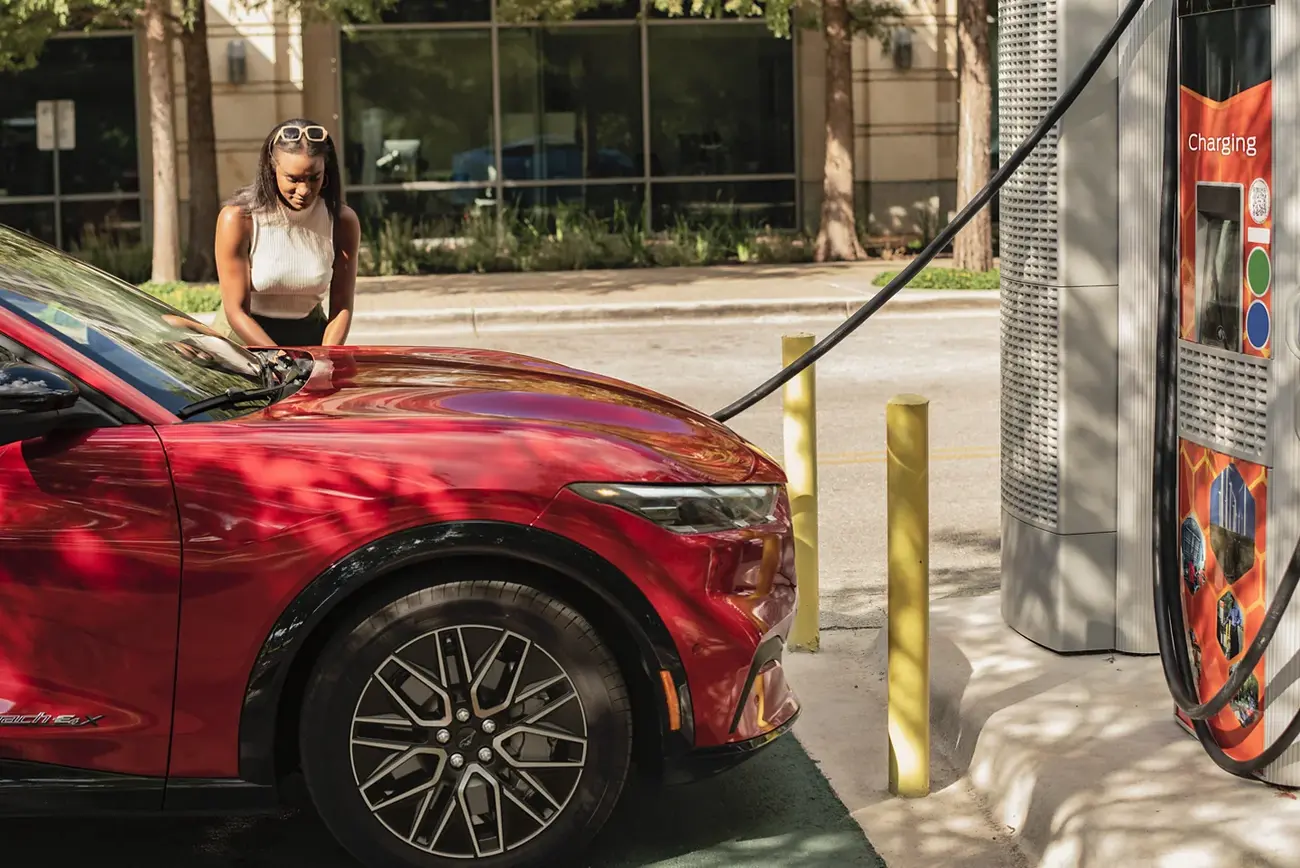
Ford points to two main drivers of Mustang Mach-E battery degradation: heat and charging habits. Cars living in hot regions, such as the American Southwest, age faster. Frequently DC fast-charging to 100% and running the pack close to empty also speed up wear.
With Alentejo and Algarve summers, that's worth taking seriously in Portugal. Ford's advice:
- Charge at home on AC for daily driving; save DC fast charging mostly for trips
- Keep the charge between 20% and 80% where possible
- Park in the shade in hot weather
- Precondition the cabin while the car is plugged in
In practice, a Mach-E that did Lisbon-Porto every week on fast chargers from the MOBI.E network (Portugal's national public charging network) won't have the same story as a garage-kept car charged on a home wallbox. Always ask the seller how the car was charged.
Mustang Mach-E battery warranty: 8 years or 160,000 km
The high-voltage battery warranty is 8 years or 160,000 km, according to the DECO Proteste spec sheet (DECO is Portugal's main consumer association). In the UK, Ford covers repair or replacement if capacity drops below 70%. We couldn't confirm whether the same 70% threshold applies in Portugal, so check the exact terms with Ford Portugal or a dealer before you sign.
If Ford's data holds, a 2021 Mach-E at 92% is nowhere near that limit. The real risk sits with the cheapest examples: high-mileage ex-company cars close to or past 160,000 km, where the warranty no longer protects you. Replacing the pack out of warranty costs just under £10,000, according to a rough, unverified UK estimate.
Buying a used Mustang Mach-E: what to check
The data is encouraging, but it doesn't replace a proper inspection. Before buying, go through this list:
- Battery health certificate. An Aviloo test through the OBD port takes about 3 minutes and gives you an independent SoH reading. Dashboard figures vary by manufacturer and can't be compared across brands.
- High-voltage contactor recall. 2021-2022 Extended Range and GT cars could overheat their main contactors, leading to loss of power. The initial software update wasn't enough; the proper fix is replacing the high-voltage battery junction box. Confirm it by VIN.
- Windscreen and panoramic roof bonding. This affects early 2021 builds; check the recall has been carried out.
- 12V battery. Recall 25S65 fixes an issue where a drained 12V battery could leave the electronic door latches locked.
- Suspension. Cars built before mid-2022 have a firmer, bouncier setup. Later builds got an update.
One last point: the Mach-E depreciates quickly. In the UK it lost around two-thirds of its value in under three years. For a buyer, that's an opportunity, as long as the battery and recalls check out.
Frequently Asked Questions
Ford says the pack is designed to last more than 10 years, and real-world data backs that up. Across roughly 36,000 2021 Mach-Es, cars past 161,000 km (100,000 miles) still average over 91% capacity, and those past 322,000 km (200,000 miles) average 88%. One 2022 Mach-E has passed 644,000 km (400,000 miles) on its original battery.
The most reliable option is an independent OBD-port test such as Aviloo's, which takes about 3 minutes and reports the battery's state of health (SoH). It matters because Aviloo found gaps of up to 13.5 percentage points between the best and worst examples of the same model. As a European benchmark, the Mach-E's median SoH is 95.1% at 50,000 km and 92.5% at 150,000 km.
According to DECO Proteste's spec sheet, the high-voltage battery is covered for 8 years or 160,000 km. In the UK, Ford covers the pack if capacity drops below 70%, but we could not confirm that the same threshold applies in Portugal. Before buying, check the exact terms and remaining coverage by VIN with Ford Portugal or a dealer.
There is no official published price for Portugal. An unverified UK estimate puts an out-of-warranty replacement at just under £10,000. With Ford's data showing an average of 92% capacity after 5 years and about 88,500 km, replacements should be rare, but the risk is higher for high-mileage cars already past the 160,000 km warranty limit.
Not directly. Every car in Ford's study is a 2021 model year with NCM (nickel-cobalt-manganese) cells, the same chemistry used in Extended Range packs. LFP only arrived on the Standard Range from model year 2023, and for those packs Ford recommends an occasional charge to 100%, unlike the 20-80% window advised for NCM batteries.
Is a used Mustang Mach-E worth buying in Portugal?
Based on this data, yes, for most buyers. Losing roughly 8% over 5 years and 88,500 km is less than many feared, and Aviloo's European testing points the same way. Pick a car with all recalls closed, ask for a battery certificate and confirm the remaining warranty with Ford Portugal. You end up with an electric SUV whose battery still has plenty of years left in it.