
Ferrari Luce Electric in Portugal: Specs, Price and Availability
Published: 26/05/2026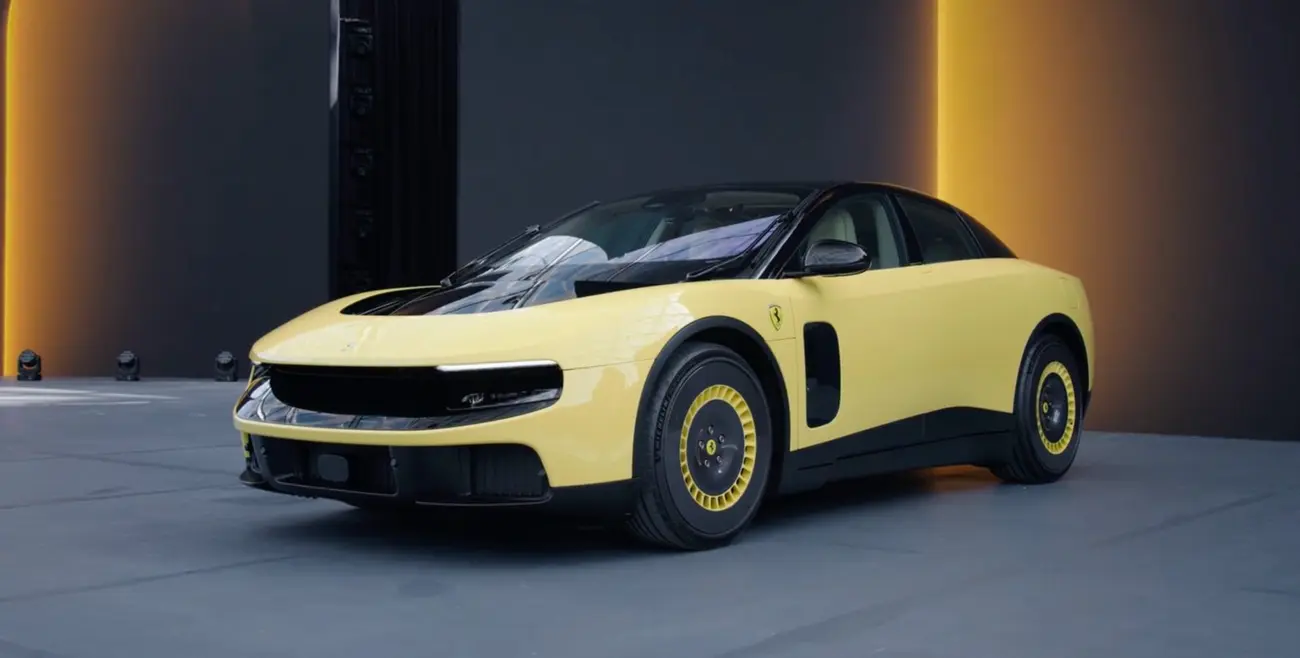
Ferrari Luce electric in Portugal: the first Ferrari without a combustion engine
It took longer than many expected, but it's here. The Ferrari Luce electric is Maranello's first fully battery-powered car, revealed on May 25, 2026, in Rome. The name means "light" in Italian, and the ambition is anything but quiet: four motors, more than 1,000 hp, and an interior shaped by Jony Ive, the man behind the iPhone.
For anyone following the market here in Portugal, this is one of those debuts that shifts the conversation. Not because of how many will roll on local roads — there will be very few — but because of what it says about where electric supercars are heading. When Ferrari moves, the rest of the industry takes notes.
How much horsepower the Ferrari Luce has: quad motors and all-wheel drive
The Luce runs four motors, one per wheel, in an all-wheel-drive layout with torque vectoring on both axles. The combined output causes some confusion across sources — Ferrari quotes over 1,000 hp in Boost mode, several outlets cite 1,113 hp (830 kW), and a few report 986 hp. The gap comes down to measurement conditions, not indecision from the brand.
The split is what tells you the car's character. Each front motor delivers 141 hp (241 N·m), while each rear motor reaches 416 hp (659 N·m). This is a rear-biased machine, true to Ferrari's DNA, with wheel torque hitting 7,999 N·m at the rear and 3,499 N·m up front.
The performance figures follow suit: 0–100 km/h in around 2.5 seconds and a top speed of 310 km/h. While cruising, the front motors disconnect to save energy — a smart touch that feeds directly into the range.
The motor layout uses a Halbach array, the same technique Ferrari runs in its Formula 1 powertrains, concentrating magnetic flux toward the stator to maximise torque density. In plain terms: far more force in the same space.
Ferrari Luce range and charging: 530 km on an 880V platform
The battery is a 122 kWh NMC pack supplied by SK On, sitting on an 880V platform developed from scratch for this model. That's 210 cells across 15 modules, with an energy density of 280 Wh/kg at cell level — top-tier figures.
The claimed WLTP range is over 530 km. For a supercar of this weight and power, that's a realistic number, especially with the front motors switching off during cruising. It won't beat a family electric sedan, but that was never the brief.
On charging, the 880V architecture allows up to 350 kW on DC, taking 10–80% in under 25 minutes in ideal conditions. In Portugal, the MOBI.E network and the fast chargers along the motorways already handle these power levels at several points, so a Lisbon-Porto run with one charging stop is entirely doable. (MOBI.E is the country's national charging network.)
Inside the Ferrari Luce: Jony Ive's analog bet
Here's the real surprise. While half the industry crams cabins with screens, Ferrari went the other way. The interior came out of a collaboration between Centro Stile Ferrari, led by Flavio Manzoni, and the LoveFrom studio of Sir Jony Ive and Marc Newson.
The philosophy is "analog first." Instead of touch controls for everything, the Luce brings physical switches and toggles in machined aluminium, a glass gear selector, and surfaces in polished and matte steel. The steering wheel is made from 100% recycled aluminium, inspired by the classic Nardi wheels of the 1950s–60s. There are screens — a 12.9" dual-layer OLED cluster and a 12" central panel — but they serve the driver rather than replacing everything.
The new eManettino offers Range, Tour, and Performance modes. And the sound? No fake engine noise: accelerometers capture the real vibrations from the rear axle and amplify them into the cabin. It's authentic sound, not a recording.
How much the Ferrari Luce costs and when it reaches Portugal
This is where honesty is needed: Ferrari hasn't announced an official price. The estimates vary widely. European analysts point to over €500,000, placing the Luce above the SF90 Stradale hybrid. Across the Atlantic, figures around $823,000 circulate; another estimate lands at $535,000 (roughly €460,000).
In Portugal, the final figure will depend on taxes. As an EV, it qualifies for ISV exemption and a reduced IUC — Portugal's car registration tax and annual road tax. On a car at this level those savings are huge in absolute terms, though irrelevant to anyone actually buying one. For the Portuguese buyer, the list price will almost certainly sit near half a million euros before options.
First deliveries are scheduled for October 2026. Ferrari expects the Luce to account for roughly 5% of its 2026 sales — deliberately a small number. CEO Benedetto Vigna was clear: this is "an addition to the lineup, not a transition." The 2030 strategy targets 20% electric, 40% hybrid, and 40% combustion.
Ferrari Luce specs at a glance
| Specification | Value |
|---|---|
| Powertrain | Quad-motor, all-wheel drive (Halbach array) |
| Combined power | Over 1,000 hp (Boost); up to 1,113 hp / 830 kW cited |
| Front motors | 141 hp each (241 N·m) |
| Rear motors | 416 hp each (659 N·m) |
| 0–100 km/h | around 2.5 s |
| Top speed | 310 km/h |
| Battery | 122 kWh NMC (SK On), 880V, 210 cells / 15 modules |
| WLTP range | over 530 km |
| DC charging | up to 350 kW; 10–80% in under 25 min |
| Platform | Dedicated 880V; 48V active suspension; four-wheel steering |
| Wheelbase | 2,959–2,960 mm |
| Weight distribution | 47:53 |
| Body | 5-door, 4–5 seats |
| Production | E-Building, Maranello (Italy) |
| Debut | May 25, 2026, Rome |
| Deliveries | October 2026 |
| Estimated price | over €500,000 (no official figure) |
Frequently Asked Questions
Ferrari hasn't announced an official price yet. European estimates point to over €500,000, placing the Luce above the SF90 Stradale hybrid, while US sources mention around $823,000 and others around $535,000 (roughly €460,000). In Portugal, as a fully electric car it qualifies for ISV exemption and a reduced IUC, but the list price will likely sit near half a million euros before options.
The Luce was revealed on May 25, 2026 in Rome, with first deliveries scheduled for October 2026. The number of units reaching Portugal will be very small, as Ferrari expects the model to account for only about 5% of its 2026 sales — deliberately a low volume.
The claimed WLTP range is over 530 km, backed by a 122 kWh NMC battery from SK On. Thanks to the 880V platform, DC charging reaches 350 kW, taking 10–80% in under 25 minutes. The front motors disconnect while cruising to save energy, and Portugal's MOBI.E network already handles these power levels at several points.
The Luce runs four motors (one per wheel) with combined output above 1,000 hp in Boost mode — several sources cite 1,113 hp (830 kW). Each front motor delivers 141 hp and each rear motor 416 hp, giving it a rear-biased character. It accelerates from 0 to 100 km/h in around 2.5 seconds and tops out at 310 km/h.
The interior came from a collaboration between Ferrari's Centro Stile and the LoveFrom studio of Sir Jony Ive and Marc Newson, built on an "analog first" philosophy. Instead of screens for everything, it features physical machined-aluminium switches, a glass gear selector, and a 100% recycled-aluminium steering wheel inspired by classic Nardi wheels. The sound isn't fake: accelerometers capture the real rear-axle vibrations and amplify them into the cabin.
Worth following the Luce, even if you won't buy one
Almost no one in Portugal will have a Luce in the garage. But what Ferrari chose to do here — keep physical buttons, refuse artificial sound, switch off motors to save energy — sets the tone for the electric luxury segment. When mainstream makers start borrowing these ideas, the electric cars we can actually buy here will get better.
For now, the timeline is what matters: debut done, deliveries from October, and the official price still to be confirmed. Worth keeping an eye on — this is the moment the electric supercar stops being a promise and becomes a product.