
Denza Z9GT Arrives in Europe with 1,500 kW FLASH Charging
Published: 26/03/2026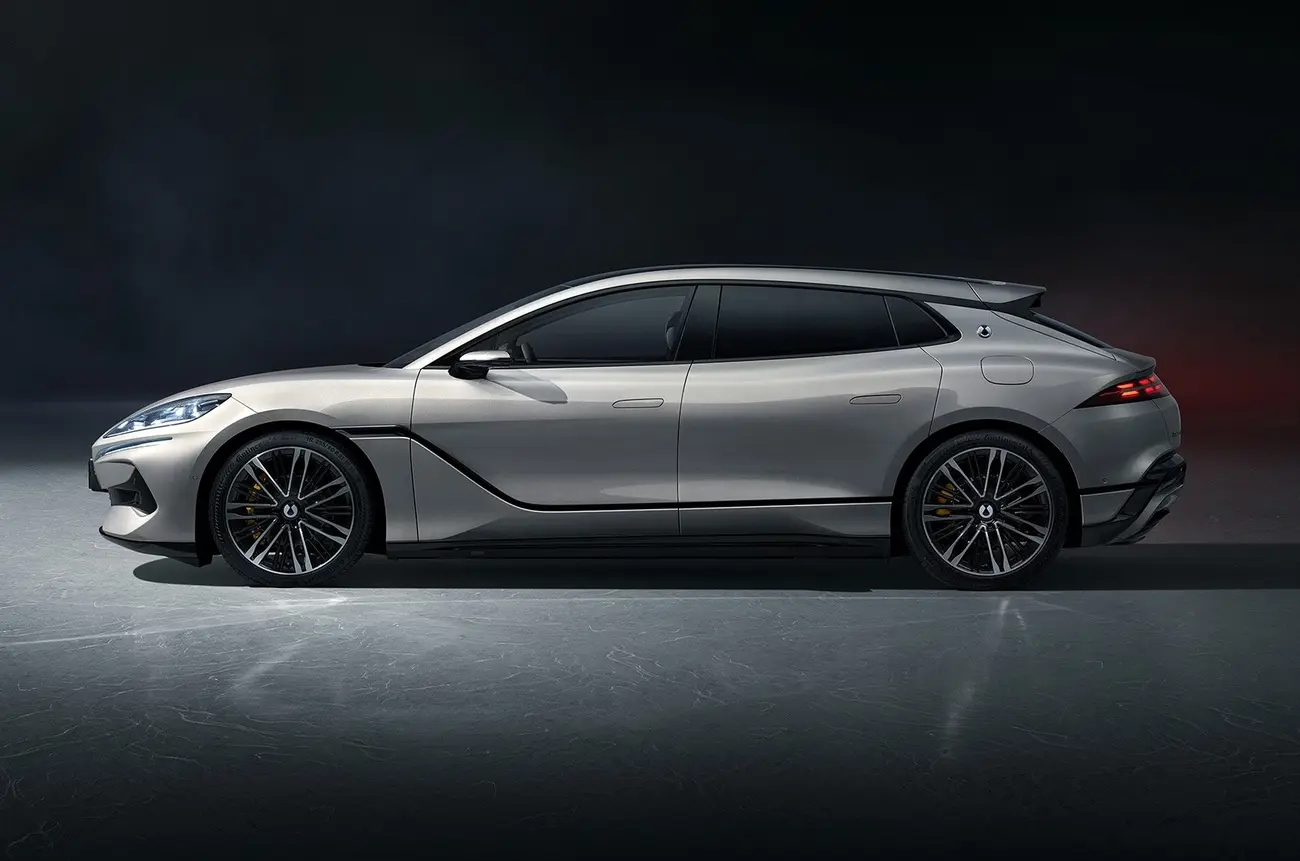
Denza Z9GT Arrives in Europe with 1,500 kW Fast Charging
Five minutes from 10% to 70%. That is what Denza claims its Z9GT can do — and on April 8, 2026, BYD's premium brand will debut in Europe at Paris's Palais Garnier opera house to prove it. The Z9GT is an electric shooting brake with up to 800 km of WLTP range, over 960 horsepower in the tri-motor variant, and a charging technology that outpaces every public charger currently installed on European soil.
This is not just another Chinese EV entering the European market. The Denza Z9GT is BYD's premium statement — positioned squarely against the Porsche Taycan Sport Turismo, BMW i5 Touring, and Mercedes-Benz EQE.
Denza Z9GT Specs: What the Numbers Say
The Z9GT is a Grand Tourer in shooting brake form, stretching 5,195 mm long and 1,990 mm wide, with a 3,125 mm wheelbase. Built on Denza's dedicated e3 Platform, it comes in two powertrain configurations:
| Configuration | Power Output | 0-100 km/h | WLTP Range |
|---|---|---|---|
| Single Motor (RWD) | 370 kW (496 hp) | — | Up to 800 km |
| Tri-Motor | 850 kW (1,140 hp / 960+ PS) | Under 3 seconds | — |
The 122 kWh battery uses BYD's second-generation Blade Battery with LFP (lithium iron phosphate) chemistry. The upgraded Chinese version achieves 1,036 km on the CLTC cycle — though European real-world figures under WLTP point to around 800 km for the rear-wheel-drive variant.
Standard equipment includes a Devialet audio system with Dolby Atmos, the God's Eye 5.0 advanced driver assistance system, DiSus-A intelligent body control, and rear-wheel steering with crab walk capability.
BYD FLASH Charging: 10% to 70% in 5 Minutes
FLASH Charging is the headline feature Denza is leading with for its European debut. The official numbers:
- 10% to 70%: 5 minutes
- 10% to 97%: 9 minutes
- 20% to 97% at -30°C: 12 minutes
Peak charging power reaches 1,500 kW through a single cable — using the Chinese-market connector. BYD sums it up as "Ready in 5, Full in 9, Cold Add 3."
There is a significant catch. Megawatt-level charging infrastructure does not exist at scale in Europe. The fastest public chargers available on Portugal's MOBI.E network (the national EV charging network) and along European motorways typically operate at 150-350 kW. Even the newest 400 kW stations fall far short of the 1,500 kW needed to hit those headline times. BYD has announced plans to deploy FLASH Charging stations in Europe but has not specified dates or locations for Portugal.
In practice, Z9GT buyers in Europe will still benefit from faster-than-average charging thanks to the second-generation battery architecture — but the 5-minute promise will have to wait for BYD's proprietary chargers to arrive.
Denza Z9GT Price in Portugal: What to Expect
European pricing estimates point to a range of EUR 75,000 to EUR 95,000, based on information from the Belgian market. The final price for Portugal will depend on Denza's strategy for the Iberian market.
For context: in China, the updated Z9GT BEV starts at 269,800 yuan (roughly EUR 36,000). The gap to European pricing reflects homologation costs, shipping, EU import tariffs on Chinese vehicles, and distribution margins.
Good news for buyers in Portugal: as a fully electric vehicle, the Z9GT qualifies for ISV exemption (Portugal's vehicle registration tax, which can add thousands to petrol car prices) and reduced IUC (annual road tax). Companies also benefit from favourable tax treatment on electric company cars. Still, at EUR 75,000-95,000, this puts the Denza directly in the territory of the Porsche Taycan Sport Turismo (from roughly EUR 95,000 in Portugal) and the BMW i5 Touring (from around EUR 75,000).
Denza Z9GT vs Premium Competitors in Europe
| Denza Z9GT (Tri-Motor) | Porsche Taycan Sport Turismo | BMW i5 Touring | |
|---|---|---|---|
| Power | 850 kW (1,140 hp) | Up to 700 hp (Turbo S) | 250 kW (340 hp) |
| 0-100 km/h | Under 3 s | 2.8 s (Turbo S) | 6.0 s |
| Battery | 122 kWh (LFP) | 105 kWh (NMC) | 84 kWh (NMC) |
| WLTP Range | Up to 800 km (RWD) | Up to 632 km | Up to 560 km |
| Est. Price (PT) | EUR 75,000-95,000 | From ~EUR 95,000 | From ~EUR 75,000 |
On raw power and range, the Z9GT clearly outperforms both German rivals. The 122 kWh LFP battery also promises better long-term durability compared to the NMC chemistry used by the competition.
But Denza faces real challenges in Europe. It has no track record for residual values, which complicates leasing contracts — the dominant purchase method in many European markets. Its service network is nonexistent in Portugal. And brand recognition among European buyers is virtually zero, despite the company being founded in 2010 as a joint venture between BYD and Daimler (Mercedes-Benz fully exited the venture in September 2024).
BYD's Luxury Brand Strategy for Europe
Denza will not follow BYD's mass-market distribution model. Instead, the brand plans flagship urban experience stores combined with a carefully curated partner network — closer to the approach of established premium brands.
The Z9GT leads a three-model European lineup planned for 2026. Its design, led by Wolfgang Egger (formerly of Audi and Lamborghini), aims to create a distinctly European visual identity. BYD's factory under construction in Hungary will eventually enable local production — an important factor for navigating EU import tariffs on Chinese electric vehicles.
Frequently Asked Questions
European pricing estimates point to EUR 75,000 to EUR 95,000, based on Belgian market data. In China, the Z9GT starts at 269,800 yuan (roughly EUR 36,000), with the gap reflecting homologation costs, shipping, and EU import tariffs on Chinese vehicles. As a fully electric vehicle, the Z9GT qualifies for ISV tax exemption and reduced annual road tax in Portugal, making it competitive against the Porsche Taycan Sport Turismo (from ~EUR 95,000) and the BMW i5 Touring (from ~EUR 75,000).
The Denza Z9GT's European debut is set for April 8, 2026, at the Palais Garnier in Paris. However, the exact availability date for the Portuguese market has not been confirmed. Denza plans a premium distribution network with urban experience stores, but has not yet announced partners or locations in Portugal.
Not yet. The Z9GT's FLASH Charging technology peaks at 1,500 kW, but the fastest chargers on Portugal's MOBI.E network operate at 150 to 350 kW. BYD has announced plans to install over 3,000 FLASH Charging stations across Europe by the end of 2026, starting in Poland, but has not specified dates for Portugal. In practice, the Z9GT will charge faster than most competitors at existing stations, but the headline 5-minute time (10% to 70%) will only be possible with BYD's proprietary chargers.
The tri-motor Z9GT delivers 850 kW (1,140 hp) versus the Taycan Turbo S's 700 hp, and its 122 kWh LFP battery provides up to 800 km of WLTP range compared to the Taycan's 632 km. On estimated pricing, the Denza starts at EUR 75,000 while the Taycan begins at roughly EUR 95,000 in Portugal. The Taycan holds the advantage in brand prestige, proven residual values, and an established service network — important factors for buyers considering leasing or resale.
The rear-wheel-drive variant (single motor, 370 kW) offers up to 800 km of WLTP range. In China, the upgraded version achieves 1,036 km on the less demanding CLTC cycle. Under real-world European driving conditions — including motorway speeds, climate, and air conditioning use — expect roughly 550 to 650 km, which still ranks among the best in the segment, surpassing the BMW i5 Touring's 560 km and the Porsche Taycan's 632 km.
What This Means for Premium EV Buyers in Portugal
The Denza Z9GT brings specifications that make its German rivals look conservative. Up to 800 km of range, over 1,000 horsepower in the top variant, and a promise of ultra-fast charging that — once the infrastructure catches up — could redefine long-distance EV travel.
For buyers in Portugal, the core question remains the same as with any new Chinese brand: is it worth being an early adopter? The ISV tax exemption helps. The specs are compelling. But the absence of a service network, uncertainty around resale values, and the lack of FLASH Charging stations in Portugal all weigh on the decision.
The April 8 launch in Paris will set the tone. Final pricing, availability for the Portuguese market, and the European fast-charging rollout plan are the key details to watch in the coming weeks.