
New Dacia Spring vs Leapmotor T03: Which Cheap EV to Buy in Portugal
Published: 05/10/2026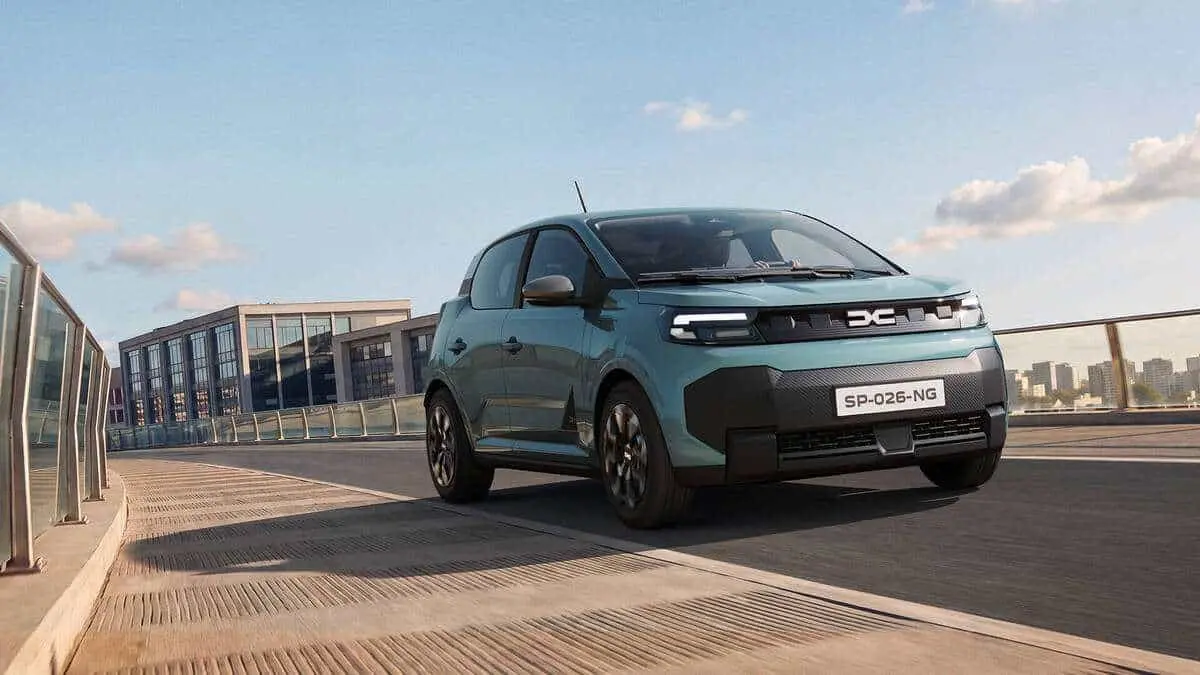
New Dacia Spring vs Leapmotor T03: two EVs under €20,000
A year ago, this was an easy call. In head-to-heads with the first-generation Spring, the Leapmotor T03 won almost every round: quicker, longer-legged and kinder to rear passengers. The second-generation Spring, revealed in September 2026 and built in Slovenia, forces a recount, and the Dacia Spring vs Leapmotor T03 Portugal matchup is wide open again.
Both cost under €20,000 in Portugal, both use LFP batteries and both seat four. Where they differ is real-world range, fast charging, space and equipment. If you're weighing up the Dacia Spring or the Leapmotor T03 as a cheap way into electric motoring here, each of those deserves a closer look.
A Spring that only kept the name
The new Spring is not a facelift. It sits on Renault Group's RG-EV platform, shared with the Renault Twingo E-Tech, and comes out of the Novo Mesto plant in Slovenia instead of China. It's the first of four EVs Dacia has promised by 2030, and it replaces a model that sold more than 210,000 units in over 40 countries since 2021.
It has grown in every direction. At 3.85 m long and 1.74 m wide, it's 15 cm longer and 18 cm wider than before. Power rises to 60 kW (80 hp) and the battery to 27.5 kWh usable. Every weakness the old Spring showed against the T03 — power, range, charging — has been targeted head-on.
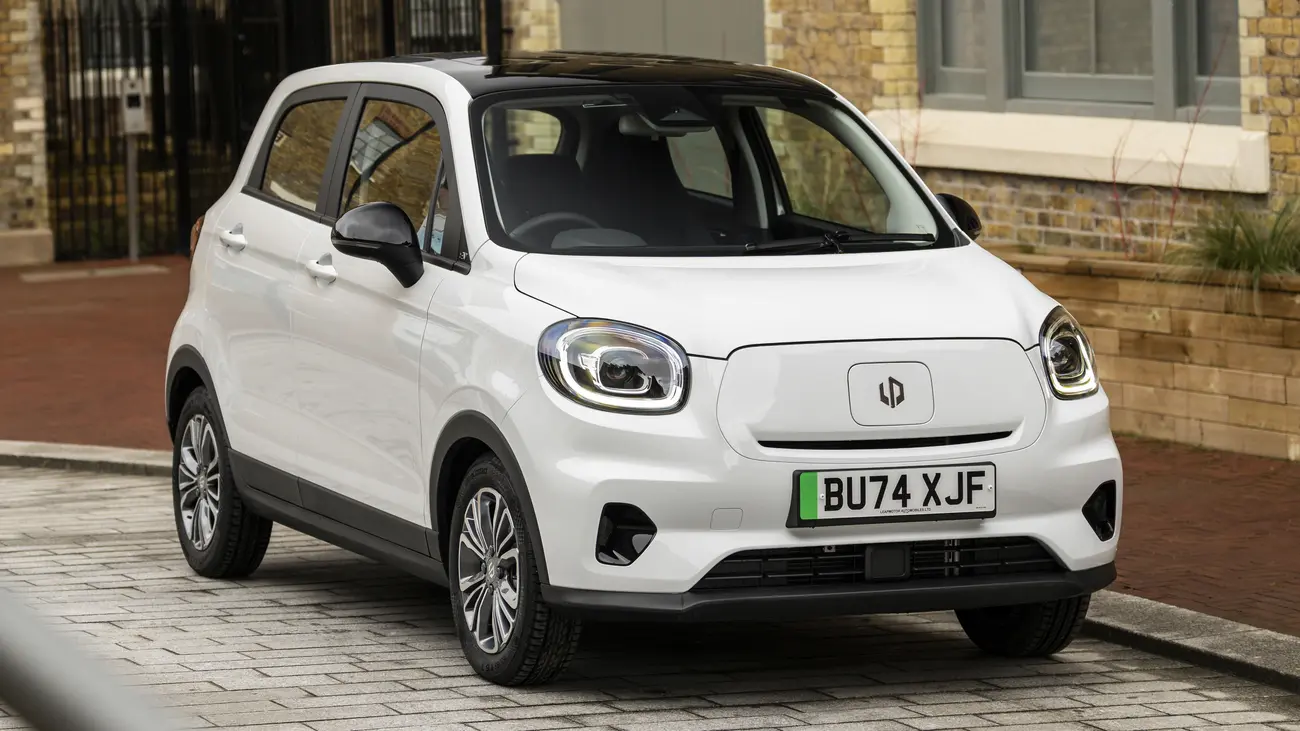
The T03 enters this fight largely unchanged. It's still a single, well-equipped trim with 70 kW (95 hp) and a 37.3 kWh gross (36.0 kWh usable) battery. The big change is logistics: production at Tychy, Poland, only ran from June 2024 to March 2025, and the car is once again imported from China.
Power, battery and dimensions side by side
| New Dacia Spring (2nd gen) | Leapmotor T03 | |
|---|---|---|
| Production | Novo Mesto, Slovenia | China (Tychy, Poland halted 03/2025) |
| Power | 60 kW / 80 hp | 70 kW / 95 hp |
| Torque | 175 Nm | 158 Nm |
| 0-100 km/h | 12.1 s | 12.7 s |
| Top speed | 130 km/h | 130 km/h |
| Battery | 27.5 kWh usable, LFP | 37.3 kWh gross / 36.0 usable, LFP |
| WLTP range | up to 250 km | 265 km |
| WLTP consumption | 12.7 kWh/100 km | 13.6 kWh/100 km (16.3 incl. charging losses) |
| AC charging | 6.6 kW (11 kW optional) | 6.6 kW |
| DC charging | 50 kW optional; 15-80% in 28 min | 48 kW; 30-80% in 36 min |
| V2L | Yes (with optional pack) | No |
| Length / width / height | 3,850 / 1,740 / 1,520 mm | 3,620 / 1,577 / 1,652 mm |
| Wheelbase | 2,490 mm | 2,400 mm |
| Weight | from 1,212 kg | 1,250 kg |
| Boot | 337 L (1,283 L) + optional 18 L frunk | 210 L (880 L) |
| Seats | 4 | 4 |
| Battery warranty | not disclosed | 8 years / 160,000 km |
Sources: Quattroruote, Auto361, EV Database, Electrifying, electrive.
Despite giving away 10 kW, the Spring is quicker from 0-100 km/h: 12.1 s against 12.7 s. Its 175 Nm of torque and slightly lower weight make the difference. Neither is built for fast motorway work — both top out at 130 km/h.
Dacia Spring vs Leapmotor T03: range and efficiency
On paper, the gap is small. The T03 claims 265 km WLTP and the Spring up to 250 km, despite carrying 8.5 kWh less usable battery. Efficiency is the reason: 12.7 kWh/100 km is one of the lowest official figures on the market.
Real-world range in winter and summer
For the T03, real-world estimates already exist. EV Database puts it at 260 km in mixed driving in mild weather (23 °C) and 190 km in the cold (-10 °C, heating on). Around town it can stretch to 345 km in summer; on the motorway it lands between 160 and 205 km. With no heat pump, winter hurts.
There's no real-world data for the new Spring yet — deliveries only start in December 2026. With a smaller battery, expect it to lose ground on the motorway and in the cold, where efficiency matters less and raw kWh matter more. In town, its low consumption should keep the gap tight.
For context, Dacia says the typical old-Spring owner drove 34 km a day at an average of 34 km/h, and 75% charged at home. For that profile, either car covers a full week of commuting without plugging in.
Cost per 100 km
Using an illustrative home tariff of €0.20/kWh (your actual rate depends on your electricity contract), the numbers look like this:
| Consumption | Cost per 100 km | |
|---|---|---|
| New Spring (WLTP) | 12.7 kWh/100 km | about €2.54 |
| T03 (WLTP, vehicle only) | 13.6 kWh/100 km | about €2.72 |
| T03 (WLTP, incl. charging losses) | 16.3 kWh/100 km | about €3.26 |
| T03 (real-world, cold, mixed) | 18.9 kWh/100 km | about €3.78 |
The difference is a matter of cents per 100 km. On fast chargers in the MOBI.E network — Portugal's national public charging network — the price per kWh climbs sharply, but it climbs for both. Running costs won't settle this one.
Fast charging: the pack that changes the Spring
This is the Spring's most important small print. As standard, it only charges on AC at 6.6 kW. 50 kW DC fast charging — 15-80% in 28 minutes — comes in an optional pack that also lifts AC charging to 11 kW and adds V2L, which lets you power electrical devices from the battery. In France that pack costs €500 and is limited to the Journey trim; Portuguese pricing hasn't been published yet.
The T03 gets DC charging as standard, peaking at 48 kW. In practice, electrive quotes 36 minutes from 30% to 80%, while EV Database measures 53 minutes from 10% to 80%, averaging only 30 kW. So a Spring with the pack is quicker at a charger — but only if the pack is fitted.
At home, it's close to a draw. Both charge at 6.6 kW on a single-phase wallbox. The Spring takes 2h55 from 15% to 80% on a 7 kW wallbox; the T03 needs around 6h30 for a near-full charge, which a normal night easily covers.
Space and boot: the Spring is now the bigger car
This is the change you'll feel most day to day. The old Spring already beat the T03 on boot space; the new one stretches the lead to 337 litres against 210. That's 127 litres more — the difference between a weekly shop fitting comfortably and bags ending up on the back seat. With the seats folded it's 1,283 L versus 880 L, and the Spring has a 50/50 split rear bench while the T03's folds in one piece.
The T03 fights back with height. It stands 1,652 mm tall against the Spring's 1,520 mm, and UK testers praise its rear space: six-footers sit in the back without brushing the roof. The new Spring is 16 cm wider than the T03 and has 9 cm more wheelbase, so the Leapmotor's rear-seat advantage should shrink. Only a side-by-side test will show by how much.
In the city, the T03 is still the easier one to park. It's 3.62 m long — 23 cm shorter than the Spring — with a 9.7 m turning circle.
Equipment: the T03 gives more, but lacks CarPlay
The Leapmotor T03 comes in one trim and it's loaded: 15" alloys, a 10.1" touchscreen, an 8" digital cluster, climate control, a panoramic roof with electric blind, LED headlights, a Bluetooth phone key, six airbags, autonomous emergency braking, blind-spot warning and lane-keep assist. At this price, that's a tough list to match.
What it lacks is something many drivers consider essential. The T03 has no Apple CarPlay or Android Auto, and Carwow called its infotainment "awful" and fiddly to use. If you rely on Google Maps or Waze on your phone, you'll notice it every single day.
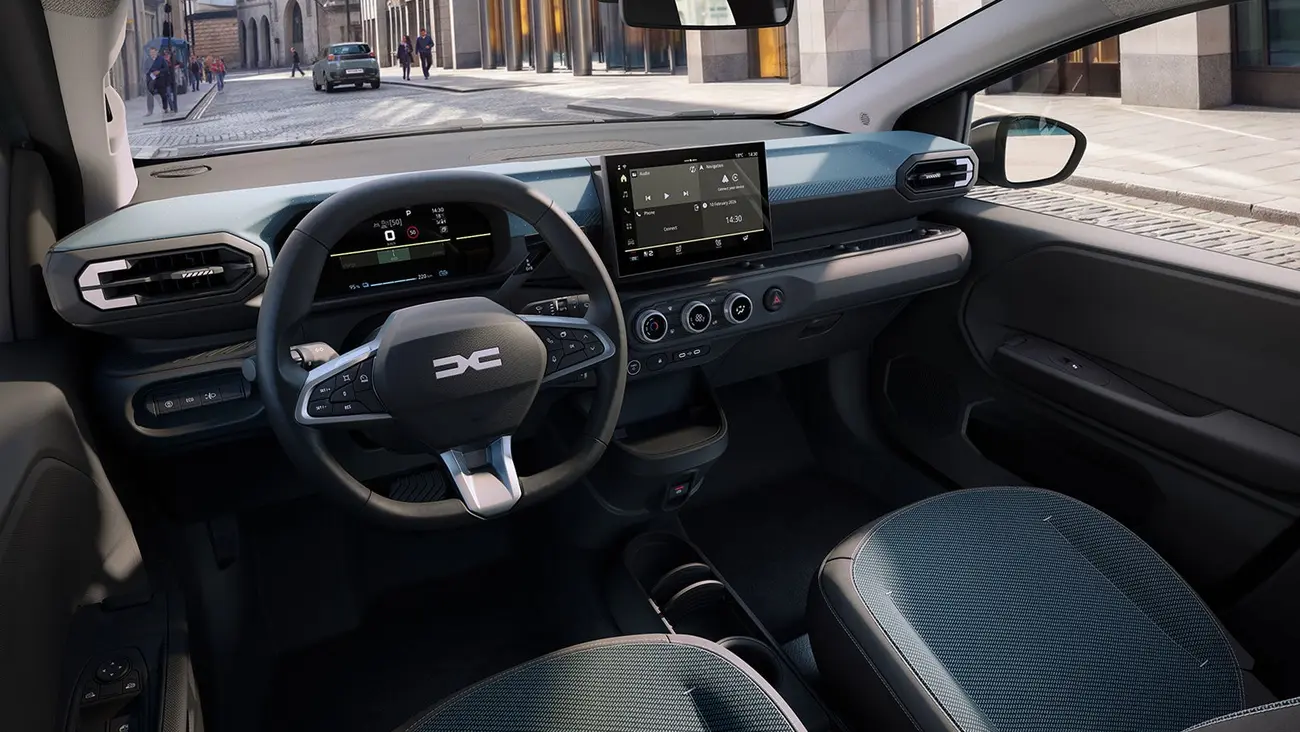
The Spring comes in two trims. Expression gets 15" Flexwheel wheels, manual air conditioning, automatic headlights, rear parking sensors and Media Control, which uses your phone as the screen. Journey adds 16" wheels, keyless entry, a reversing camera and the 10.1" Media Nav Live with wireless Apple CarPlay and Android Auto, eight years of connected navigation and charge scheduling.
Safety is a question mark on both sides. The old Spring scored just one star in Euro NCAP in 2021, and the T03 has never been tested. The new Spring has no published results yet — worth watching before you sign.
Portuguese prices and the "made in Europe" factor
Electric city cars under €20,000: where the two sit
| Version | Price in Portugal | Excl. VAT (companies) |
|---|---|---|
| Dacia Spring Expression | €17,900 | €14,553 |
| Dacia Spring Journey | €19,400 | €15,772 |
| Leapmotor T03 (launch, 2025) | €19,600 | — |
| Leapmotor T03 (dealer campaigns) | from around €18,438 | from €14,990 |
On list price, the Spring Expression is the cheapest. It's also the most basic, and the only one without fast charging. The fair comparison is a Spring Journey with the pack against the T03 — and there the figures land very close together, in the €19,000-20,000 range, with T03 dealer campaigns giving it the edge while they last.
Tax treatment is identical. Both are exempt from ISV (Portugal's one-off vehicle registration tax) and from IUC (the annual road tax) as fully electric cars, and both enjoy the usual company-car benefits. If a Fundo Ambiental purchase incentive returns, both sit comfortably below any likely price cap.
Slovenia vs China
Where a car is built matters more than it seems. The Spring is now made inside the EU, which keeps it clear of the countervailing duties on Chinese-built EVs and makes it eligible for incentives reserved for European production in other markets. The T03 is back to shipping from China and subject to those duties since Polish production stopped.
For a buyer in Portugal, that doesn't change today's price, but it could shape tomorrow's. A brand squeezed by tariffs has less room for discounts — or more reason to offer them to protect volume. The service network is another factor: Dacia has been in Portugal for decades, and the T03 is sold through the Stellantis network.
Frequently Asked Questions
The second-generation Spring was unveiled in September 2026, with deliveries starting in December 2026. Portuguese prices are already confirmed at €17,900 for the Expression and €19,400 for the Journey, but the price of the optional pack that adds 50 kW DC fast charging has not been announced yet. The Leapmotor T03, by contrast, is already on sale through the Stellantis dealer network.
Excluding VAT, the new Spring costs €14,553 in Expression trim and €15,772 in Journey trim. The T03 launched in Portugal at €19,600 including VAT, but dealer campaigns have brought it down to €14,990 + VAT (around €18,438). Like all electric cars, both are exempt from ISV purchase tax and IUC road tax, and VAT is deductible on company cars within the legal limits.
For the T03, EV Database estimates 190 km of mixed driving in cold weather (-10 °C with heating on) and 260 km in mild conditions, against 265 km WLTP; on the motorway it manages 160-205 km. The new Spring claims up to 250 km WLTP from 27.5 kWh of usable battery, but there is no real-world data yet because deliveries only start in December 2026. Without a heat pump, the T03 loses about 27% of its range in the cold, a useful benchmark for what to expect from a city EV in this class.
No. The T03 has a 10.1-inch touchscreen and an 8-inch digital instrument cluster, but offers neither Apple CarPlay nor Android Auto, and reviewers describe its infotainment as awkward to use. On the new Spring, the Journey trim gets wireless CarPlay and Android Auto on the 10.1-inch Media Nav Live screen, while the Expression uses your own phone as the display via Media Control.
It can be, especially for city driving: the 37.3 kWh LFP battery handles frequent full charges well and is covered by an 8-year or 160,000 km warranty, which protects early second-hand buyers. It comes standard with 48 kW DC charging, six airbags and a panoramic roof. Before buying, check the battery health and bear in mind that the model has never been Euro NCAP tested and lacks smartphone mirroring.
Dacia Spring or Leapmotor T03: which should you choose?
Go for the new Spring if you need a proper boot, want Apple CarPlay or Android Auto, like the idea of a European-built car and are happy to step up to the Journey with the charging pack. It's the more rational of the two, and the roomier one.
Go for the Leapmotor T03 if you want the most kit for the least money, drive mostly in town, can catch a dealer campaign and can live without phone mirroring. It has the bigger battery, standard DC charging and it's on sale now — the Spring only arrives in December 2026.
There's a third route, too. Both models already turn up on the used market in Portugal, and a low-mileage T03 or a first-generation Spring can cost well below any new version. If you drive 30 or 40 km a day, that may be the cheapest way to go electric.
The next milestone is the new Spring reaching Portuguese dealers, along with pricing for the charging pack and the first real-world range tests. Until then, the T03 has the field to itself — and plenty of arguments for anyone who doesn't want to wait.