
Paying for EV charging with a bank card in Portugal: what changes in 2027
Published: 15/10/2026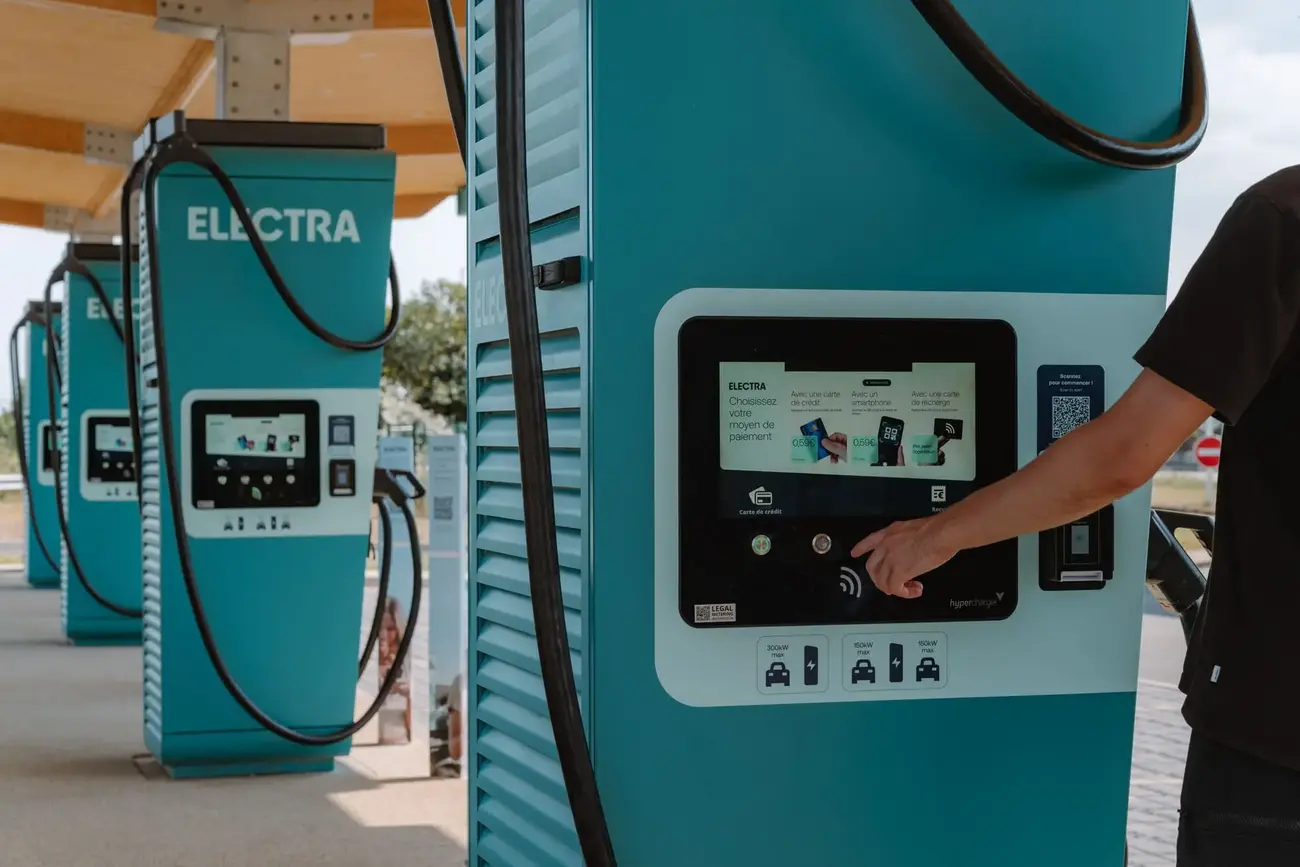
Paying for EV charging with a bank card in Portugal: what changes in 2027
Tap your card, charge, drive off. No app, no account, no supplier card. From 1 January 2027, being able to pay for EV charging with a bank card becomes mandatory on fast chargers of 50 kW or more that were already installed before the new EU rules — not just on the ones built since April 2024.
The rule comes from AFIR, the EU's Alternative Fuels Infrastructure Regulation (Regulation 2023/1804), which applies directly in every Member State. In Portugal it overlaps with the new electric mobility regime (Decree-Law 93/2025), which scraps the old requirement to hold a contract with a CEME — a specialised electricity retailer for EV charging. The Portuguese timetable shifted this summer, though: Decree-Law 155/2026 extended the transition period by a year, to 31 December 2027. Plenty of pages online still quote 2026. That date is out of date.
What AFIR requires for card payment
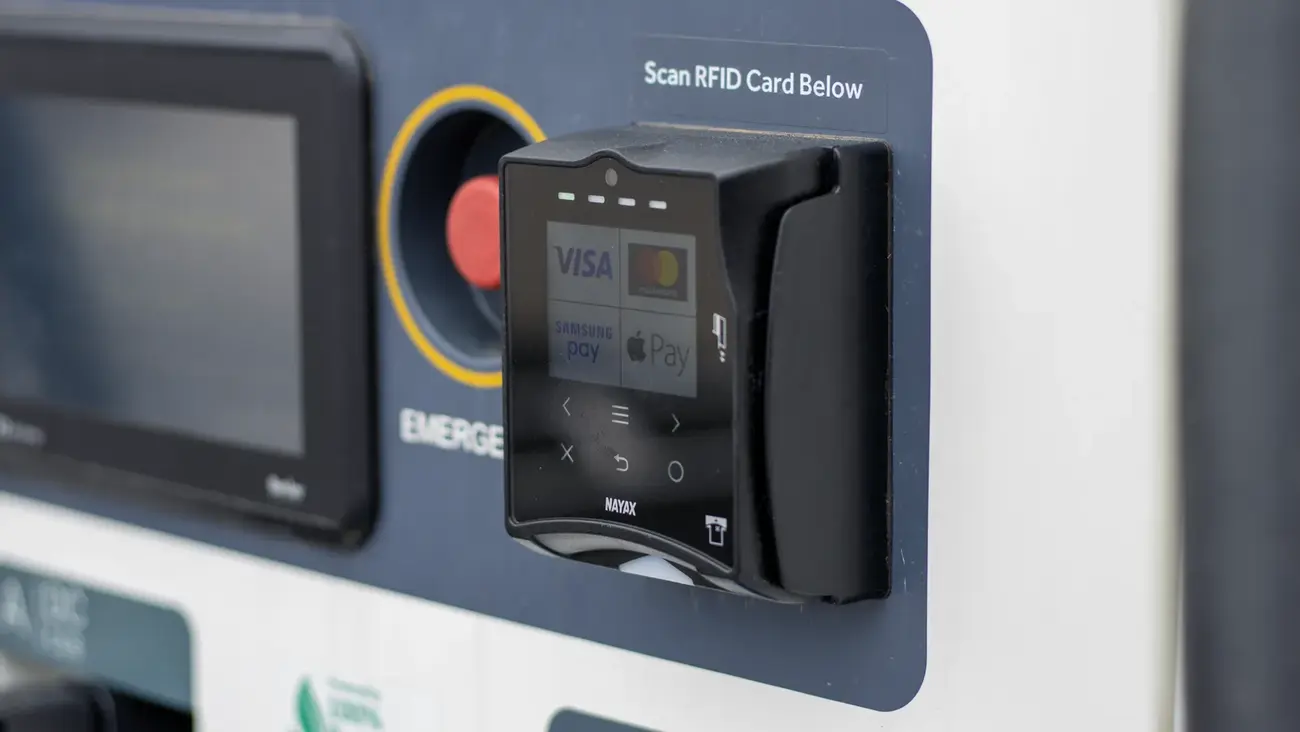
AFIR has applied since 13 April 2024. Since then, every public charging operator has had to offer ad hoc charging — no contract, no subscription, no prior sign-up. Chargers installed from that date must accept a payment method widely used in the EU, through at least one of:
- a payment card reader;
- a contactless device able to read bank cards;
- a secure online payment, such as a dedicated QR code — but this option only counts for chargers below 50 kW.
On a new fast charger, then, a QR code isn't enough. There has to be a card reader or a contactless terminal.
50 kW chargers must accept bank cards from 2027
The big change lands on 1 January 2027. From that date, every public charger of 50 kW or more along the trans-European transport network (TEN-T) — on the road itself or within 3 km of an exit — and in safe and secure parking areas must accept card or contactless payment, including those installed before 13 April 2024. Operators have to retrofit their older units.
Two practical details. A single payment terminal can serve several charging points in the same pool, so don't expect a reader on every post. And the rule doesn't apply to free chargers.
Portuguese law goes further. According to legal guides on Decree-Law 93/2025 (Cuatrecasas, Abreu, PLMJ), all public chargers of 50 kW or more that were already running when the decree took effect must meet the ad hoc payment requirements from 1 January 2027 — without AFIR's TEN-T limitation. The transition extension in Decree-Law 155/2026 did not change this date.
Price per kWh shown before you charge
Paying by card solves only half the problem. The other half is knowing what you'll pay — and AFIR is clear here too.
At chargers of 50 kW or more, the ad hoc price must be based on the price per kWh. Operators may add a per-minute occupancy fee, meant to discourage drivers who leave their car plugged in after charging finishes. Both — the kWh price and any per-minute fee — must be displayed at the charger before the session starts.
Below 50 kW, every price component must be shown in this order:
- price per kWh;
- price per minute;
- price per session;
- any other components.
General rules apply on top: prices must be reasonable, easy to compare, transparent and non-discriminatory. Operators can't charge differently depending on whether you pay ad hoc or come in through an e-mobility service provider (EMSP). EMSPs, in turn, must show the full price breakdown before charging and can't add extra cross-border roaming fees.
What about Plug&Charge?
If your car supports automatic authentication (Plug&Charge), it keeps working. But AFIR guarantees you can always opt out and pay ad hoc — handy when the walk-up price at the charger beats your contract rate.
The end of CEME: what changes for Mobi.E by 2027
To understand the impact in Portugal, it helps to know how the system worked. Since 2015, Mobi.E has been the mandatory national platform: any driver with a valid card could charge at any public charger in the country. The catch was that the electricity was sold by a CEME, and drivers needed a contract with one. A single charger could serve more than 40 different CEMEs in a month.
Decree-Law 93/2025, in force since 19 August 2025, dismantles that model. It abolishes the CEME role and the mandatory contract, lets charge point operators (CPOs) sell energy directly, and creates a new data aggregation body to take over Mobi.E's role of feeding the National Access Point.
Mobi.E in 2027: the Decree-Law 155/2026 extension
Decree-Law 155/2026, published on 31 July and in force since 1 August 2026, pushed the end of the transition from 31 December 2026 to 31 December 2027. Until then:
- Mobi.E keeps running the platform;
- CEMEs have until the end of 2027 to convert into CPOs and/or EMSPs;
- CPOs have until the end of 2027 to say whether they want to take chargers off the Mobi.E network (if they say nothing, the chargers stay);
- the Mobi.E platform tariff, set annually by the regulator ERSE, remains — and if passed on to drivers, it must be itemised on the bill.
The government's reason? Around 70% of charging points are covered by concession contracts with municipalities and other bodies, and those contracts need revising.
Will Mobi.E cards stop working in 2027?
According to Mobi.E's official page, until 31 December 2027 CEME cards and apps keep working at Mobi.E-connected chargers, alongside ad hoc payment by bank card or QR code. From 1 January 2028 the new model takes full effect: a direct relationship between operator and driver, with ad hoc payment mandatory at TEN-T and secure parking stations under AFIR.
So no, your Mobi.E card isn't going away in 2027. But from January 2027 you can pay for EV charging with a bank card at fast chargers as a real alternative.
Timeline: AFIR and Portugal's new regime
| Date | What happens |
|---|---|
| 13 Apr 2024 | AFIR applies; new chargers of 50 kW or more take card/contactless; kWh pricing |
| 14 Oct 2024 | All public chargers must be digitally connected |
| 14 Apr 2025 | Public DC chargers must have a fixed cable |
| 19 Aug 2025 | Decree-Law 93/2025 takes effect (end of CEME, ad hoc charging) |
| 1 Aug 2026 | Decree-Law 155/2026 takes effect (transition extended) |
| 1 Jan 2027 | Card/contactless mandatory on existing chargers of 50 kW or more |
| 31 Dec 2027 | End of Portugal's transition period; TEN-T core 600 kW pools |
| 1 Jan 2028 | New model without central Mobi.E fully in force |
AFIR also sets power targets on motorways. On the TEN-T core network, every 60 km in each direction there must be charging pools of at least 400 kW with one 150 kW point by the end of 2025, rising to 600 kW with two 150 kW points by the end of 2027. If you drive Lisbon–Porto or down to the Algarve, that means powerful chargers at predictable intervals.
Fines for operators without electronic payment
Decree-Law 93/2025 has teeth. Failing to offer electronic payment or clear price information counts as a minor offence:
| Offence | Individual | Company | Additional sanctions |
|---|---|---|---|
| Minor (e.g. no clear info, no electronic payment) | €100 to €1,000 | €1,500 to €15,000 | — |
| Serious (e.g. no licence, no insurance, excluding users) | €300 to €3,000 | €4,000 to €40,000 | Closure of the charger or licence revocation |
ERSE handles regulation, the transport authority AMT monitors the market, and the energy-sector authority ENSE enforces the rules with support from the PSP police. Operators must also issue itemised invoices.
Frequently Asked Questions
Yes. Since 13 April 2024, new chargers of 50 kW or more must accept bank cards via a card reader or contactless terminal. From 1 January 2027, this also applies to chargers of 50 kW or more installed before that date. Below 50 kW, operators may instead offer secure online payment, for example via a QR code, rather than a card reader.
Not in 2027. Decree-Law 155/2026, in force since 1 August 2026, extended Portugal's transition period from 31 December 2026 to 31 December 2027. Until then, existing CEME cards and apps keep working at Mobi.E-connected chargers alongside ad hoc payment. The new model, with direct operator-to-driver relationships, only takes full effect on 1 January 2028.
Under AFIR, every public charge point operator must offer ad hoc charging with no contract, subscription or prior registration. At fast chargers of 50 kW or more you simply tap your bank card on the terminal; at slower chargers payment can be made through a QR code. This removes the long-standing need for visitors to install a CEME app just to charge at a service area.
Yes. At chargers of 50 kW or more, the ad hoc price must be based on a price per kWh, optionally plus a per-minute occupancy fee, and both must be shown at the station before the session starts. Below 50 kW, all price components are displayed in order: per kWh, per minute, per session and other. Until the end of 2027, the ERSE-set Mobi.E platform tariff also remains and must be itemised on the invoice if passed on to drivers.
Under Decree-Law 93/2025, failing to offer electronic payment or clear price information is a minor offence, with fines of €100 to €1,000 for individuals and €1,500 to €15,000 for companies. Serious offences carry €300 to €3,000 and €4,000 to €40,000 respectively, plus possible closure of the charging point or licence revocation. Enforcement is handled by ENSE, supported by the PSP police.
What this means for drivers in Portugal
Portugal now has around 14,341 public charging points, roughly 100 operators and about 40 CEMEs/EMSPs (March 2026 figures), in a market where fully electric cars took 25% of sales in February. As of early 2026, no operator had fully left Mobi.E. Expect the shift to be gradual.
In practice, for 2027:
- At fast chargers (50 kW or more), expect to pay by debit or credit card, contactless included, from January.
- At slower chargers, payment can be made by QR code with no sign-up.
- Your CEME card stays valid on the Mobi.E network until the end of 2027 — no need to cancel it yet.
- Compare prices: with the kWh price displayed before you start, you'll quickly see whether your plan pays off or walk-up charging works out cheaper.
For tourists and newly arrived expats, this ends a long-standing headache: no more hunting for the right app just to charge at a motorway service area. Worth watching which operators actually hit the January deadline — and what they charge per kWh once the price is printed on the charger.