
EV Battery Heat Damage in Portugal: How Summer Heat Cuts Range and Lifespan
Published: 06/07/2026
Everyone knows the cold steals range from an electric car. What far fewer people know is that heat is worse — because cold is temporary and heat leaves permanent scars. During a Portuguese heatwave, with the thermometer climbing past 40°C, EV battery heat damage in Portugal isn't measured only in the kilometres you lose today, but in how healthy your battery still is five years from now.
Why heat harms the battery and cold doesn't
The difference is chemical, not just a matter of degree. In the cold, the electrolyte thickens and lithium ions move more slowly — you lose range, but capacity returns as soon as it warms up. Heat does the opposite: internal chemical reactions speed up and cause damage that never reverses.
Above 30°C, those reactions start degrading the battery faster. The protective SEI layer on the anode breaks down, and the battery burns energy constantly repairing it; the electrolyte decomposes; active lithium gets consumed. As Hervé Eloin of MyBatterieHealth puts it: "above 60°C, a lithium battery risks degrading." And unlike the cold, this damage is permanent and irreversible.
The ideal battery temperature for an electric car
An EV battery works best between 15 and 25°C. That's the zone where the chemistry is balanced and wear is minimal. Beyond it, every degree counts:
- Above 30°C: accelerated chemical degradation
- Above 38°C: risk rises sharply
- Between 50 and 70°C: irreversible battery damage
The catch is that, in a Portuguese summer, reaching those numbers inside the car is easier than it sounds.
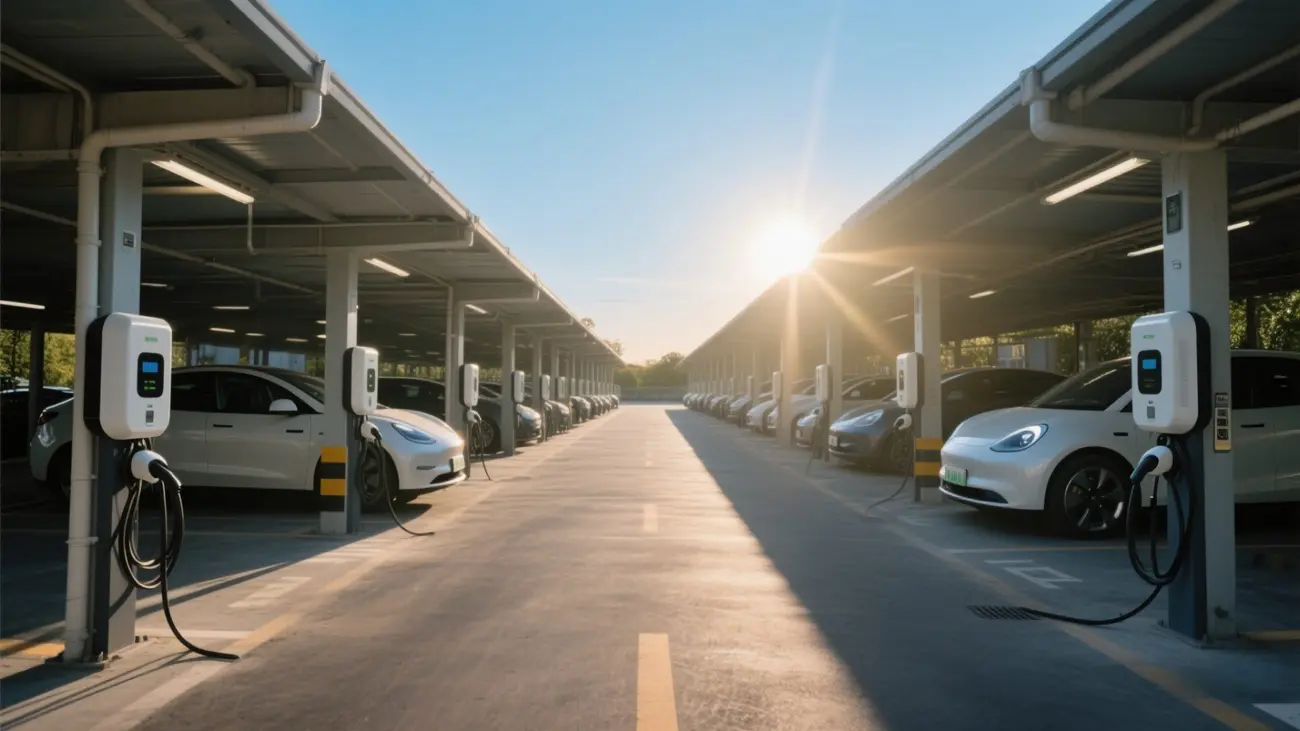
An EV parked in the sun is the real danger
When it's over 40°C outside and the car sits in direct sun, the interior can hit 60 to 70°C. And here's the part almost nobody realises: in most models, the battery's cooling system only runs while you drive or charge. With the car parked and switched off, the battery is left to the ambient temperature — slow-cooking for hours in a supermarket car park or outside the office.
That's why parking in the shade isn't a minor detail. The gap between a sunny spot and a shaded one or a garage can reach 14°C in battery temperature. Fourteen degrees that separate the safe zone from the degradation zone.
How much heat cuts range — and lifespan
There are two separate effects, and it pays not to confuse them. One is immediate: you lose range today, mostly because of the air conditioning. The other is silent: the battery ages faster, and you only notice years later.
On range, the loss in heat is real but smaller than in cold. At 35°C, with the A/C running, you're looking at around 17% less range compared with 24°C. At 38°C, the loss can reach 31%. In practice, a typical driver loses 10 to 20% on a very hot day — a 400 km EV manages roughly 320 to 360 km. The air conditioning draws 1 to 2 kW, the equivalent of 5 to 10 km per 100 km driven.
The long-term damage is the expensive part. Sustained exposure above 30°C can cut battery lifespan by more than 20%. Regularly exposing the battery to 30°C instead of 20°C increases capacity loss by 33 to 44% over the same period. At 40°C, the rate of degradation can double or triple.
| Condition | Impact on the battery |
|---|---|
| Ideal temperature | 15-25°C |
| Onset of accelerated degradation | above 30°C |
| Car interior in the sun (over 40°C outside) | 60-70°C |
| Range loss at 35°C (with A/C) | around 17% |
| Range loss at 38°C | up to 31% |
| Lifespan cut above sustained 30°C | over 20% |
| Shade vs sun difference in the battery | up to 14°C |
The hardest numbers come from a Geotab study of more than 22,700 EVs. Average degradation is 2.3% a year — leaving a battery at 81.6% health after eight years. But in hot climates, with more than 35 days a year above 25°C, degradation runs 0.4% faster per year. It sounds small; across the life of the car, it isn't.
Fast charging in the heat: the biggest stressor
If there's one thing that punishes a battery more than heat, it's heat combined with fast charging. The same Geotab study identifies high-power DC fast charging (above 100 kW) as the single biggest wear factor — it can double the degradation rate compared with people who charge slowly.
The combination to avoid is easy to picture: arriving from a long trip with the battery already hot, then plugging straight into a fast charger on a scorching day. The battery is already near its thermal limit and the charger piles more heat on top. On the hottest days, give it time to cool before charging, or choose a slower charge.
How to protect your EV battery in summer
The good news is that almost everything that protects the battery is in your hands and costs nothing:
- Park in the shade or in a garage. The up-to-14°C saving is the most effective and simplest measure there is.
- Charge during the cool hours. Late at night or early morning, the battery charges cooler — and electricity is usually cheaper too.
- Use preconditioning while plugged in. Cooling the cabin with the car connected to the charger draws grid power, not battery power, and you set off at the right temperature.
- Avoid fast charging on the hottest days, especially right after long drives.
- Drive smoothly. Repeated hard acceleration heats the battery; gentle driving can, according to L'argus, nearly double its lifespan.
What charge level to keep the battery at in the heat
For daily use, the rigid 20-80% rule really is a myth. Geotab is clear: degradation only spikes when the car spends over 80% of its total time very full or nearly empty. For normal use, charging to whatever you need is fine.
The exception is leaving the car parked for a long time in the heat. For extended parking in high summer, the ideal is to leave the battery between 30 and 70% — neither full nor empty. A battery at 100% sitting in the sun for days is the worst possible scenario for its long-term health.
Not every EV handles heat the same way
Cooling technology makes all the difference. EVs with liquid cooling lose 1 to 2% of capacity per year in hot climates. Older models with air or passive cooling — like the Dacia Spring, the Nissan Leaf or the Renault Twingo E-Tech — can reach 4% a year. After a few summers, the gap is enormous.
Chemistry matters too: LFP batteries tolerate heat and sitting fully charged better than NMC, though they lose more range in the cold. If you're buying a used EV and will run it in a hot climate, it's worth knowing what cooling and what chemistry it has — because a replacement battery costs between 5,000 and 20,000 euros.
Extreme heat is no reason to avoid EVs. It's a reason to treat the battery well: in the shade, charged during the cool hours, and without fast-charging abuse on furnace days. Do that, and the Portuguese summer stops being a problem for your car's battery.
Frequently Asked Questions
The battery works best between 15 and 25°C. Above 30°C the internal chemical reactions speed up and degradation accelerates, and between 50 and 70°C the damage becomes irreversible. In a car parked in the sun with over 40°C outside, the interior can reach 60 to 70°C — already inside the danger zone.
The loss in heat is real but smaller than in cold: around 17% at 35°C with the A/C on, and up to 31% at 38°C. In practice, a typical driver loses 10 to 20% on a very hot day, so a 400 km EV manages roughly 320 to 360 km. The air conditioning draws 1 to 2 kW, the equivalent of 5 to 10 km per 100 km.
Parking in the shade or a garage is the most effective and free measure: the difference from a sunny spot can reach 14°C in battery temperature. This matters because, in most models, the battery's cooling only runs while you drive or charge — with the car parked, the battery is left at ambient temperature for hours.
For daily use, the rigid 20-80% rule is a myth: according to Geotab, degradation only spikes when the car spends over 80% of its time very full or nearly empty. The exception is leaving the car parked for a long time in the heat — then the ideal is to keep the battery between 30 and 70%. A battery at 100% sitting in the sun for days is the worst case for its health.
Yes, it is the worst combination. Geotab's study of more than 22,700 EVs identifies fast charging above 100 kW as the single biggest wear factor, capable of doubling the degradation rate. On hot days, avoid fast charging right after a long trip with an already-warm battery — give it time to cool or choose a slower charge.