
BYD Ti7 in Portugal: The Chinese Defender-Style PHEV SUV With 127 km EV Range
Published: 02/06/2026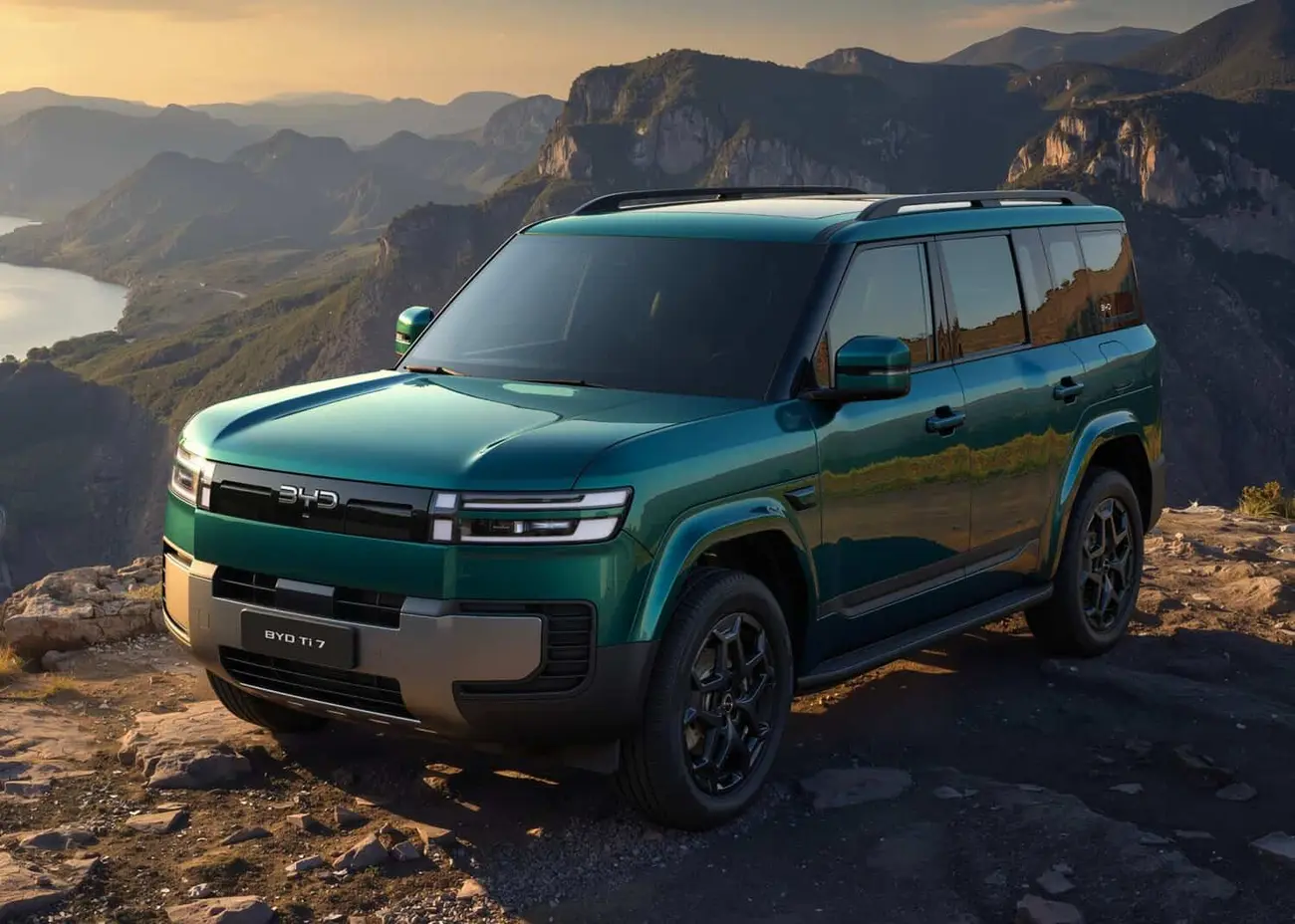
A Chinese Defender at half the price — and it's heading for Europe
BYD has just confirmed the Ti7, a seven-seat SUV with unmistakable Land Rover Defender looks and a plug-in hybrid heart. It lands in the UK in late 2026 as the brand's new flagship, with a price expected under £50,000 — at a time when a Defender Octa runs into six figures. The question that matters if you're in Portugal: will the BYD Ti7 cross the Channel and reach mainland Europe?
For now the official confirmation is British only. But a UK launch is rarely a final destination for BYD — it's the test run before a model spreads across the rest of Europe. And the BYD Ti7 isn't travelling alone: it's part of a wave of rugged Chinese SUVs taking the Defender on at its own game.
What the BYD Ti7 is, and why it looks like a Defender
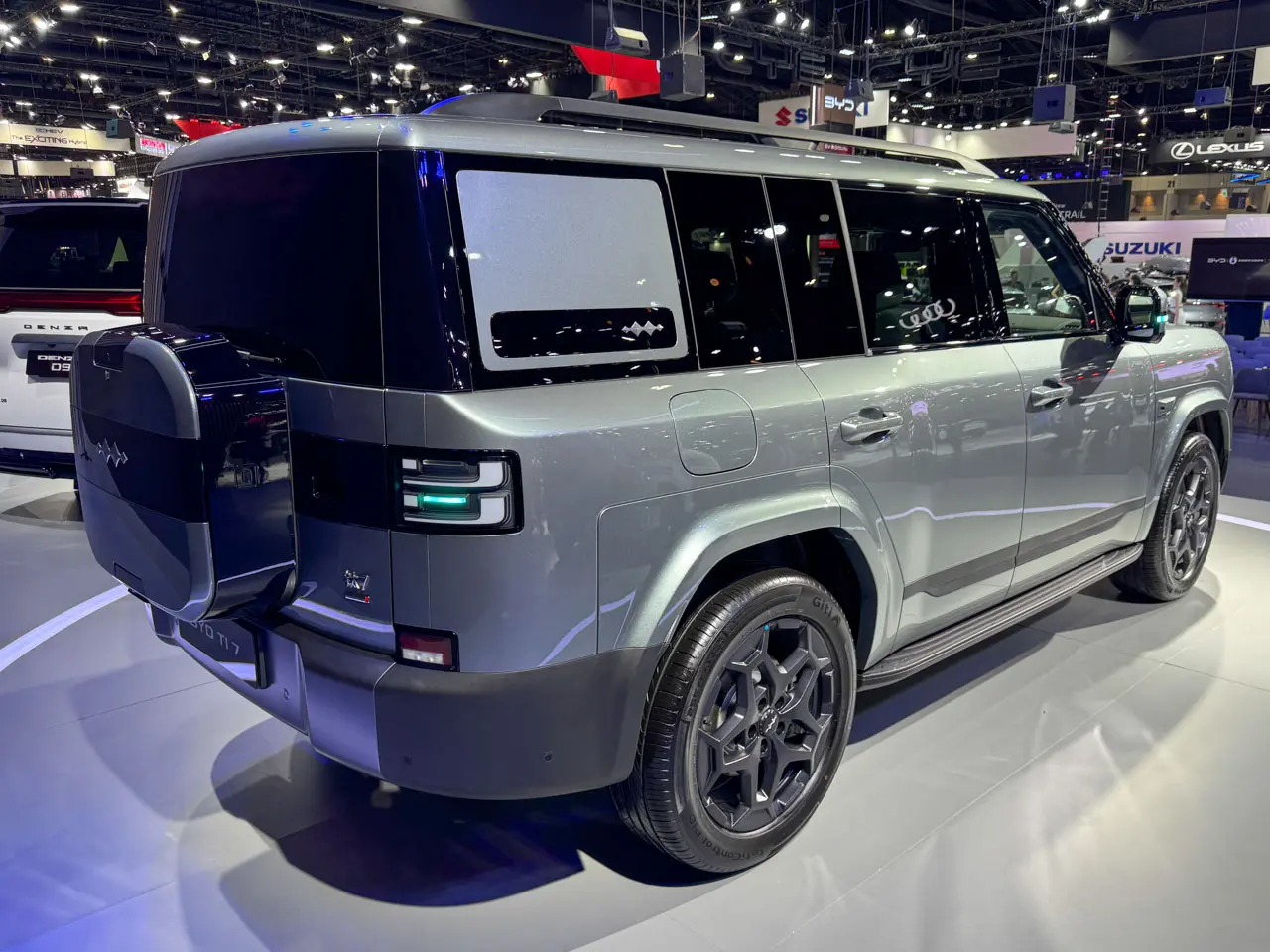
The Ti7 has the classic boxy 4x4 silhouette: straight edges, contrasting bumpers, a floating roof, and a spare wheel mounted on the tailgate. One glance and you see the Defender — with a hint of Toyota Land Cruiser too. That's deliberate. BYD pitches the Ti7 between the Defender 110 and 130 in size and ambition.
In China the car is sold under the premium Fangchengbao (Fang Cheng Bao) brand, the group's youthful, aspirational division. In Europe it will wear the more familiar BYD badge. It's the bigger sibling of the Denza B5, a body-on-frame off-roader also bound for Europe. The distinction matters: the B5 is built to get its tyres genuinely dirty, while the monocoque Ti7 leans on rugged styling without pretending to cross deserts.
Specs: the DM-p plug-in hybrid explained
The Ti7 debuts BYD's DM-p (Dual Mode Performance) system in the UK — the sportier version of the brand's plug-in hybrid tech. It pairs a 1.5-litre turbo petrol engine with two electric motors, one per axle (so all-wheel drive), and a 35.6 kWh LFP battery.
Electric range is around 127 km (79 miles, WLTP). In everyday terms: enough for most urban and commuting trips without burning a drop of petrol, with the combustion engine reserved for longer journeys or topping up the battery. The 1.5 turbo works mainly as a generator rather than the main source of drive.
| Specification | Value |
|---|---|
| Body / seats | 7-seat SUV (UK) |
| Length | 5,146 mm (UK) / 4,999 mm (China) |
| Width | 1,995 mm |
| Height | 1,865 mm |
| Wheelbase | 2,920 mm |
| Powertrain | DM-p PHEV: 1.5 turbo petrol + 2 e-motors, AWD |
| Battery | 35.6 kWh LFP |
| Electric range | around 127 km (WLTP) |
| Power | up to 646 bhp |
| Torque | 845 Nm |
| 0-100 km/h | 4.5 to 4.8 s |
| Top speed | around 190 km/h |
| Weight | 2,400 kg |
| Price (UK) | under £50,000 (estimated) |
| Launch | late 2026 (UK) |
Power figures vary between outlets — you'll see 483, 600 and 646 bhp depending on who's reporting. Auto Express, which has actually driven the car, quotes 646 bhp and 845 Nm. Despite weighing 2.4 tonnes, the Ti7 hits 100 km/h in around 4.5 seconds. Nearly as quick as a Defender Octa (3.8 s), in Auto Express's words, "at a five-figure price, instead of six".
How it drives — and where the limits are
Those who have tested it describe a car that favours comfort over aggression. The suspension copes well over long distances, and the generous wheelbase kills the bounce that plagued the Seal U. There are Snow, Sand, Mud, Mountain and Sport+ modes, but the changes they make to steering and suspension are mild. The honest translation: the Ti7 looks like an off-roader but drives like a road SUV. Anyone who genuinely needs serious off-road ability should look at the Denza B5.
Inside, the Defender influence continues, with chunky grab bars inside and out, rubber floor mats, and kit that shames plenty of premium rivals: heated and ventilated seats across all three rows, a massage function up front, and a fridge under the central armrest. The central screen measures 15.6 inches and the instrument cluster 10.25 inches.
The fully electric version China already has
China also gets a fully electric Ti7, and the numbers are striking. It uses the second-generation Blade Battery and claims 755 km of range (CLTC cycle, more optimistic than Europe's WLTP). The headline is the charging: 10% to 70% in 5 minutes, thanks to BYD's Flash Charging network, which delivers up to 1500 kW. Even at -30°C, the impact on charging time is just three extra minutes.
In China this electric Ti7 starts at around 199,800 yuan (about $29,000). The plug-in hybrid version sits between 280,000 and 350,000 yuan. Whether the electric Ti7 reaches Europe isn't confirmed yet — for now, it's the PHEV that has a clear European destination.
BYD Ti7 vs Land Rover Defender: does the comparison hold?
On paper, the Ti7 offers much of what makes the Defender desirable — presence, seven seats, a capable look — for a fraction of the price. Where the Defender wins is heritage, an established service network, and genuine off-road ability. The Ti7 counters with far lower running costs (thanks to 127 km of electric range for daily use) and more generous standard equipment.
For a buyer in Portugal, the real question isn't which is the better off-roader — it's which makes more sense as a large family SUV that occasionally leaves the tarmac. And there the Ti7 has a strong case: Defender looks, electrified mechanicals, and a price tag that hurts a lot less.
Frequently Asked Questions
There is no official Portuguese price yet. In the UK it is estimated under £50,000 (roughly €58,000 to €59,000 at a direct conversion), but the Portuguese figure will depend on the ISV purchase tax applied to a plug-in hybrid of this size and on BYD's pricing strategy for mainland Europe. For comparison, a Land Rover Defender Octa runs into six figures, so the Ti7 should be considerably more affordable.
For now only the UK launch is confirmed, expected in late 2026. There is no official date for Portugal or mainland Europe. However, BYD rarely confirms a model for the UK without expanding it across the rest of Europe afterwards, and the brand is already well established in the Portuguese market, which makes a medium-term arrival plausible.
The DM-p plug-in hybrid version bound for Europe claims around 127 km of electric range (79 miles, WLTP cycle), thanks to a 35.6 kWh LFP battery — enough for most urban and commuting trips without using petrol. China also has a fully electric Ti7 with 755 km of range (CLTC cycle), but its arrival in Europe is not confirmed.
Not to the same level. The Ti7 uses a monocoque body and favours on-road comfort, with approach and departure angles of 24° and 25° versus the Defender 110's 38° and 40°. It has Snow, Sand, Mud and Mountain modes but is essentially a family SUV with rugged styling. Anyone needing serious off-road ability should look at its body-on-frame sibling, the Denza B5.
It depends on your use. The Ti7 offers presence, seven seats and a capable look for a fraction of the Defender's price, with lower running costs thanks to 127 km of electric range and very generous standard equipment. The Defender wins on heritage, service network and genuine off-road ability. As a large family SUV that occasionally leaves the tarmac, the Ti7 makes a strong case.
When the BYD Ti7 reaches Portugal, and what it might cost
Let's be straight: there's no official Portuguese date or price yet. What we know is that BYD is well established in our market, that the model is confirmed for the UK in late 2026, and that the original French source raises exactly the question of whether these Chinese Defender rivals reach mainland Europe — France, Portugal and the rest.
A reasonable estimate: if the UK price lands under £50,000 (roughly €58,000 to €59,000 at a direct conversion), the Portuguese figure will depend heavily on the ISV (Portugal's vehicle purchase tax) applied to a plug-in hybrid of this size, plus BYD's pricing strategy for mainland Europe. As a PHEV with more than 50 km of electric range, it qualifies for more favourable ISV treatment than a pure-petrol equivalent — though not the full exemption reserved for 100% electric cars. All of this stays unconfirmed until — and if — a Portuguese launch is announced.
It's worth watching the next few months. BYD rarely confirms a model for the UK only to leave it stranded on the British Isles, and the wave of Defender-style Chinese SUVs is clearly aimed at the whole of Europe. If you like the idea of a large, electrified, well-equipped off-roader without the luxury price, the Ti7 is a name to keep in mind.