
BYD Ti7 Price in Portugal: Euro Estimate, ISV Impact and 2027 Arrival
Published: 17/08/2026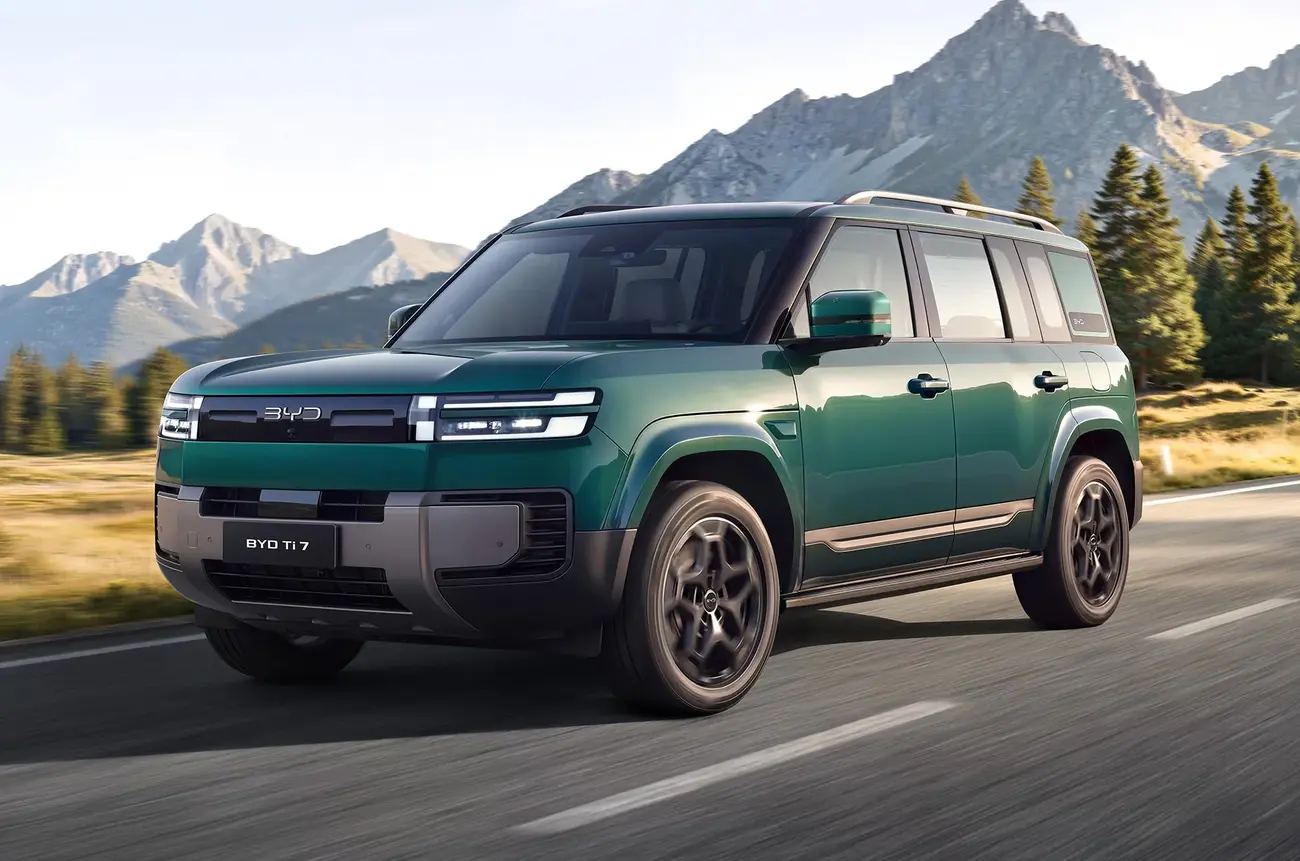
GBP 47,995 for a seven-seat SUV with 408 hp
BYD has put its cards on the table in the UK: the Ti 7 costs GBP 47,995 on the road, in a single Excellence AWD trim. That buys a five-metre SUV with seven seats, all-wheel drive and a 408 hp plug-in hybrid system. It also undercuts a Land Rover Defender 110 PHEV by roughly GBP 25,000.
If you are buying in Portugal, the obvious next question is the one nobody has answered yet. Here is what is confirmed, what is an estimate, and what depends entirely on the Portuguese tax office.
BYD Ti 7 price in Portugal: the honest estimate
Start with the important part: BYD has not announced a euro price. The GBP 47,995 figure applies only to the UK and already includes British taxes.
At current exchange rates, GBP 47,995 works out at roughly EUR 55,000. Treat that number carefully. It is arithmetic, not a price list, and BYD's other models show that continental prices rarely land on a straight conversion from the UK sheet. Different volumes, different distribution, and a completely different tax structure.
What ISV will do to that figure
ISV is Portugal's one-off vehicle registration tax, and it is where plug-in hybrids either win or lose. A PHEV qualifies for the reduced 25% rate only if it meets two conditions at once: at least 50 km of electric-only range, and CO2 emissions below 50 g/km.
The first is comfortably met. The Ti 7 claims up to 119 km (74 miles) of electric range, more than double the threshold. The second is the unknown: BYD has not published a European WLTP CO2 figure, and getting a 2.4-tonne SUV with a 1.5-litre turbo under 50 g/km is not a given. If it clears the bar, ISV drops sharply and the Portuguese price could land near — or even below — that EUR 55,000 estimate. If it does not, the full environmental component applies and the number jumps by several thousand euros.
IUC, the annual road tax, holds no surprises: plug-in hybrids are taxed like any combustion car, based on engine displacement (1.5 litres puts it in a modest bracket) and emissions. None of the exemptions that pure EVs enjoy here.
When the BYD Ti 7 reaches Portugal
Order books are already open in the UK. First cars land in showrooms in November 2026, with customer deliveries starting January 2027. Early buyers get a nudge: a GBP 500 deposit is matched by another GBP 500 from BYD.
Continental Europe, Portugal included, follows in 2027. That is BYD's usual pattern — launch in one market, adjust, then widen the rollout. There is still no firm date for Portuguese dealers, and no confirmation that the seven-seat layout will be the only one sold here. In the UAE, for instance, the Ti 7 is offered as a five-seater.
The specs: DM-p, 408 hp and a 35.6 kWh Blade battery
The Ti 7 brings BYD's DM-p Super Hybrid system to Europe for the first time — the performance-focused branch of its plug-in hybrid technology. A 150 hp 1.5-litre turbo petrol engine works alongside electric motors front and rear (the official release describes two motors; several outlets report three), with permanent all-wheel drive.
| Specification | Value |
|---|---|
| Combined output | 408 PS (402 bhp / 300 kW) |
| Petrol engine | 1.5-litre turbo, 150 PS |
| Battery | 35.6 kWh Blade (LFP) |
| Electric range | up to 119 km (164 km in city driving) |
| Combined range | up to roughly 710 km |
| 0-100 km/h | 4.8 s |
| Top speed | 190 km/h |
| Length | roughly 5.0 to 5.15 m |
| Wheelbase | 2,920 mm |
| Kerb weight | around 2.4 tonnes |
| Construction | unibody |
| Seats | 7 |
Four point eight seconds to 100 km/h in a 2.4-tonne, three-row family car is the kind of figure that five years ago required a German badge and a six-figure invoice.
What that electric range means day to day
The claimed 119 km of electric range covers most Portuguese daily driving without burning a drop of petrol. In town BYD quotes up to 164 km — plug-in hybrids are at their most efficient in city traffic, where regenerative braking does the heavy lifting. In practice: a daily Lisbon-Cascais round trip, or Porto to Braga and back, on electricity alone if you charge at home.
Long trips fall back on the tank. Combined range is quoted at around 710 km, enough for Lisbon to the Algarve with margin to spare and without planning stops on the MOBI.E public charging network. There is also V2L, which turns the car into a power socket for external equipment — handy for camping, worksites, or a blackout.
Seven seats, a 126-litre boot and a fridge in the centre console
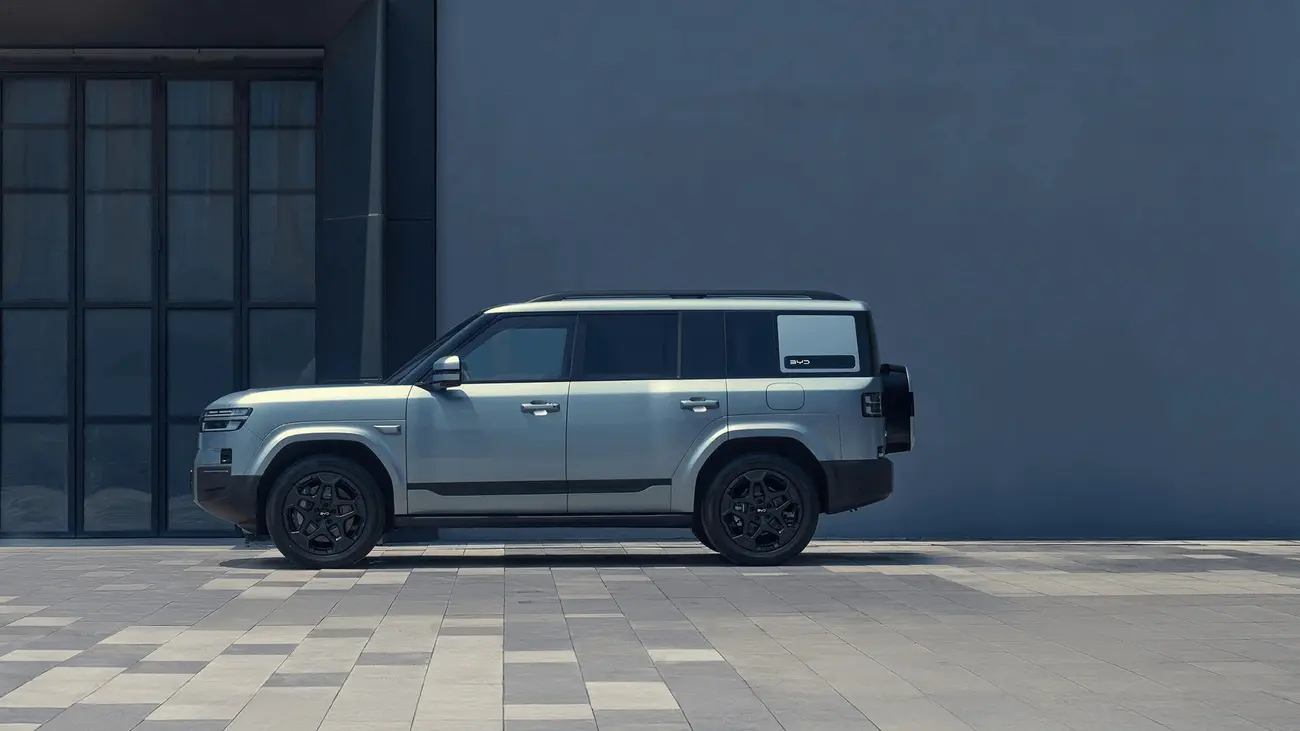
Here is the trade-off nobody escapes. With all three rows up, the Ti 7's boot holds just 126 litres — enough for a few shopping bags and little else. Fold the third row and it grows to 970 litres. Fold the second row as well and you get 1,830 litres.
Standard equipment does a lot to make up for that:
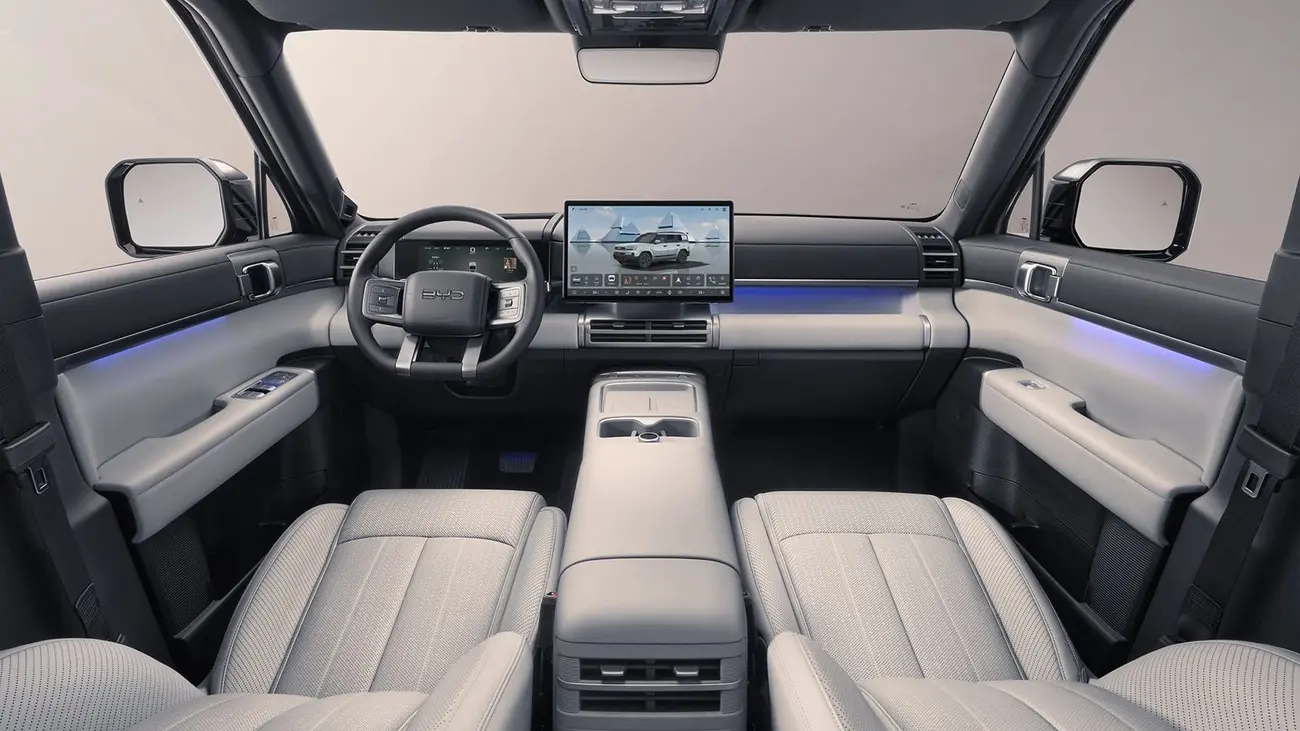
- 15.6-inch touchscreen and 10.25-inch digital instrument cluster
- 18-speaker sound system
- Two 50 W wireless phone chargers
- Leather upholstery in three finishes (black, light grey, brown)
- Heated and ventilated front seats and outer second-row seats
- Three-zone climate control
- Fridge and drinks warmer in the centre console
- Panoramic glass roof, acoustic front glazing, 20-inch alloys
Starlight Silver is free. Mountain Green, Obsidian Black, Jade Green and Titanium Grey add GBP 1,100, while Matte Titanium Grey asks GBP 2,000.
BYD Ti 7 vs Land Rover Defender: the comparison BYD wants you to make
It is not subtle, and that is precisely why it works. The Defender 110 PHEV starts at GBP 71,840 in the UK with 50 km of electric range. The Ti 7 asks GBP 25,000 less and delivers more than double the electric range, plus a third row the Defender only offers in other configurations.
Credit where it is due: the Defender is a proper off-roader with a track record. The Ti 7 uses unibody construction tuned for interior space and on-road refinement, not for wading through riverbeds. Same silhouette, different tools.
For a Portuguese buyer the closest realistic alternative is the Kia EV9 — seven seats, fully electric, already on sale here, and exempt from the ISV the Ti 7 will always pay. If you regularly drive in areas where charging is awkward, the plug-in wins. If you mostly drive in the city and charge at home, the pure EV probably makes more sense.
Frequently Asked Questions
BYD has not announced a euro price for Portugal. The only official figure is the UK one: GBP 47,995 on the road, including British taxes, in a single Excellence AWD trim. At current exchange rates that converts to roughly EUR 55,000, but this is arithmetic rather than a price list — Portuguese taxation (ISV and VAT) and continental distribution can move the final figure by several thousand euros in either direction.
Order books are open in the UK, with the first cars reaching showrooms in November 2026 and customer deliveries starting in January 2027. Continental Europe, Portugal included, follows during 2027, after the British launch. There is still no confirmed date for Portuguese dealers, and no confirmation that the seven-seat layout will be the only one sold here — in the UAE, for example, the Ti 7 is offered as a five-seater.
That depends on a figure BYD has not yet published. In Portugal a plug-in hybrid only qualifies for the reduced ISV rate (25% of the standard amount) if it meets two conditions at once: at least 50 km of electric-only range and CO2 emissions below 50 g/km. The Ti 7 clears the first comfortably with its claimed 119 km, but the European WLTP CO2 figure is still unknown — and getting a 2.4-tonne SUV with a 1.5-litre turbo under 50 g/km is far from automatic. IUC, the annual road tax, offers no exemptions: it is taxed like any combustion car.
The 35.6 kWh Blade LFP battery is quoted at up to 119 km (74 miles) of electric-only range, rising to as much as 164 km in city driving, where regenerative braking does the heavy lifting. In practice that covers most Portuguese daily commutes without burning petrol, provided you charge at home. Longer trips fall back on the petrol tank, with a combined range quoted at around 710 km. The car also supports V2L, working as a power socket for external equipment.
In the UK the gap is stark: the Defender 110 PHEV starts at GBP 71,840 with just 50 km of electric range, against the Ti 7's 119 km for around GBP 25,000 less. The caveat is technical — the Ti 7 uses unibody construction tuned for space and on-road refinement, not the Defender's serious off-road engineering. For Portuguese buyers the closest alternative is the Kia EV9: seven seats, fully electric, already on sale here and exempt from ISV, a tax advantage the Ti 7 will never have. If you mostly drive in the city and charge at home, the pure EV usually wins; if you cover long distances away from charging infrastructure, the plug-in makes more sense.
What still needs confirming
Two numbers hold up any decision right now: the euro price and the homologated CO2 figure. They are what separates a 408 hp seven-seat SUV at EUR 55,000 — genuinely aggressive for our market — from one at EUR 65,000, where the competition gets a lot tougher.
Worth watching too are the complaints reported in China, where the car sells as the Fangchengbao Ti7 and has already racked up 94,417 sales: owners have reported panoramic roof glass detaching and water getting into the charging port. The European version arrives after those fixes, but it is a point to check in the first road tests. With the rollout set for 2027, BYD Portugal has plenty of time to put real numbers on the table.