
BYD Sealion 05 in Portugal: Full Specs, Price and When It Arrives
Published: 25/04/2026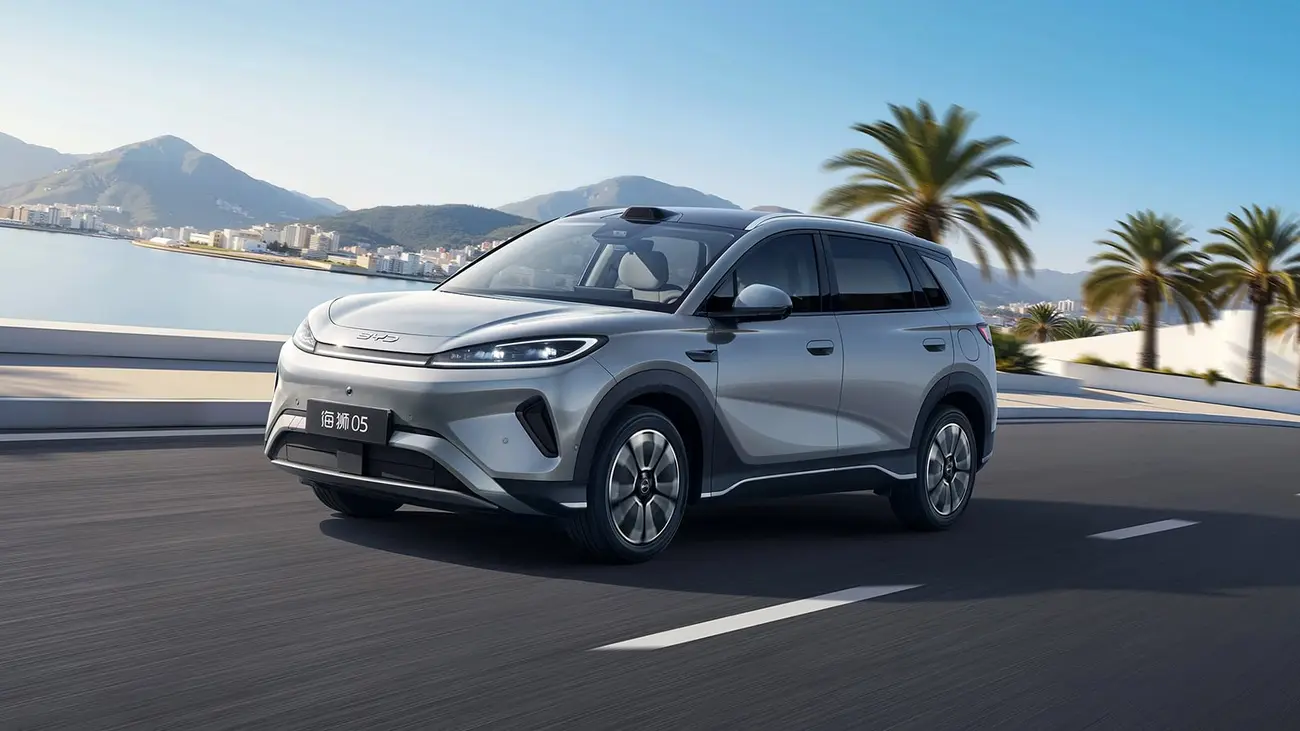
BYD Sealion 05 Portugal: what flash-charging means for the next wave of Chinese SUVs
BYD officially launched the 2026 Sealion 05 in China on 20 April 2026 in two flavours — a pure electric SUV promising near-instant charging and a plug-in hybrid DM-i variant capable of 2,105 km with a full tank and a full battery. A Portugal arrival is not yet confirmed, but BYD already sells the previous-generation Sealion 5 DM-i in the European catalogue, which makes this model one of the most relevant launches of the 2026 Chinese offensive.
One caveat before diving in: all range figures come from the Chinese CLTC cycle, typically 15 to 25% more optimistic than the European WLTP standard. And the much-publicised "5-minute charging" claim, based on official data, is actually 10% to 97% in around 9 minutes on a compatible DC charger. Still impressive — but worth separating the marketing headline from the technical reality.
BYD Sealion 05 specs: EV and DM-i side by side
Both variants share the body, interior and platform but differ completely in philosophy. Here is the direct comparison based on official data from the Chinese launch.
| Specification | Sealion 05 EV | Sealion 05 DM-i |
|---|---|---|
| Length | 4,620 mm | 4,620 mm |
| Width | 1,860 mm | 1,860 mm |
| Height | 1,630 mm | 1,630 mm |
| Wheelbase | 2,770 mm | 2,770 mm |
| Electric motor power | 200 kW (268 hp) or 240 kW (322 hp) | 120 kW (161 hp) |
| Combustion engine | — | 1.5 L naturally aspirated, 74 kW / 126 Nm |
| Battery | 57.5 kWh LFP or 68.5 kWh (second-gen Blade) | 26.6 kWh or 34.3 kWh (Blade) |
| CLTC range | 540 km or 630 km | 220 km or 305 km electric-only; 2,105 km combined |
| 0-100 km/h | 5.9 s (top trim) | n/a |
| DC charging | 10 to 97% in around 9 minutes | 57 kW (small pack) or 74 kW (large pack) |
| AC charging | n/a | 7 kW |
| Fuel consumption (battery depleted) | — | 3.1 L/100 km |
| Boot | 600 L (1,460 L seats folded) + 110 L frunk | 650 L |
| Airbags | 7 | 7 |
BYD has pushed the envelope on almost every metric compared with the model currently sold in Europe. Electric-only range on the DM-i has tripled — from 71 or 100 km in the previous generation to 220 or 305 km CLTC. Boot capacity jumped from 463 L to 650 L. AC charging climbed from 3.3 kW to 7 kW. The one metric that moved the other way: the DM-i's electric motor dropped from 145 kW to 120 kW.
What flash charging actually delivers
BYD unveiled the Sealion 05 EV with the second-generation Blade Battery and flash-charging technology. The corporate messaging talks about "five minutes to fill the battery". The official data points to 10% to 97% in around 9 minutes on a compatible DC charger — still a strong number, but it needs two asterisks.
First, this technology requires ultra-high-power DC chargers, the megawatt class, which are just starting to appear in Europe and remain rare. In Portugal, the MOBI.E network and operators like Galp, BP and IONITY mostly run between 50 and 350 kW. Second, the figures were measured under ideal temperature and battery-state conditions — real-world times will generally be longer.
Price and trims: Chinese benchmark and what to expect in Portugal
In China, the pricing is aggressive:
- DM-i: 97,900 to 127,900 CNY (around €12,260 to €16,010 in direct conversion)
- EV: 119,900 to 145,900 CNY (around €15,000 to €18,300)
For context, the Tesla Model Y RWD starts at 263,500 CNY on the Chinese market — more than double.
These figures are direct currency conversions and do not reflect what the Sealion 05 would cost in Portugal. Between EU import tariffs on Chinese EVs, homologation costs, shipping, VAT and distribution margin, final European prices typically land 80 to 120% above the direct Chinese conversion. For reference: the previous-gen Sealion 5 DM-i sits in BYD's European catalogue as a "Super Hybrid SUV", and launched in Australia at AUD 33,990 (around €20,500 to 21,000) — though Australia does not face the EU tariffs.
When will the BYD Sealion 05 arrive in Portugal
Honest answer: nobody knows yet. BYD has not confirmed dates or prices for Europe. What we do know is that the brand is expanding its dealer network in Portugal (currently run through Caetano) and that the previous-gen Sealion 5 DM-i is already in the European catalogue. It is reasonable to expect the refreshed version to follow the same route — but there may be a gap of months or even years, and BYD could keep the "Sealion 5 DM-i" name in Europe for range consistency.
Until that clears up, Portuguese buyers who need a midsize PHEV with generous electric range already have plenty of options on sale. One thing to watch: if the Sealion 05 EV lands in Portugal with tariffs applied, it will compete directly with the BYD Atto 2 (smaller but already here), the MG ZS EV and the Chery Tiggo 7 — all sitting in the €25,000 to €35,000 bracket.
Portuguese buyer perspective: what really matters
In a country where ISV (the Portuguese vehicle registration tax) is one of the biggest factors in any car's final price, the Sealion 05's electric positioning is attractive. Pure EVs are exempt from ISV and pay a reduced IUC (annual road tax), which makes the EV version particularly competitive on total cost of ownership. For the DM-i plug-in hybrid, partial ISV exemption only applies if the homologated WLTP electric range clears certain thresholds — the 305 km CLTC of the top trim could translate to 230 to 260 km WLTP, which, if confirmed, would place the car in a very favourable tax bracket.
In real-world use, a Portuguese family that does Lisbon-Porto monthly benefits more from the DM-i: 2,105 km combined range eliminates range anxiety on long trips, and day-to-day the 300 km of electric driving covers several weeks of urban commutes without burning a drop of petrol. For buyers who live in urban centres with home charging and rarely drive more than 300 km in a single stretch, the 630 km CLTC EV (likely around 500 km WLTP) is more than enough.
BYD Sealion 05 EV or DM-i: which to pick
The answer depends on driving pattern and charging access.
- Sealion 05 EV: best for buyers with home charging, mostly daily commutes and typical drives up to 400 km. Lower cost per kilometre, simpler maintenance, maximum tax benefits.
- Sealion 05 DM-i: best for buyers who regularly cross the country, have limited charging access, or want an electrified car without range compromises. Loses on per-km cost when the engine kicks in, but wins on flexibility.
Frequently Asked Questions
BYD has not yet confirmed dates or prices for Europe. The model launched in China on 20 April 2026 and, because the previous-generation Sealion 5 DM-i is already in BYD's European catalogue, it is reasonable to expect a Portuguese launch through the Caetano dealer network. There may, however, be a gap of months or even years, and BYD could keep the 'Sealion 5 DM-i' name in Europe for range consistency.
In China, the DM-i sells for 97,900 to 127,900 CNY (roughly €12,260 to €16,010 in direct conversion) and the EV for 119,900 to 145,900 CNY (€15,000 to €18,300). After EU tariffs on Chinese EVs, VAT, ISV, homologation and distribution margin, final European prices typically land 80 to 120% above the direct conversion. A realistic Portuguese price for the EV version would be between €28,000 and €38,000.
The advertised 540 or 630 km follow the Chinese CLTC cycle, which is typically 15 to 25% more optimistic than European WLTP. Converted to WLTP, the top 68.5 kWh version should land near 500 km and the 57.5 kWh version around 420 to 450 km. In Portuguese real-world use — for example motorway driving at 120 km/h on the A1 — expect a further 10 to 15% drop.
Not quite. Marketing talks about 'five minutes', but the official figure is 10% to 97% in around 9 minutes on a compatible DC charger. On top of that, this flash-charging technology requires ultra-high-power DC chargers (megawatt class), which are still very rare in Portugal — the MOBI.E network and Galp, BP or IONITY stations mostly operate between 50 and 350 kW, so real-world charging times will be considerably longer.
It depends on driving pattern and charging access. The EV (630 km CLTC, around 500 km WLTP) is ideal for buyers with home charging who mostly drive in town — it also qualifies for full ISV exemption and reduced IUC road tax. The DM-i, with 2,105 km combined range and 220 to 305 km electric-only, is a better fit for drivers who regularly cross the country or have limited charging access, and may qualify for partial ISV exemption if its WLTP electric range clears the Portuguese tax thresholds.
What to watch next
A Portuguese launch for the Sealion 05 depends on three moving parts: BYD's European naming strategy (whether it uses "Sealion 05" or keeps "Sealion 5"), how EU tariffs on Chinese EVs evolve, and how much capacity the Caetano dealer network has to absorb another model. When all three line up, the car will probably land in Portugal priced somewhere between €28,000 and €38,000 for the EV version — nowhere near the Chinese numbers, but competitive in the C-segment SUV bracket.
Until then, one thing is certain: BYD is not slowing down. The Sealion 05 is another step in an offensive that has already pushed the brand into Europe's best-selling rankings — and Portugal will feel the impact, sooner or later.