
BYD Great Seagull: Specs, Price and the Dolphin Surf Question in Portugal
Published: 28/08/2026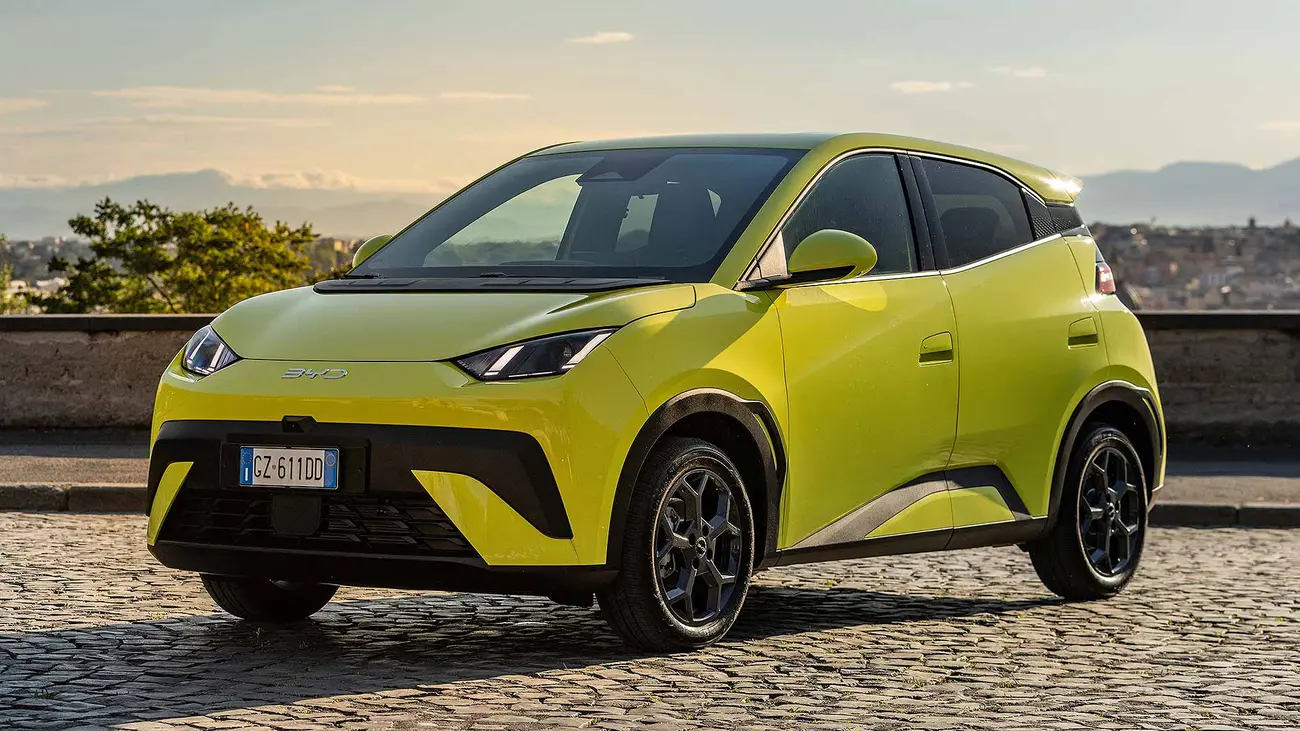
BYD Great Seagull: the Chinese city EV that grew by 42 centimetres
It is called the Great Seagull (Da Haiou, 大海鸥) and it launches in China before the end of 2026. Zhang Zhuo, general manager of BYD's Ocean network sales division, confirmed it at the Chengdu Auto Show. The name borrows from the Dynasty series — Da Tang, Da Han — and the car does exactly what the name suggests: it takes the Seagull, the model sold in Portugal as the Dolphin Surf, and stretches it.
By 425 mm, to be precise. Today's Seagull is 3,780 mm long; the Great Seagull measures 4,205 mm, which leaves it just 65 mm shy of the Dolphin. If you are shopping for a cheap electric city car in Portugal, the obvious question is whether this one reaches us — and whether it is worth waiting for.
What the MIIT filing already tells us about the specs
The car cleared China's MIIT homologation process before the Chengdu announcement. MIIT filings force manufacturers to publish dimensions and motor data ahead of sale, which is where the hard numbers come from.
| Specification | Great Seagull | Current Seagull | Dolphin Surf (Europe) |
|---|---|---|---|
| Length | 4,205 mm | 3,780 mm | 3,990 mm |
| Width | 1,810 mm | 1,715 mm | 1,720 mm |
| Height | 1,570 mm | 1,540 mm | 1,590 mm |
| Wheelbase | 2,650 mm | 2,500 mm | 2,500 mm |
| Kerb weight | 1,180–1,255 kg | n/a | 1,465 kg (Comfort) |
| Power | 95 kW (127 hp) | 55 kW (74 hp) | 65 kW (88 hp) / 115 kW (156 hp) |
| Battery | 30 kWh / 39.2 kWh FinDreams LFP | 30.08 / 38.88 kWh Blade LFP | 30 / 43.2 kWh usable Blade LFP |
| Range | 320–420 km CLTC | 305 / 405 km CLTC | 220 / 322 / 310 km WLTP |
| Top speed | 150 km/h | 130 km/h | 150 km/h |
The most meaningful jump is not the tape measure, it is the motor. Today's Seagull makes do with 55 kW (74 hp) and 135 Nm — fine around town, breathless joining a motorway. The Great Seagull gets a 95 kW (127 hp) permanent magnet synchronous motor, nearly double the output, with top speed rising from 130 to 150 km/h. The extra 150 mm of wheelbase goes almost entirely into cabin space, since the seats and console do not grow with the chassis.
Batteries are LFP units from FinDreams, BYD's in-house battery arm, in 30 kWh and 39.2 kWh sizes, rated at 320 to 420 km on the CLTC cycle. That "CLTC" matters: it is China's homologation cycle and it flatters every car it touches. Converted roughly to Europe's WLTP standard, you are looking at something like 250 to 330 km — broadly what the Dolphin Surf already delivers, but in a bigger and considerably quicker car.
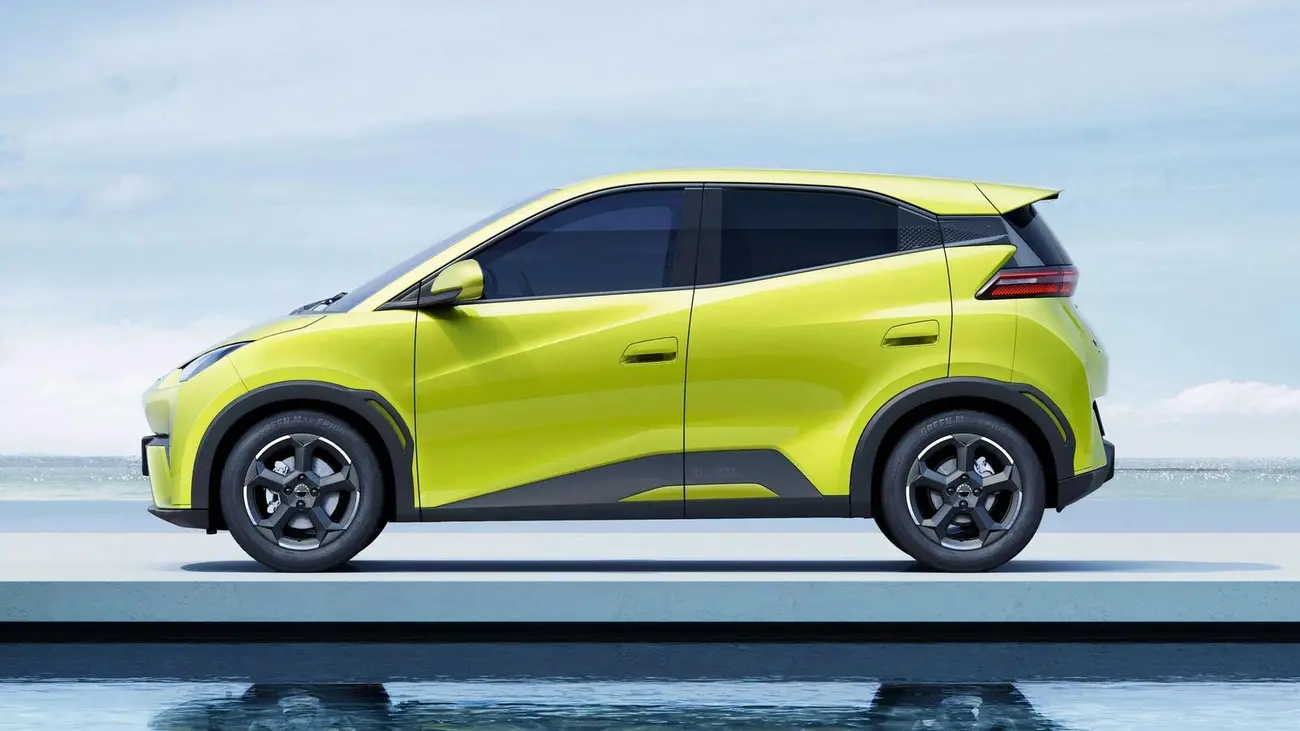
BYD Great Seagull vs Dolphin: why BYD needs this car
The sales sheet explains it. BYD delivered 9,825 Seagulls in China in June 2026. Geely shifted 33,359 Xingyuan (also badged EX2) in the same month — more than three times as many. July brought 8,879 Seagulls against 13,910 Dolphins, with the April 2026 peak of 34,005 units firmly in the rear-view mirror.
The Seagull is still a global hit — the fifth best-selling EV in the world through May 2026, with over 125,000 units. But the Chinese segment has moved on: buyers now want a bigger car for the same money. The Great Seagull is the direct answer to the Xingyuan and the GAC Aion UT, and it is expected to work as a cheaper, less powerful alternative to the Dolphin, possibly replacing that model's entry-level version.
LiDAR in an electric car costing under 15,000 dollars
Great Seagull prototypes are running with a roof-mounted LiDAR feeding the DiPilot 300 system — BYD's "God's Eye B" — with NOA assisted driving on city streets and motorways, traffic-light and roundabout recognition and automated parking, all handled by an Nvidia Drive Orin chip.
This is not entirely new ground. The 2026 Seagull sold in China already offers the same package from 90,900 yuan (around 13,400 dollars), making it the first sub-15,000-dollar EV with LiDAR on a mainstream trim. The full Chinese range runs from 69,900 to 97,900 yuan, or roughly 10,300 to 14,400 dollars. That gap between Chinese and European pricing is worth keeping in mind: import duties, European homologation, different standard equipment and VAT account for most of it.
BYD Dolphin Surf price in Portugal: what you can buy today
Until the Great Seagull leaves China, the car you can actually order here is the Dolphin Surf, in three trims:
- Active — 30 kWh battery, 88 hp, 220 km WLTP, 0-100 km/h in 11.1 s, DC charging up to 65 kW
- Boost — 43.2 kWh usable, 88 hp, 322 km WLTP, 12.1 s, DC up to 85 kW
- Comfort — 43.2 kWh usable, 156 hp and 220 Nm, 310 km WLTP, 9.1 s, DC up to 85 kW
UK list prices are £18,650, £21,950 and £23,950. On the continent, EV Database records €26,690 in the Netherlands and €30,990 in Germany for the Comfort, while Electrek quotes €22,990 as the European entry price. In Portugal, BYD has run campaigns with the Dolphin Surf from around €19,990 (plus VAT), and dealer listings sit near €21,000 for the Active and €28,000 for the Comfort — figures that shift with each campaign and that you should confirm directly with a dealer before committing.
The tax side helps. As a fully electric car, the Dolphin Surf is exempt from ISV (Portugal's vehicle registration tax), pays a reduced IUC (the annual road tax) and remains eligible for purchase incentives while funding lasts.
Real-world Dolphin Surf range in daily use
The Comfort's 310 km WLTP figure is not what the trip computer shows. EV Database puts real consumption at roughly 305 km combined in mild weather (400 km in pure city driving, 240 km on the motorway) and 220 km in the cold, at -10 °C with the heating on.
Applied to Portuguese driving: for a commute around Lisbon or Porto with home charging, that is comfortable — one charge a week covers it. Lisbon to Porto is a different conversation. With an 85 kW peak and 10-80% in 32 minutes on a fast charger, it is doable, but with a mandatory stop. EV Database rates its long-distance suitability at 1.5 out of 5. The 308-litre boot (1,037 L with the seats folded) and four homologated seats set the profile too: this is a city and weekend car, not a motorway cruiser.
Safety is not the weak spot. Five Euro NCAP stars in 2025, with 82% for adult occupants and 86% for children, plus six airbags, AEB, lane assist and driver monitoring across the range.
Frequently Asked Questions
There is no confirmed date and no guarantee the model will reach Europe at all. BYD has only confirmed, through Zhang Zhuo at the 2026 Chengdu Auto Show, a China launch during this year. Electrek notes that the brand anticipates introducing comparable upgrades to the Dolphin Surf and Dolphin Mini for international markets, which is a general intention rather than a commitment. Historically, a BYD model launched in China takes 12 to 24 months to reach Europe fully homologated and often under a different commercial name, so any Portuguese arrival would realistically be a 2027 or 2028 story.
The price has not been announced, not even in China. The closest reference is the current Seagull, sold in China between 69,900 and 97,900 yuan (roughly 10,300 to 14,400 dollars). Since the Great Seagull is bigger, has 95 kW instead of 55 kW and FinDreams LFP batteries of 30 and 39.2 kWh, it should sit above that range. A direct conversion to Portugal does not work: the equivalent Chinese Seagull costs about 10,300 dollars, yet the Dolphin Surf lands here at around 20,885 euros once shipping, European homologation, VAT and a different standard equipment level are added.
The Great Seagull is 425 mm longer: 4,205 mm against the Seagull's 3,780 mm, with 150 mm more wheelbase (2,650 mm) and 95 mm more width. Power rises from 55 kW (74 hp) to 95 kW (127 hp), top speed goes from 130 to 150 km/h, and the 30 and 39.2 kWh LFP batteries claim 320 to 420 km CLTC, equivalent to roughly 250 to 330 km WLTP. In practice the Great Seagull ends up only 65 mm shorter than the Dolphin, positioning it as a cheaper alternative to that model.
Fully electric vehicles are exempt from ISV (vehicle tax) and IUC (annual road tax) in Portugal, which is the biggest fiscal advantage over an equivalent petrol city car. For companies, VAT on the purchase is deductible within the legal acquisition-value limits set for electric vehicles. There are also periodic zero-emission purchase incentives with a limited annual budget, so it is worth confirming what is available at the time of purchase. With list prices around 20,885 euros for the Active trim, these factors can materially change the final cost.
The Dolphin Surf sits above the Dacia Spring on power and safety, and below the Citroen e-C3 and Hyundai Inster on interior space. At 3,990 mm long, with a 308-litre boot (1,037 litres with the seats folded) and only four homologated seats, it is a city car first. The Boost and Comfort trims offer 322 and 310 km WLTP with DC charging up to 85 kW, covering 10 to 80% in about 32 minutes, and every trim carries a five-star Euro NCAP rating from 2025 with 82% for adult occupants. If the Great Seagull ever reaches Europe, its 4.2 metres and 127 hp would put it in direct competition with the e-C3, the Inster and the Renault 5 E-Tech.
Wait for the Great Seagull, or buy now?
Worth being blunt here: there is no confirmation that the Great Seagull is coming to Europe, let alone a date or a European name. What Electrek reports is that BYD "anticipates introducing comparable upgrades to the Dolphin Surf and Mini models for international markets" — a general intention, not a commitment. The Chinese price has not even been announced yet.
Historically, a model launched in China takes 12 to 24 months to arrive in Europe with local homologation, adjusted equipment and a different badge. If you need a car in 2026, there is nothing concrete to wait for. If you can hold out until 2027 or 2028, it is worth watching: a 4.2 m city car with 127 hp and an LFP battery would land squarely against the Citroën ë-C3, the Renault 5 E-Tech and the Hyundai Inster, in a segment where Portuguese pricing is still settling.
The number to watch over the coming months is the Great Seagull's Chinese sticker price. If it lands near the Seagull's 69,900 yuan, BYD is holding its aggressive line — and that is the point at which a European version starts to make commercial sense.