
BYD Atto 8 in Portugal: The 7-Seat Electric SUV with 5-Minute Flash Charging
Published: 21/10/2026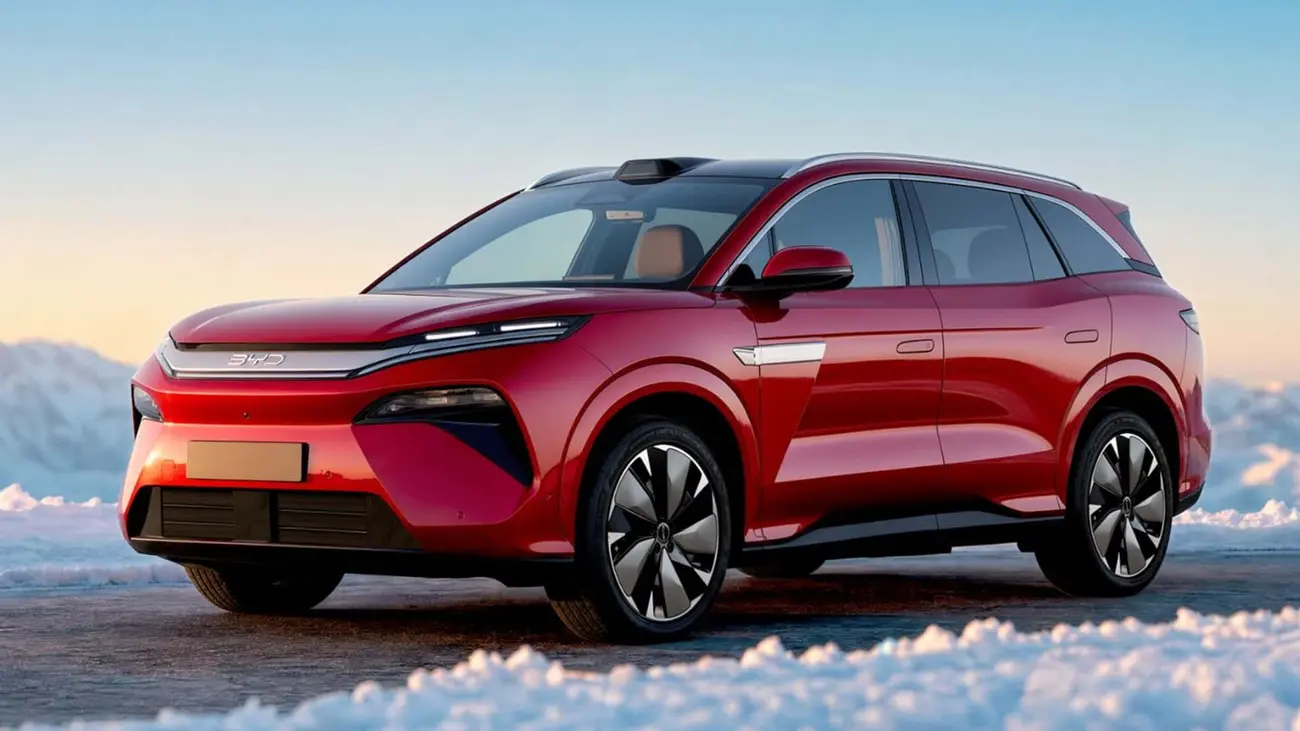
BYD Atto 8 in Portugal: the brand's first 7-seat electric SUV
Nine minutes from 10 to 97%. That is the headline figure BYD brought to the Paris Motor Show on 12 October 2026 to unveil the Atto 8 — the first three-row SUV the brand sells in Europe and its new flagship, sitting above the Atto 2, Atto 3, Sealion 5 and Seal U. Order books open in the first quarter of 2027, and the BYD Atto 8 in Portugal is expected to follow the European timeline.
One thing to clear up first. Search for "BYD Atto 8" and most of what comes back is Brazilian. That Atto 8 is a different car: a plug-in hybrid (DM-p) sold in Brazil for R$ 399,990. The Atto 8 coming to Europe is fully electric, carries a 115 kWh battery and is the European version of the Tang L EV sold in China. Everything below refers to this electric model.
From China's Tang L to Europe's Atto 8
In China the same car is called the Tang L and only comes with five seats. For Europe, BYD has fitted a 2+3+2 layout, giving seven seats as standard. The Chinese Tang L EV costs 222,800 to 272,800 yuan, but that tells us little about what buyers here will pay — taxes, logistics and positioning are entirely different.
This is a properly large SUV:
- Length: 5,040 mm
- Width: 1,996 mm
- Height: 1,760 mm
- Wheelbase: 2,950 mm
Five metres of car is something you will notice in a Lisbon or Porto car park. The upside is that the length makes room for three genuinely usable rows.
There is also some industry chatter: EV Powered suggests the Atto 8 could eventually be built at BYD's plant in Szeged, Hungary, in line with its "in Europe, for Europe" strategy. BYD has not confirmed this.
BYD Atto 8 specs: two versions, one battery
Both versions use the new second-generation Blade battery (LFP chemistry) with 115 kWh — the first BYD in Europe to get it. The difference comes down to drivetrain and power.
| Design (RWD) | Excellence (AWD) | |
|---|---|---|
| Drive | Rear-wheel | All-wheel |
| Power | 462 PS (340 kW) | 775 PS (570 kW) |
| Torque | 365 Nm | 775 Nm |
| 0-100 km/h | about 8.0 s | 4.6 s |
| WLTP range | up to 652 km (405 miles) | up to 602 km (374 miles) |
| Top speed | n/a | 240 km/h |
| Battery | 115 kWh Blade LFP | 115 kWh Blade LFP |
At 775 PS, BYD claims the Atto 8 is the most powerful seven-seat SUV in Europe. It is not the quickest, though: an Audi SQ7 does 0-100 km/h in 4.1 s. For a family, the Excellence is more of a statement than a necessity.
BYD Atto 8 range: what to expect day to day
The Design's 652 km WLTP figure is the one that matters for most buyers. Even allowing for the usual gap between WLTP and real driving — especially at motorway speeds of 120 km/h with a full load of people and luggage — a Lisbon-Porto run (around 310 km) should be doable without stopping, with plenty in reserve. Lisbon to the Algarve is also within reach on a single charge.
The Excellence gives up 50 km of rated range in exchange for all-wheel drive and the extra power. Unless you need 4.6 s to 100 km/h, the Design looks like the more sensible choice.
Flash charging: 5 minutes, with an asterisk
This is the Atto 8's real party trick. With BYD's FLASH Charging system, which delivers up to 1,500 kW (1.5 MW) through a single connector, BYD quotes:
- 10-70%: about 5 minutes
- 10-97%: about 9 minutes
- 20-97% at -30 °C: about 12 minutes
For scale: the fastest chargers currently available in the UK top out at 480 kW. Carwow tested the same technology on the Denza Z9 GT (122 kWh battery) and recorded 10-80% in 6 min 28 s and a full charge in 8 min 57 s — so BYD's numbers are not just lab theory.
Where are the BYD flash chargers in Portugal?
Here is the asterisk. Those times are only possible at BYD's own Flash stations, which are still rare. The brand promises 3,000 stations in Europe by the end of 2027 (6,000 outside China), but has not said how many — or where — will be in Portugal.
In practice, for the first months Atto 8 owners will mostly charge on MOBI.E, Portugal's national public charging network, and at motorway rapid chargers, at far more modest speeds. BYD has not disclosed the Atto 8's peak charging power on conventional DC chargers, which is worth confirming before you buy.
Interior and space: three rows, short boot
Equipment is generous across both versions:
- 15.6-inch central touchscreen with Google built-in (Maps and Assistant)
- 10.25-inch digital instrument cluster and 26-inch head-up display
- 2.39 m² panoramic glass roof
- Tri-zone climate control
- Heated, ventilated and massaging front and outer second-row seats
- Climate-controlled console that cools to -6 °C and warms to +50 °C (Excellence only, according to Carscoops)
- 10-speaker audio (Design) or 21-speaker DiSound (Excellence)
- Two 50 W smartphone chargers and a projection-activated power tailgate
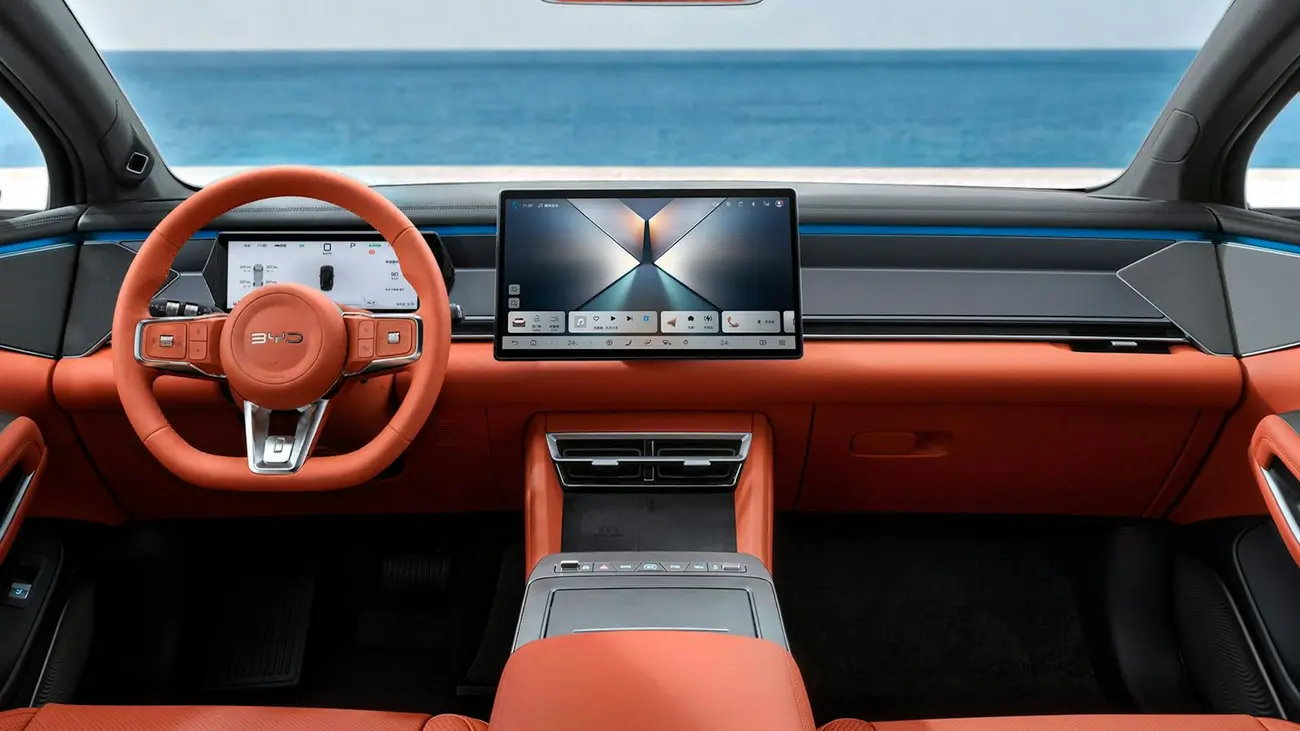
The boot is the weak spot. With all seven seats in use you get 270 litres, rising to 1,960 litres with the second and third rows folded. The 136-litre front trunk (frunk) helps make up for it — enough for the charging cables and a backpack or two.
BYD Atto 8 vs Skoda Peaq and Kia EV9
The declared target is the Skoda Peaq, launched in June 2026, with the Kia EV9 as the other obvious benchmark. The Peugeot e-5008 plays a tier below on price — around €5,000 cheaper than the Peaq.
| BYD Atto 8 | Skoda Peaq | Kia EV9 | |
|---|---|---|---|
| Battery | 115 kWh | 86 kWh net | n/a |
| Max power | 775 PS | 299 hp | n/a |
| Max WLTP range | up to 652 km | up to 644 km | n/a |
| Fast charging | 10-97% in 9 min (Flash) | 10-80% in 28 min (199 kW) | 800 V architecture |
| Boot (7 seats up) | 270 L | 299 L | about 330 L |
| Frunk | 136 L | 37 L | about 90 L |
| Price | TBA | from €56,460 | n/a |
BYD Atto 8 or Skoda Peaq for a family?
On range, the two are practically tied. The differences lie elsewhere. The Peaq is shorter (4,874 mm), has more boot space with seven seats up and is backed by Skoda's dealer network across the country. The Atto 8 answers with far more power, a frunk almost four times bigger and, above all, dramatically faster charging — provided there is a Flash station on your route.
Against the Kia EV9, the Atto 8 gives up around 60 litres of boot space in seven-seat mode but gains 46 litres in the frunk. The EV9 has the advantage of an 800 V architecture, which already makes good use of today's public ultra-fast chargers.
How much will the BYD Atto 8 cost in Portugal?
Pricing has not been announced — not for Portugal, nor for any European market. So we are not going to make up a number. What we do have are clues:
- Carwow estimates a starting price of around £70,000 in the UK.
- BYD's current seven-seat SUV in Europe, the Tang EV, lists at €75,000 in Germany, although BYD's website shows it on promotion at €47,990.
- The Skoda Peaq starts at €56,460 (including tax, before incentives).
Putting the pieces together, it is reasonable to expect the Atto 8 to sit above the Peaq, at least in Excellence form. That said, BYD has a track record of aggressive pricing and strong launch campaigns, so there is plenty of room for surprise.
Taxes and incentives for a 7-seater electric SUV in Portugal
As a fully electric car, the Atto 8 is exempt from ISV (Portugal's one-off vehicle registration tax) and from IUC (the annual road tax). For companies, the purchase price matters: electric cars up to €62,500 are exempt from autonomous taxation (tributação autónoma) on company cars and allow VAT to be deducted. If the final price lands above that threshold — plausible for the better-equipped versions — the tax picture for fleet buyers changes, and that will be a deciding factor for anyone buying through a business.
Frequently Asked Questions
BYD has not yet announced pricing for the Atto 8 in Portugal or any other European market. The best reference points are Carwow's estimate of around GBP 70,000 in the UK and the Tang EV, BYD's current 7-seat SUV, which lists at EUR 75,000 in Germany. Its direct rival, the Skoda Peaq, starts at EUR 56,460, so the Atto 8 is expected to sit above it, especially in Excellence trim.
BYD is targeting the first quarter of 2027 for European order books to open, with deliveries starting in spring 2027. There is no Portugal-specific date yet, but BYD's European launches have typically reached the Portuguese market without major delays. The car was unveiled at the Paris Motor Show on 12 October 2026.
With its 115 kWh Blade battery, the rear-wheel-drive Design version (462 PS) is rated at up to 652 km WLTP, while the all-wheel-drive Excellence (775 PS) is rated at up to 602 km WLTP. Real-world range at 120 km/h motorway speeds with seven occupants will be lower, but a Lisbon-Porto trip (around 310 km) should be comfortably doable on a single charge. For comparison, the Skoda Peaq claims up to 644 km WLTP.
The 10-70% in around 5 minutes (and 10-97% in around 9 minutes) figures are only achievable at BYD Flash stations, which deliver up to 1,500 kW. BYD plans 3,000 of these stations across Europe by the end of 2027 but has not said how many will be built in Portugal. Until then, the Atto 8 will rely on the MOBI.E network and conventional fast chargers at much lower power.
The European Atto 8 is fully electric, with a 115 kWh battery and seven seats (2+3+2) as standard. In China the same car is sold as the Tang L, but only with five seats. The Atto 8 sold in Brazil is a plug-in hybrid (DM-p) priced at R$ 399,990, so Brazilian spec sheets do not apply to the model coming to Portugal.
When will the BYD Atto 8 arrive in Portugal?
BYD is targeting the first quarter of 2027 for European order books, with sales starting in spring. No country-specific dates have been given, but Portugal has generally received BYD's European launches without major delays.
Until then, the 7-seater electric SUV market in Portugal remains thin: Skoda Peaq, Kia EV9, Peugeot e-5008 and little else. The Atto 8 arrives with the fastest charging in its class and power to spare. What we still need to know is the price and how many Flash chargers Portugal will actually get — and those two answers, more than the 775 PS, will decide whether it is worth waiting for.