
New BYD Atto 3: 9-Minute Charging, 517 km Range and Portugal Launch
Published: 30/04/2026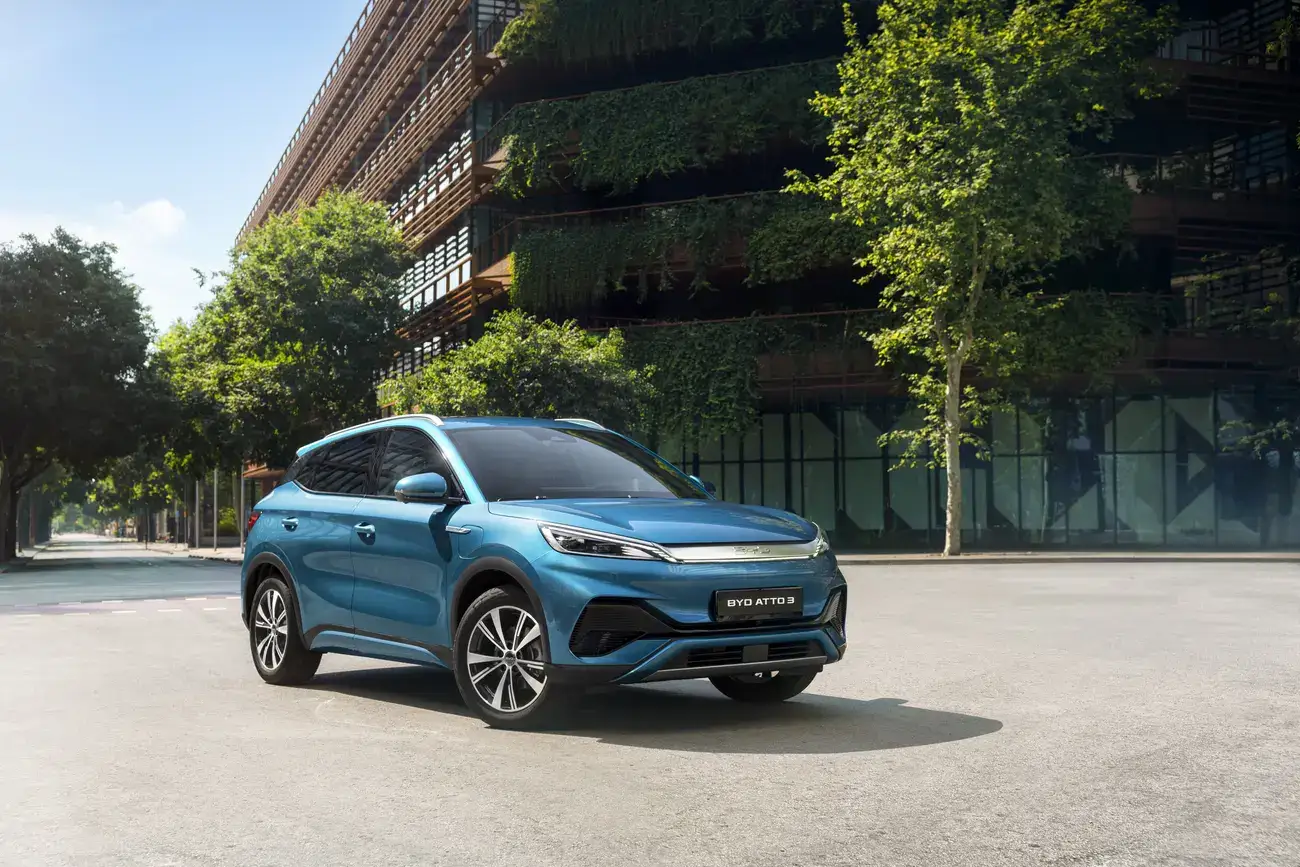
9 minutes to charge from 10 to 97% — what the new BYD Atto 3 brings to the table
Charging an electric SUV from 10 to 97% in 9 minutes. That is the headline promise of the new BYD Atto 3, revealed at Beijing Auto Show 2026 and the Chinese brand's first serious shot at the Peugeot e-3008 and Volkswagen ID.4 in the mid-size EV segment. For buyers in Portugal who still hesitate over charging times, the number is striking — but it is worth understanding the conditions behind it, and when the car actually lands here.
This is the third generation of the model (sold as Yuan Plus in China), fully redesigned and substantially bigger than the version currently on sale in Portugal. After the previous generation collapsed 73.2% year-on-year in Chinese Q1 2026 sales, BYD chose a clean-sheet redesign over a refresh.
What is behind the 9-minute charging claim
The leap comes from BYD's second-generation Blade Battery — LFP chemistry built to accept charging power well above the 220 kW of the current 800V platform. Official numbers:
- 10% to 70% in 5 minutes
- 10% to 97% in 9 minutes
- In cold weather (-30 °C), add roughly 3 minutes
There is one important caveat. These times need ultra-fast chargers that can actually deliver the power. Portugal's MOBI.E network and the Galp, Repsol and Ionity hubs currently top out around 150 to 350 kW. The Atto 3 will use whatever is available, but the headline 9 minutes only happens at next-generation high-output stations. Even so, on a 250 kW charger the new car will be clearly faster than today's Atto 3 Evo, which needs 25 minutes for 10 to 80%.
Two batteries, two ranges — rear-wheel drive only
BYD launches the new Atto 3 with two LFP battery options, both rear-wheel drive at debut:
| Version | Battery | Power | CLTC range | WLTP range |
|---|---|---|---|---|
| Base | 57.545 kWh | 200 kW (268-272 hp) | 540 km | 443 km |
| Top | 68.547 kWh | 240 kW (322-326 hp) | 630 km | 517 km |
The 517 km WLTP figure on the top variant puts the Atto 3 among the segment leaders. For a Lisbon-Porto run — about 320 km of motorway — there is healthy margin even at 120 km/h with the air conditioning on. The base version's 443 km WLTP is still enough for everyday Portuguese driving, with occasional stops on longer trips.
Bigger, roomier, closer to a Tesla Model Y
The new generation grows noticeably and now sits much closer to the Tesla Model Y in footprint, where the outgoing Atto 3 was a smaller compact SUV.
- Length: 4,665 mm (+210 mm vs predecessor)
- Width: 1,895 mm (+20 mm)
- Height: 1,675 mm (+60 mm)
- Wheelbase: 2,770 mm (+50 mm)
- Kerb weight: 1,690 kg
- Boot: 750 litres + 180-litre frunk (front trunk)
The 750-litre boot is a major step up from the 490 litres in today's Atto 3 Evo. For a family juggling luggage, a stroller and weekly groceries, the Atto 3 becomes a real alternative to the ID.4 (543 L) and the e-3008 (520 L).
Tech: LiDAR, "God's Eye" ADAS and a built-in fridge
BYD used the redesign to load the Atto 3 with kit usually reserved for segments above:
- DiPilot 300 — LiDAR-based driver assistance (called "God's Eye" in China), with advanced motorway assist functions
- 16-speaker audio
- Built-in fridge with both heating and cooling modes
- Ambient lighting in 256 colours
- Dual 50 W wireless chargers
- Head-up display
- Two-spoke steering wheel with column-mounted gear selector
The open question is how much of this list crosses to Europe. BYD has historically kept tech packages largely intact on European models, but some LiDAR functions still depend on local homologation.
BYD Atto 3 vs Peugeot e-3008 vs VW ID.4: how it stacks up
Portugal's mid-size electric SUV segment is getting crowded. The main rivals the new Atto 3 will face:
| Model | Usable battery | WLTP range | Max DC charge | Boot |
|---|---|---|---|---|
| BYD Atto 3 (new, top) | 68.5 kWh | 517 km | flash (10-97% in 9 min) | 750 + 180 L |
| Peugeot e-3008 Long Range | 73 kWh | 700 km | 160 kW | 520 L |
| VW ID.4 Pro | 77 kWh | 550 km | 175 kW | 543 L |
| Tesla Model Y RWD | 60 kWh | 500 km | 175 kW | 854 L |
The e-3008 wins on raw range in Long Range trim, but loses clearly on charging speed. The ID.4 is the more balanced all-rounder but has fallen behind on tech. The Atto 3's strongest argument is charging time — if a family is driving Lisbon-Algarve, stopping for 9 minutes instead of 25 to 30 changes the entire trip.
When does the new BYD Atto 3 arrive in Portugal
Here is the bad news. Chinese orders open in mid-2026, and BYD plans the European launch only for late 2027 or early 2028. Until then, what is sold in Portugal stays the previous-generation Atto 3 Evo, with its 74.8 kWh battery, 800V platform and 220 kW charging (10-80% in 25 minutes).
No official pricing yet. For reference, the current Atto 3 Evo starts at around £38,990 in the UK (close to 46,000€ in the EU). The new generation, being bigger and more advanced, should land above 45,000-50,000€ in Portugal — though Portugal's ISV (vehicle purchase tax) exemption and reduced IUC (annual road tax) for EVs continue to help the segment's appeal.
Frequently Asked Questions
Chinese orders open in mid-2026 and the European launch is planned for late 2027 or early 2028. Until then, what is sold in Portugal remains the previous-generation Atto 3 Evo, with its 74.8 kWh battery, 800V platform and 220 kW charging (10-80% in 25 minutes).
Official pricing has not been announced. For reference, the current Atto 3 Evo starts at around £38,990 in the UK (close to 46,000€ in the EU). The new generation, being bigger and more technologically advanced, should start above 45,000-50,000€ in Portugal — while still benefiting from the ISV exemption and reduced IUC road tax applicable to electric vehicles.
The top variant delivers 517 km WLTP (630 km on the Chinese CLTC cycle) from a 68.547 kWh LFP battery, while the base version reaches 443 km WLTP (540 km CLTC) with 57.545 kWh. Driving realistically at 120 km/h on a Portuguese motorway, the top version can cover Lisbon-Porto (roughly 320 km) without a charging stop.
The 9-minute 10-97% claim requires ultra-fast chargers delivering over 500 kW, which do not yet exist in Portugal. The MOBI.E network and Galp, Repsol and Ionity hubs currently top out at 150 to 350 kW. Even so, on a 250 kW charger the new Atto 3 will be clearly faster than the 25 minutes needed by the current Atto 3 Evo.
The Peugeot e-3008 Long Range has more raw range (700 km WLTP vs 517 km) but charges much slower (160 kW DC). The VW ID.4 Pro sits in the middle with 550 km WLTP and 175 kW. The new Atto 3's strongest argument is charging time and a 750 + 180-litre frunk boot, clearly larger than the e-3008's 520 L and the ID.4's 543 L.
Is it worth waiting?
For anyone who needs a car now, the current Atto 3 Evo is a solid pick with 510 km WLTP and a known price. For anyone who can wait 18 to 24 months and genuinely values charging time, the new generation looks like a real step up — provided Portuguese infrastructure catches up with the 500+ kW that Blade Battery 2.0 needs to actually deliver the promised 9 minutes. The next few months should bring more detail on European pricing and equipment, and BYD's announcements through year-end are worth watching.