
BYD Atto 3 Evo vs Renault Scénic E-Tech in Portugal: Which EV to Buy?
Published: 14/11/2026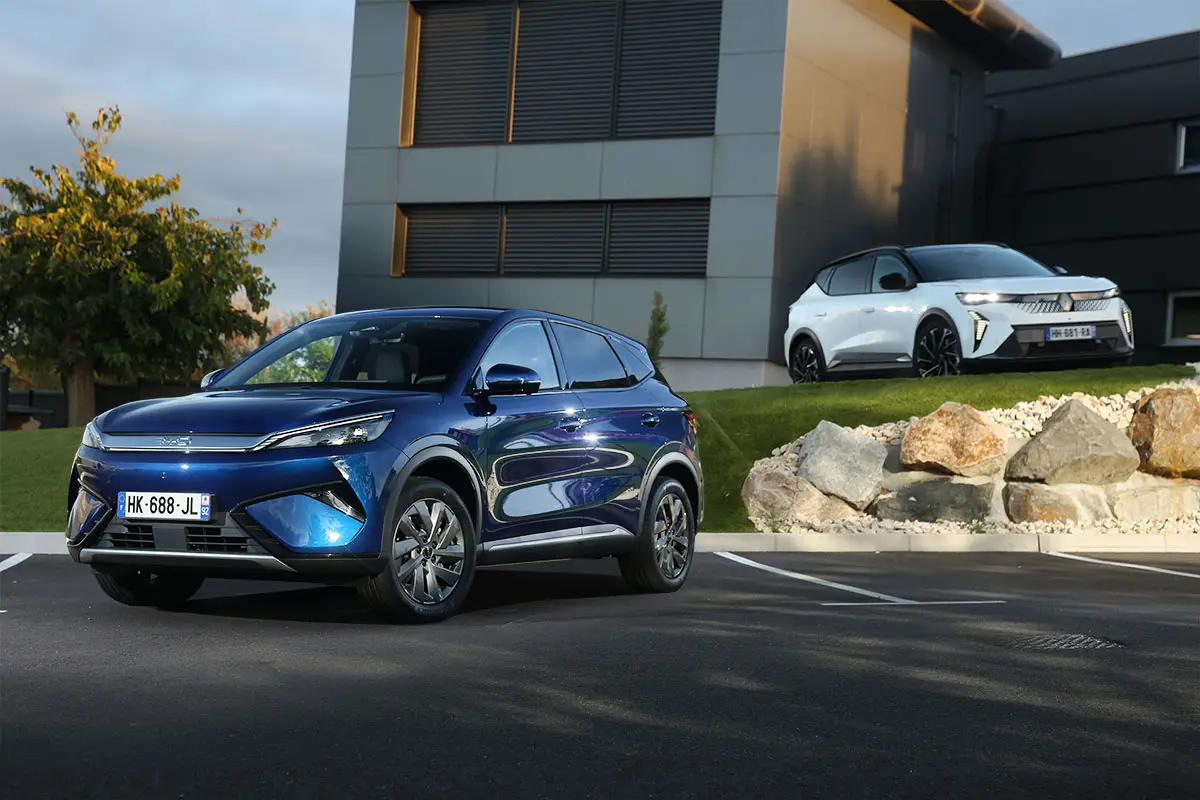
BYD Atto 3 Evo vs Renault Scenic in Portugal: two electric SUVs, two philosophies
They are almost exactly the same length: 4.455 m against 4.47 m. Nearly everything else sets them apart. The BYD Atto 3 Evo now has rear-wheel drive, 313 hp and 220 kW charging. The Renault Scénic E-Tech counters with a bigger battery, a more comfortable ride and Google built into its infotainment. If you're shopping for a compact electric SUV in Portugal, these two will almost certainly end up on your shortlist together.
To compare the BYD Atto 3 Evo vs Renault Scenic in Portugal, we used Bevolt's back-to-back test in France, electrive.com's reviews and the manufacturers' official data. We added the Portuguese prices we could confirm. The short answer: it depends heavily on how much motorway driving you do each month.
| BYD Atto 3 Evo Design (RWD) | Renault Scénic E-Tech 220 Long Range | |
|---|---|---|
| Length / wheelbase | 4,455 mm / 2,720 mm | ~4,470 mm / 2,790 mm |
| Drive | Rear-wheel, 1 motor | Front-wheel, 1 motor |
| Power / torque | 230 kW (313 hp) / 380 Nm | 160 kW (218 hp) / 300 Nm |
| 0-100 km/h | 5.5 s | n/a |
| 80-120 km/h (Bevolt test) | 3.6 s | 5.4 s |
| Battery | 74.8 kWh LFP Blade (~72 kWh usable) | 87 kWh NMC (89 kWh for MY27) |
| WLTP range | 510 km | 625 km (642 km for MY27) |
| WLTP consumption | 16.4 kWh/100 km | 16.8 kWh/100 km |
| DC charging (peak) | 220 kW | 150 kW |
| AC charging | 11 kW | 11 kW (22 kW optional) |
| Boot | 490 L + 101 L frunk | 545 L (official) |
| Weight | 1,880 kg | under 1,900 kg |
| Built in | China | Douai, France |
How much each one costs in Portugal
BYD Atto 3 Evo price in Portugal
The Atto 3 Evo arrived in Portugal in a single version, the rear-wheel-drive Design, with a recommended retail price of €43,990. The business price is €35,770 + VAT, which lines up with the retail figure. Portuguese press has also reported €33,900 + VAT tied to promotional campaigns, so ask the dealer which offers are currently running.
The all-wheel-drive Excellence (449 hp, 0-100 km/h in 3.9 s) is sold in other markets but isn't part of the Portuguese line-up. That's no great loss. Even Auto Express, which tested the Excellence, concluded that the Design is the smarter buy.
Renault Scenic E-Tech price in Portugal
The Scénic is harder to pin down. At launch, the Portuguese range started at €40,690 for the 170 hp version with the 60 kWh battery. The 220 versions with the 87 kWh battery went past €50,000 in the higher trims (around €52,650 to €52,990 for the Iconic, depending on the source).
There's no confirmed Portuguese price yet for the updated Scénic with the 89 kWh battery. In France, Renault has repositioned it at €38,750, and the upcoming 67 kWh LFP version will cost €31,750. That hints at lower prices once the update reaches Portugal, but for now treat any figure as indicative and check Renault's configurator.
In practice, an Atto 3 Evo at €43,990 undercuts a similarly equipped Scénic 220 on the current price list. If Renault repeats the French repositioning here, that advantage could shrink or vanish.
Tax: a draw
Both are fully electric, so both are exempt from ISV (Portugal's vehicle purchase tax) and IUC (the annual road tax). For company buyers, both sit below the €62,500 cap that allows VAT to be deducted and avoids autonomous taxation (tributação autónoma), so tax won't decide this one.
Real-world range: where the Scénic wins
On paper the Renault has a 115 km advantage (625 vs 510 km WLTP), rising to 132 km with the new 89 kWh battery. In Bevolt's test the real-world gap was smaller, but it didn't go away:
| Estimated range (test) | BYD Atto 3 Evo | Renault Scénic E-Tech (87 kWh) |
|---|---|---|
| Mixed consumption | ~17 kWh/100 km | ~18 kWh/100 km |
| Motorway consumption | ~24 kWh/100 km | ~25 kWh/100 km |
| Real-world mixed range | ~415 km | ~480 km |
| Real-world motorway range | ~295 km | ~345 km |
The BYD is slightly more efficient, but the Scénic's bigger battery counts for more. electrive.com reached similar numbers with the Atto 3 Evo: an average of 17.7 kWh/100 km, implying about 420 km of real range, with a best result of 485 km.
BYD Atto 3 Evo real-world range on the motorway
Around 295 km at motorway speeds is the BYD's weak spot. Lisbon to Porto on the A1 is roughly 310 km, so you'll need a stop on the way even if you leave home fully charged. The Scénic's ~345 km is enough for the same trip without charging, though with little to spare. For daily driving (commuting around Lisbon or Porto, school runs, errands) either car will cover a full week on one charge at home.
Fast charging: BYD Atto 3 Evo vs Scenic
This is where the Atto 3 Evo made its biggest leap. The old Atto 3 charged at 110 kW and took about 44 minutes from 10 to 80%. The Evo claims a 220 kW peak and 10-80% in 25 minutes, and electrive.com briefly measured 225 kW.
Bevolt was less generous. Its best real-world time was 28 minutes, and the car often stayed below 150 kW. The 87 kWh Scénic peaks at 150 kW, averaged about 101 kW and took around 37-38 minutes from 10 to 80%. Even so, the Renault's charging curve was described as more consistent.
The new 89 kWh Scénic keeps the 150 kW peak but improves the curve: 15 to 80% now takes 28 minutes, down from 37. On a fast charger on the MOBI.E network (Portugal's national public charging network), that brings the two cars much closer.
A 500 km trip: one stop against two
The calculation that matters most for long-distance drivers comes from Bevolt's 500 km motorway trip:
- Renault Scénic: about 5h00, with one charging stop.
- BYD Atto 3 Evo: about 5h10, with two stops.
Faster charging isn't enough to make up for the smaller battery. It's only 10 minutes, but it's one more stop and one more charger you need to find free.
Space and boot for a family
From the outside you can barely tell them apart. Inside, the Scénic has 7 cm more wheelbase (2.79 vs 2.72 m), but testers found slightly more rear legroom in the BYD.
For luggage, Renault officially quotes 545 litres for the Scénic, more than the BYD's 490 L. Bevolt measured only 440 L in the Renault, which probably reflects a different measuring method. The Scénic also has deep underfloor storage and a 40/20/40 split rear seat, but the opening is narrower and the loading lip is high.
The BYD's ace is up front: a 101-litre frunk, which holds the charging cables and a backpack without eating into boot space. With the seats folded, the Atto 3 Evo offers 1,360 L. It can also tow 1,500 kg and has V2L up to 3.3 kW, so you can power electrical devices from the car. The Scénic answers with 11 kW bidirectional charging.

Behind the wheel: comfort against performance
With 313 hp and rear-wheel drive, the BYD is clearly the quicker car. It goes from 80 to 120 km/h in 3.6 s against 5.4 s for the Renault, which you'll notice when overtaking on a national road. Rear-wheel drive also helps in the rain, and the steering stays cleaner under acceleration than in the old front-drive Atto 3.
The price of that performance is the suspension. The Atto 3 Evo rides firmly, so it's more agile but less comfortable. electrive.com also noted wind noise above 130 km/h. The Scénic soaks up broken tarmac better, brakes better and is clearly set up for long distances.
Does the BYD Atto 3 Evo have one-pedal driving?
No, and it's one of the most frequent criticisms. The BYD has two regeneration levels, both mild, and it won't stop the car without the brake pedal. The Scénic has paddles to adjust regen and full one-pedal driving, a real advantage in city traffic.
Tech and ergonomics
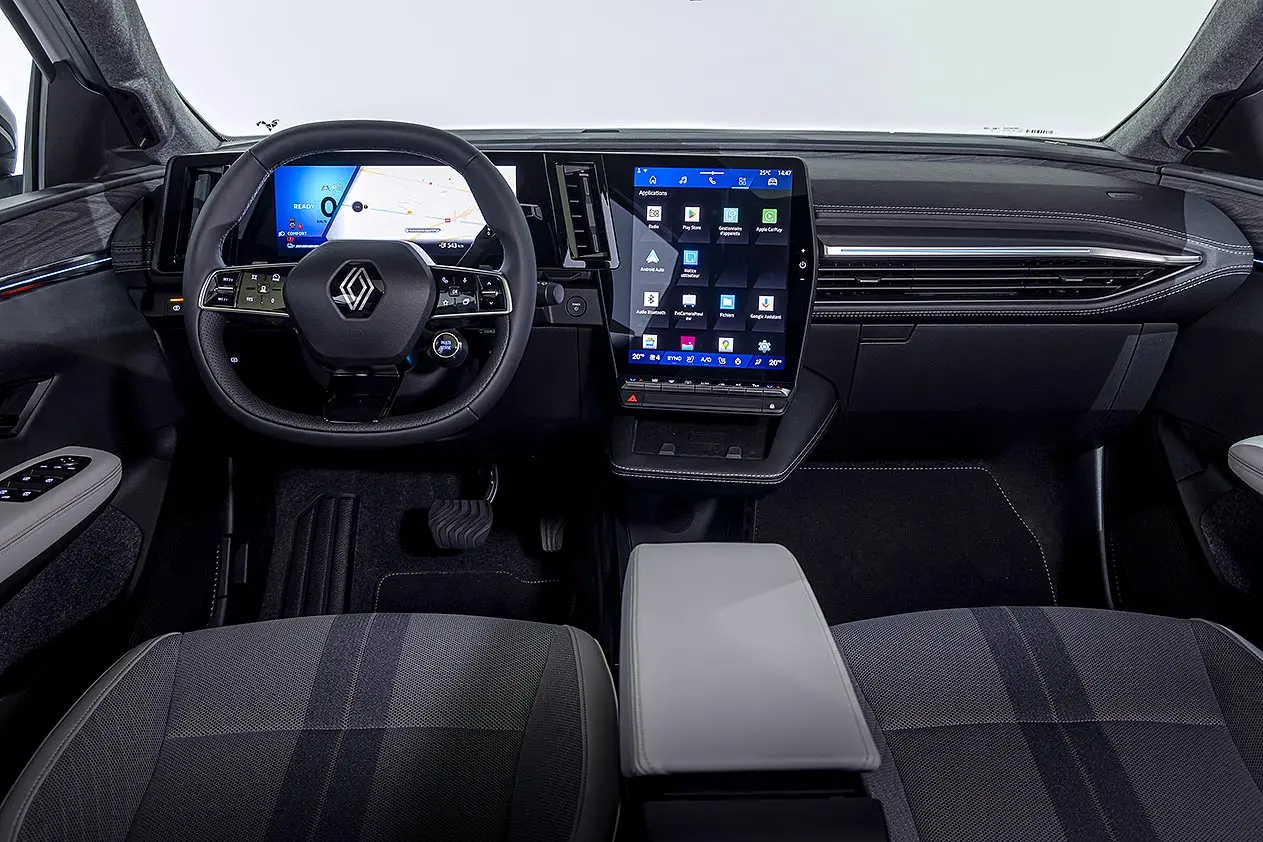
The Atto 3 Evo's cabin has grown up: a larger screen, a cooled wireless charging pad and physical buttons for climate and drive modes. Even so, its route planner is weak and its traffic-sign recognition is unreliable, according to electrive.com. Switching off the driver aids means digging through menus.
The Scénic is in a different league here. Its openR Link system has Google built in, Google Maps with charging-stop planning and now Gemini as a voice assistant. There's also a dedicated button to switch off driver aids as soon as you set off, a small detail you'll appreciate every day.
On warranty, BYD offers 6 years on the vehicle and 8 years or 250,000 km on the battery, with a minimum of 70% capacity.
Frequently Asked Questions
In Portugal the BYD Atto 3 Evo comes in a single rear-wheel-drive Design version at €43,990 (€35,770 + VAT for businesses), and campaign offers of €33,900 + VAT have been reported. The Scénic E-Tech range started at €40,690 (170 hp, 60 kWh), while better-equipped 220 versions with the 87 kWh battery went past €52,000. There is no confirmed Portuguese price yet for the new 89 kWh Scénic. In France it dropped to €38,750, so check Renault's configurator before deciding.
BYD claims 25 minutes for 10-80% with a 220 kW peak, but in Bevolt's test the best real-world time was 28 minutes and the car often stayed below 150 kW. That is still a big step up from the old Atto 3, which took around 44 minutes at 110 kW. The 87 kWh Scénic needs 37-38 minutes, while the new 89 kWh version does 15-80% in 28 minutes. On AC, both accept 11 kW (22 kW optional on the Scénic).
The Scénic E-Tech is the better motorway car. It offers 625 km WLTP (642 km with the 89 kWh battery) and about 345 km of real motorway range, against 510 km WLTP and about 295 km for the BYD. On a 500 km motorway trip, Bevolt recorded one stop and about 5h00 for the Renault, against two stops and 5h10 for the Atto 3 Evo. On a Lisbon-Porto run via the A1 (about 310 km), the Scénic can make it without charging, though with little margin, while the BYD will need to stop.
Yes, and tax won't decide between them. Both sit below the €62,500 cap that allows VAT to be deducted and avoids autonomous taxation (tributação autónoma), and as fully electric cars both are exempt from ISV and IUC. The BYD's business price is €35,770 + VAT. For the Scénic, the final figure will depend on the version and on the Portuguese price of the 89 kWh model.
At current prices, the Atto 3 Evo gives you more for your money: 313 hp, 0-100 km/h in 5.5 s, a 490 L boot plus a 101 L frunk, and an 8-year or 250,000 km battery warranty. The Scénic E-Tech costs more but makes up for it with longer range, one-pedal driving, better comfort and openR Link with built-in Google. If the 89 kWh Scénic reaches Portugal with a price cut similar to France's, the BYD's advantage shrinks.
BYD Atto 3 Evo or Renault Scénic E-Tech: which one to choose
Choose the BYD Atto 3 Evo if you want the most car for your money, enjoy a quick car and need the extra storage of the frunk. It suits drivers whose miles are mostly urban and suburban, with the occasional long trip.
Choose the Renault Scénic E-Tech if you drive on the motorway often, value comfort and one-pedal driving, and want the better navigation system of the two. If you drive Lisbon-Porto or Lisbon-Algarve every month, the bigger battery and one fewer stop make a difference.
Bevolt gives the overall win to the Scénic as the more complete car, and the value-for-money win to the Atto 3 Evo. We agree, with one Portuguese caveat: it all depends on the price the 89 kWh Scénic arrives at here. If it follows the price cut seen in France, the Renault becomes hard to beat. If not, the BYD's €43,990 remains a very strong argument.