
Bontu Electric Microcar in Portugal: Price and Specs
Published: 25/06/2026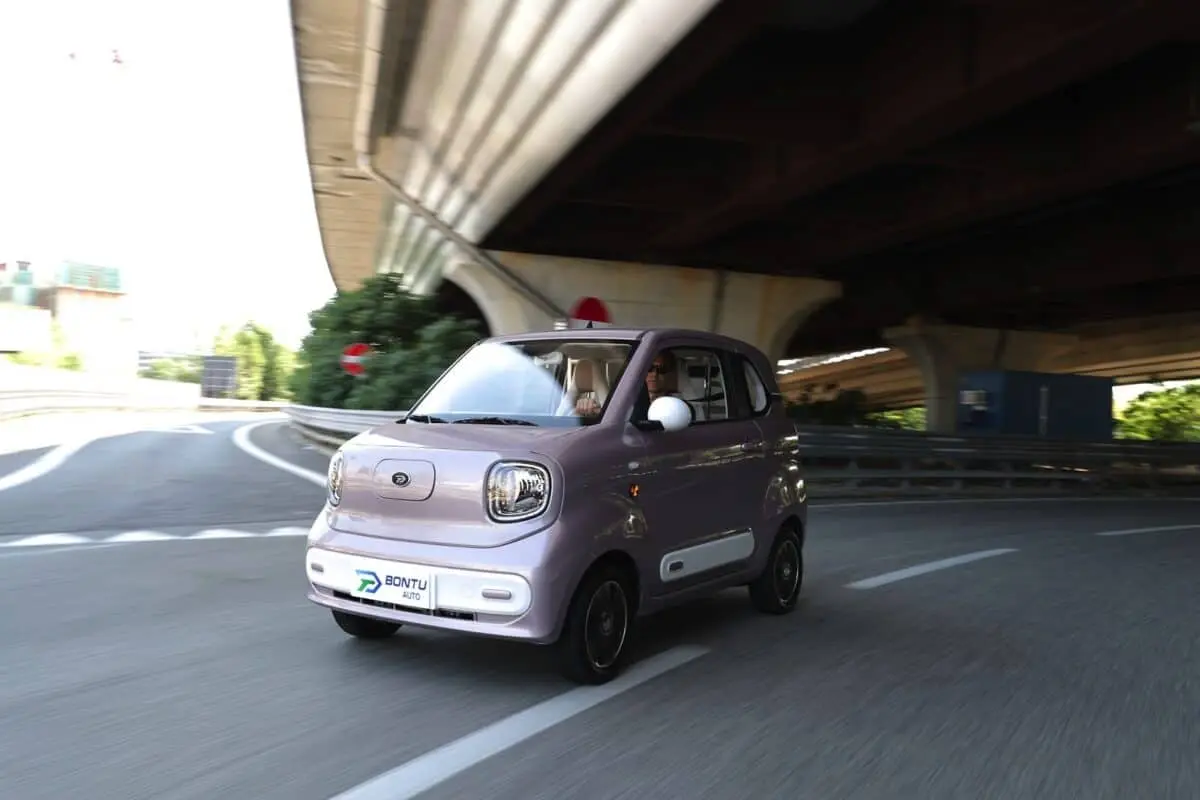
Who is Bontu, and why Italy first
There's a new Chinese carmaker testing the European waters — but not with SUVs or saloons. Bontu, a name you've almost certainly never heard, has bet on electric microcars: those tiny quadricycles that squeeze in anywhere and can be driven from age 14 or 16. The reveal was in Milan, on 22 May 2026, and the Bontu electric microcar reaches Europe with three models: two city runabouts (the BTE05 and BT09) and a small commercial van (the BTE03).
The brand belongs to Shandong Bentu New Energy Vehicle Industry and was founded in March 2020 in Xintai, in China's Shandong province. Italy is the chosen base for southern Europe: it already has an Italian subsidiary and a spare-parts warehouse running in Ancona. The logic holds — in southern markets, with tight city centres and low-emission zones spreading fast, a three-metre car has an audience.
The tariff play: why Bontu dodges the import taxes
Here's the strategic detail that explains everything. The anti-dumping tariffs the EU slapped on Chinese electric cars — the ones that pushed up the price of models from BYD, MG and the rest — do not apply to L6e and L7e quadricycles. Bontu homologated its entire range under EU Regulation 168/2013, the same category as the Citroën Ami. The result: it enters Europe without the tax burden holding back the other Chinese brands, and with far lower homologation and distribution costs than a full car carries.
It's a clever side door. While Brussels argues over tariffs on Chinese cars, microcars slip in under the radar. For the buyer, that translates into something simple: prices starting at €9,500.
Bontu BT09: the Citroën Ami alternative with double the range
The BT09 is the entry model and the most interesting for anyone after a no-licence electric microcar in Portugal. It measures 2.75 metres — 25 cm shorter than its bigger sibling — and comes in two versions.
The L6e version carries a 7.68 kWh battery, covers 130 km, tops out at 45 km/h and can be driven from age 14 with an AM licence. That's the light-quadricycle setup, the most accessible one. The L7e version steps up to 10 kWh, 150 km of range, 75 km/h and four seats, but requires you to be 16 with a B1 licence. Both use a 6 kW rated / 12 kW peak permanent-magnet synchronous motor and charge in roughly 3 hours from a household socket.
The point that sets it apart is range. The Citroën Ami and Fiat Topolino, the obvious rivals, manage around 75 km. The BT09 promises nearly double — 130 to 150 km — for a comparable price, between €9,500 and €11,000. If you only use the car in town, that extra range means charging half as often.
Bontu BTE05: three metres, up to 222 km and the range-topper
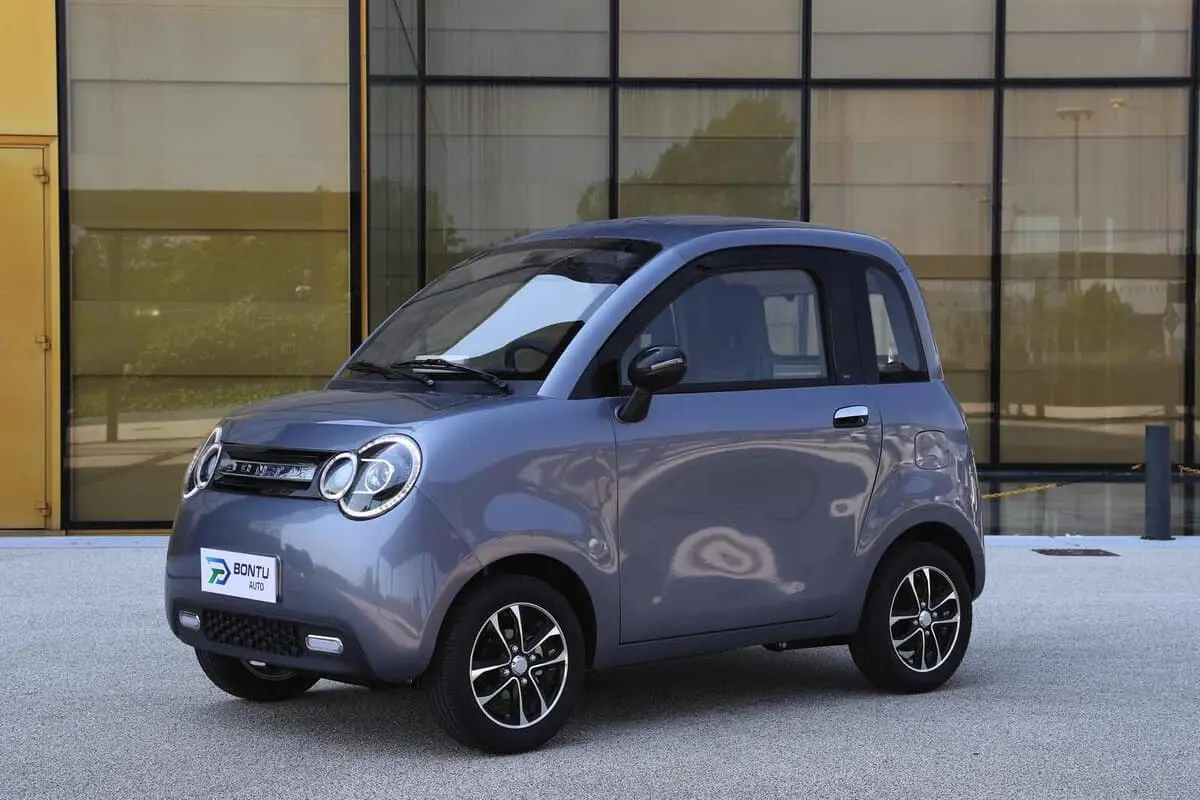
The BTE05 is the most serious microcar in the lineup. It's three metres long, 1.50 wide and 1.63 tall, and Bontu claims interior space comparable to an A-segment city car. It's homologated as an L7e (heavy quadricycle), driven from age 16 with a B1 licence, and offered with two or four seats.
Range is the selling point. There are two batteries: 13.9 kWh for 170 km, or 18.1 kWh for 222 km. For a quadricycle, 222 km is a striking figure — enough for a week of city errands without plugging in. Top speed sits at 90 km/h and the motor delivers up to 30 kW peak. Fast charging recovers 30 to 80% in about 65 minutes.
| Specification | BTE05 | BT09 L6e | BT09 L7e | BTE03 |
|---|---|---|---|---|
| EU category | L7e | L6e | L7e | L7e-CU |
| Length | 3.00 m | 2.75 m | 2.75 m | 3.56 m |
| Battery | 13.9 / 18.1 kWh | 7.68 kWh | 10 kWh | 8.35 kWh |
| Range | 170 / 222 km | 130 km | 150 km | 80-100 km |
| Top speed | 90 km/h | 45 km/h | 75 km/h | 81 km/h |
| Seats / payload | 2 or 4 | 2 | 4 | 340 kg |
| Min age / licence | 16 / B1 | 14 / AM | 16 / B1 | — |
| Indicative price (IT) | €14,000-17,000 | €9,500-11,000 | €9,500-11,000 | €12,000-14,000 |
Inside, the BTE05 isn't as bare as the category might suggest: ABS, electronic brake distribution, a driver airbag, air conditioning, a rear camera, parking sensors and a 12-inch touchscreen (plus a second 7" display). The cell uses 60% high-strength steel. Bontu positions it directly against the Ligier Myli, Opel Rocks-e and Microlino — and with 222 km, it out-ranges all of them.
Bontu BTE03: the last-mile commercial van
The third model is the BTE03 commercial van, built for urban deliveries. It's 3.56 m long, carries 340 kg of cargo and comes as a pickup, truck or cargo van. The 8.35 kWh battery gives 80 to 100 km, the 7.5 kW motor produces 60 Nm and top speed is 81 km/h. It charges to 80% in 90 minutes and fully in 3 hours.
It's not a car for the ordinary buyer — it has only a driver's door, with rear and side doors optional — but it makes sense for florists, caterers or couriers working inside a city who want to escape the running costs of a diesel van.
Frequently Asked Questions
There are no official Portuguese prices yet, but in Italy the Bontu BTE05 starts at €14,000 and runs to about €17,000 depending on the battery (13.9 kWh/170 km or 18.1 kWh/222 km). The smaller BT09 costs between €9,500 and €11,000. Because it is homologated as an L7e quadricycle, it sidesteps the EU anti-dumping tariffs on Chinese electric cars, which helps keep the price low.
It depends on the model: the BTE05 offers 170 km (13.9 kWh battery) or up to 222 km (18.1 kWh), while the BT09 covers 130 km (L6e version) or 150 km (L7e). That's nearly double the roughly 75 km of the Citroën Ami and Fiat Topolino, and the BTE05's 222 km out-ranges rivals such as the Ligier Myli, Opel Rocks-e and Microlino.
The BT09 in L6e form can be driven from age 14 with an AM licence (in Portugal, from 16 with the same AM licence). The more powerful versions — BT09 L7e and BTE05 — are L7e heavy quadricycles and require you to be 16 with a B1 licence. They top out at 45 km/h (L6e) or up to 90 km/h (BTE05) and are not allowed on motorways.
The BT09 sits in the same L6e/L7e category as the Citroën Ami and Fiat Topolino and is similarly priced (€9,500 to €11,000), but offers nearly double the range — 130 to 150 km versus the Ami's ~75 km. The L7e version also adds four seats and a 75 km/h top speed, making it a more capable alternative for anyone who needs a microcar strictly for city use.
Nothing is official for Portugal yet — Bontu set up in Italy, with a parts warehouse in Ancona, and is expected to roll out across southern Europe first. A European CKD assembly plant is planned, with site selection by the end of 2026 and series production between late 2027 and early 2028. The whole range carries a 3-year or 50,000 km warranty, and Portugal's legal framework for quadricycles already exists and works in its favour.
Will it reach Portugal? What we know (and don't)
The inevitable question: what about Portugal? For now, nothing official. Bontu set up shop in Italy and its parts warehouse is in Ancona, which points to a southern-Europe rollout before it gets here. There's also a European CKD assembly plant on the horizon — site selection by the end of 2026 and series production between late 2027 and early 2028, according to the Italian press.
In Portugal, the legal framework already exists and works in its favour: an L6e can be driven from age 16 with an AM licence, and the Italian prices (from €9,500) would be competitive in our market, where the Citroën Ami has already opened the door for this category. The whole range comes with a 3-year or 50,000 km warranty. (For context, an L6e is the lightest quadricycle class and ISV — Portugal's vehicle registration tax — barely touches these tiny EVs.)
There is one honest catch, though: these cars don't do motorways. Above 70 km/h the suspension starts transmitting wobbles, according to those who drove them in Milan, and the top speed rules out any longer trip. They're city cars, full stop. For anyone who needs exactly that — and only that — Bontu brings more range and a lower price than the established competition. Worth keeping an eye on the next price announcements and on whether a Portuguese importer steps forward.