
BMW M3 Electric in Portugal: Same Price as the Combustion G84
Published: 17/05/2026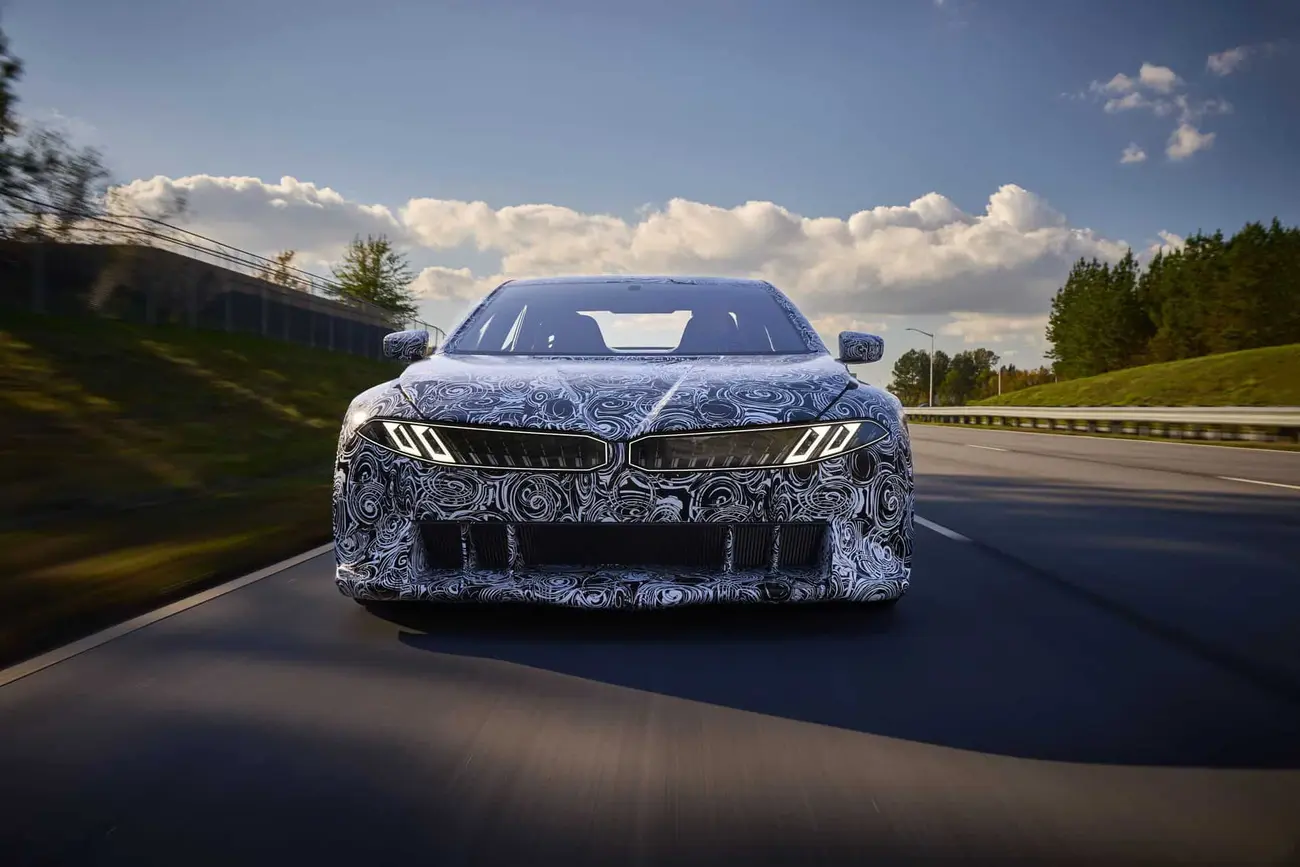
BMW M3 electric at the same price as the combustion version: customer picks
One thousand electric horsepower or 552 hp from a straight-six, for the same money. That is BMW M's bet for the next-generation M3, and it may be the brand's boldest product decision in decades. Sylvia Neubauer, BMW M's Vice President of Customer, Brand and Sales, told Autocar the electric version (codename ZA0) and the combustion version (G84) will sit "in the same ballpark" on price. For Portuguese buyers, that translates simply: the electric M3 will not carry the premium-EV surcharge that usually punishes electric models in this segment.
The play is interesting. Instead of nudging customers into the EV with discounts, or keeping the combustion version as the cheaper purist option, BMW puts both on the table without an economic bias. If you want the twin-turbo inline-six, you pay X. If you prefer four electric motors and a thousand horsepower, you pay roughly the same.
What we know about the BMW M3 ZA0 (electric)
The electric M3 lands in 2027 — production starts in March that year according to figures reported by BMW BLOG. It sits on the new Neue Klasse platform, shared with the upcoming i3, and uses a quad-motor architecture with one motor per wheel. Top-spec output is projected near 1,000 hp (1,014 PS), with base versions likely launching in the 700 to 800 hp range.
This architecture unlocks things no combustion M3 has ever done: per-wheel torque vectoring, a pure rear-wheel-drive mode that decouples the front motors, and a shorter front end now that no inline-six needs space under the hood. The gearbox is single-speed with simulated shifts to preserve M-car feel — a divisive choice among purists, but consistent with what other premium brands are trying.
BMW M3 EV vs ICE: direct comparison
| Spec | M3 electric (ZA0) | M3 combustion (G84) |
|---|---|---|
| Platform | Neue Klasse (dedicated EV) | Updated CLAR |
| Power | around 800 to 1,000 hp | about 552 hp (560 PS) |
| Engine | Quad-motor (4 motors) | 3.0L twin-turbo I6 S58 plus mild hybrid |
| Drive | AWD with RWD mode | xDrive AWD only |
| Transmission | Single-speed with simulation | Automatic (manual likely dropped) |
| Production start | March 2027 | July 2028 |
| Interior | Panoramic iDrive | Panoramic iDrive |
The power gap is enormous — more than 400 hp separating the two — but BMW insists the M experience is not measured in horsepower alone. "It's not only about acceleration and power, it's about drivability, manoeuvrability and that level of trust," Neubauer said.
The M3 G84: the inline-six survives
Anyone expecting the combustion M3 to disappear once the EV arrives is mistaken. The G84 enters production in July 2028 and keeps the S58, the familiar 3.0-litre twin-turbo straight-six, now paired with a mild-hybrid system to meet Europe's tougher Euro 7 rules. The projected 552 hp is a step up from the current M3 Competition's 510 hp, which signals BMW is still investing in combustion.
The pricing benchmark is what matters here. Today's G80 base model costs 96,500 euros in Germany — but that is the manual rear-wheel-drive version, a configuration the G84 will almost certainly skip. The realistic reference point is the current M3 Competition xDrive at 107,600 euros in Germany. Start there to imagine what the G84 — and by extension the ZA0 — will cost.
How much will the BMW M3 electric cost in Portugal
This is where the math gets interesting for Portuguese buyers. The current M3 in Portugal starts above 130,000 euros once full VAT is applied on top of the German list price (no ISV vehicle tax applies to combustion-engine performance models in the same way as smaller ICE cars, but full VAT still hits). For the next generation, a reasonable estimate looks like this:
- M3 G84 combustion in Portugal: from 130,000 to 140,000 euros, depending on options and the typical generational price bump.
- M3 ZA0 electric in Portugal: in the same bracket on paper, but with meaningful tax advantages — ISV exemption (ISV is Portugal's vehicle registration tax, and on a performance combustion model it adds up to tens of thousands of euros), reduced IUC road tax, and VAT deduction for company vehicles in certain cases.
This is where factory-gate price parity becomes asymmetric in favour of the EV. If BMW charges the same ex-works, the Portuguese buyer ends up paying significantly less for the ZA0 once local taxes are layered on. In practice, the electric version could land 15,000 to 25,000 euros cheaper than the combustion equivalent in our market — even though the headline "BMW price" is the same.
Is it worth waiting for the BMW M3 electric?
Depends on the buyer. If you value the sound of the inline-six, the mechanical sensation of a real auto box swapping ratios, and you want to drive away in 2025 or 2026, the current G80 or the upcoming G84 make more sense. If you want raw performance, tax efficiency in Portugal, and you can wait until 2027, the ZA0 offers something no previous M car has: a thousand horsepower with green plates.
There is also a third factor: infrastructure. Portugal's MOBI.E charging network has grown a lot, and motorway fast charging is no longer a problem for a Lisbon-Porto run. But a 1,000 hp M3 with a heavy right foot will drain a battery quickly — real-world range under sporting driving remains an unknown until BMW publishes WLTP figures.
Frequently Asked Questions
BMW has confirmed that the electric M3 (ZA0) and combustion M3 (G84) will be priced in the same ballpark ex-works, with the benchmark sitting at the current M3 Competition xDrive's 107,600 euros in Germany. In Portugal this should translate to a window between 130,000 and 140,000 euros, but the electric version benefits from ISV exemption and reduced IUC road tax, which could make it 15,000 to 25,000 euros cheaper than the equivalent combustion model once Portuguese taxes are layered on.
Production of the BMW M3 ZA0 electric begins in March 2027, according to internal figures reported by BMW BLOG, with first European deliveries expected in the second half of that year. The combustion G84 only enters production in July 2028, meaning the electric version reaches the Portuguese market more than a year before its combustion sibling.
The electric ZA0 delivers up to 1,000 hp through a quad-motor architecture, a rear-wheel-drive mode, and meaningful tax advantages in Portugal (ISV exemption, reduced IUC). The combustion G84 keeps the S58 twin-turbo straight-six at around 552 hp with mild-hybrid assistance and the classic mechanical soundtrack. Buyers prioritizing tax efficiency and raw performance should pick the ZA0; those who value the mechanical character of a combustion engine will still find the G84 makes sense.
The BMW M3 electric ZA0 is expected to deliver between 800 and 1,014 hp (1,000 PS) in top-spec form, with base versions starting around 700 to 800 hp thanks to the quad-motor architecture on the Neue Klasse platform. The WLTP range has not yet been disclosed by BMW, but the Neue Klasse platform promises efficiency gains of around 25% compared with BMW's current generation of electric vehicles.
In Portugal, the BMW M3 electric benefits from full ISV exemption, reduced IUC road tax (around 30 euros per year versus hundreds of euros for a combustion model), and VAT deduction for company vehicles, which does not apply to the combustion M3. The Fundo Ambiental incentive is not available because the price far exceeds the 62,500 euro cap, but the lifetime tax savings can easily reach tens of thousands of euros.
The M strategy goes beyond the M3
The M3 is just the start. The next X5 M is expected to follow the same template — parallel combustion and electric versions — while the X3 M may go EV only, with no combustion counterpart at all. For Portuguese customers, this means that from 2027 onwards BMW M offers genuine powertrain choice within the same segment and at the same price band.
The approach is unusual. Most manufacturers force the transition with aggressive EV pricing or kill off combustion abruptly. BMW prefers to give a choice. As Neubauer put it: "When we talk about the BMW M3, it's the M3 no matter the drivetrain." The question is how many M customers in Portugal will choose 1,000 silent horsepower over 552 hp with a soundtrack. Watch for the official pricing announcements — and the first test-drive tours BMW is already planning to convert the sceptics.