
BMW i4 eDrive40 Buying Guide for Portugal: Range, Charging and Price
Published: 27/07/2026
Three versions, one obvious choice
One version of the BMW i4 does nearly everything the expensive one does, uses less energy and costs considerably less. It's the eDrive40 — and reviewers who have driven the whole range keep landing on the same answer. CAR magazine, testing the 2026 car, put it plainly: the eDrive40 delivers around 80% of the M60's performance, with better range and more engagement, for substantially less money.
If you're working through a BMW i4 eDrive40 buying guide for Portugal, this is the part that matters: what actually separates eDrive35, eDrive40, xDrive40 and M60, how far each one goes in the real world, and where the money is being wasted.
eDrive35 or eDrive40? And where the xDrive40 and M60 fit
The i4 is the 4 Series Gran Coupé, electrified. The battery is just 11 cm thick and sits in the floor, which is why the silhouette barely changed. The European range breaks down like this:
| Version | Drive | Power | Usable battery | WLTP range | 0–100 km/h |
|---|---|---|---|---|---|
| eDrive35 | rear-wheel | 282 bhp | 67.1 kWh | around 490 km | 5.8–6.0 s |
| eDrive40 | rear-wheel | 335 bhp, 430 Nm | 80.7 kWh | up to 613 km | 5.6–5.7 s |
| xDrive40 | all-wheel | 396 bhp, 443 lb-ft | 80.7 kWh | lower (EPA: 431–462 km) | 4.9 s |
| M60 (ex-M50) | all-wheel | 593 bhp, 586 lb-ft | 80.7 kWh | around 545 km | 3.6–3.7 s |
The eDrive35 carries the small pack. It saves money up front and gives up more than 100 km of range — a bad trade for anyone who uses the motorway regularly. At the top, the M60 (it was the M50 until summer 2025, when it gained 57 bhp) accelerates absurdly hard but consumes far more, which eats into long-distance range. The xDrive40 exists mainly for markets that want all-wheel drive and isn't the core of the European offer.
Worth noting: CAR's testers found the rear-drive cars more fun than the twin-motor M60. Less power, more character.
Real-world range: 613 km on paper, 478 km on the road
The official figure is up to 613 km WLTP. The useful figure is different. In Automobile Propre's Supertest, measured at 18 °C, the eDrive40 returned 16.9 kWh/100 km on a mixed cycle — 478 km of real range. By road type: 15.6 kWh/100 km on secondary roads (517 km), 17.2 in town (469 km), 17.9 on the motorway (451 km). ElectriqueMag reports roughly 490 km observed in mixed use, which lines up closely.
The rule of thumb: expect about 80% of WLTP in mixed driving and about 55% at motorway speeds.
What happens once you join the A1
Steady speed changes everything. At 110 km/h consumption sits at 17.4 kWh/100 km, good for 464 km. At 130 km/h it climbs to 23.8 kWh/100 km and range drops to 339 km. That 20 km/h costs you 125 km. L'Argus measured much the same: 24.4 kWh/100 km at 130 km/h (330 km) and 15.7 kWh/100 km on secondary roads (513 km).
Cold weather makes it worse. Over a 500 km motorway run at 6 °C, the average was 20.9 kWh/100 km, leaving only 270 to 347 km usable between 10–80% charging stops. In Portugal that's a winter scenario inland rather than a summer one in the Algarve, but it's real.
Driving style matters even more than temperature: eco-driving brought consumption down to 13.0 kWh/100 km (621 km), while hard driving pushed it to 22.9 kWh/100 km (352 km). A 76% swing in the same car.
Charging: 8h15 at home, 31 minutes on the motorway
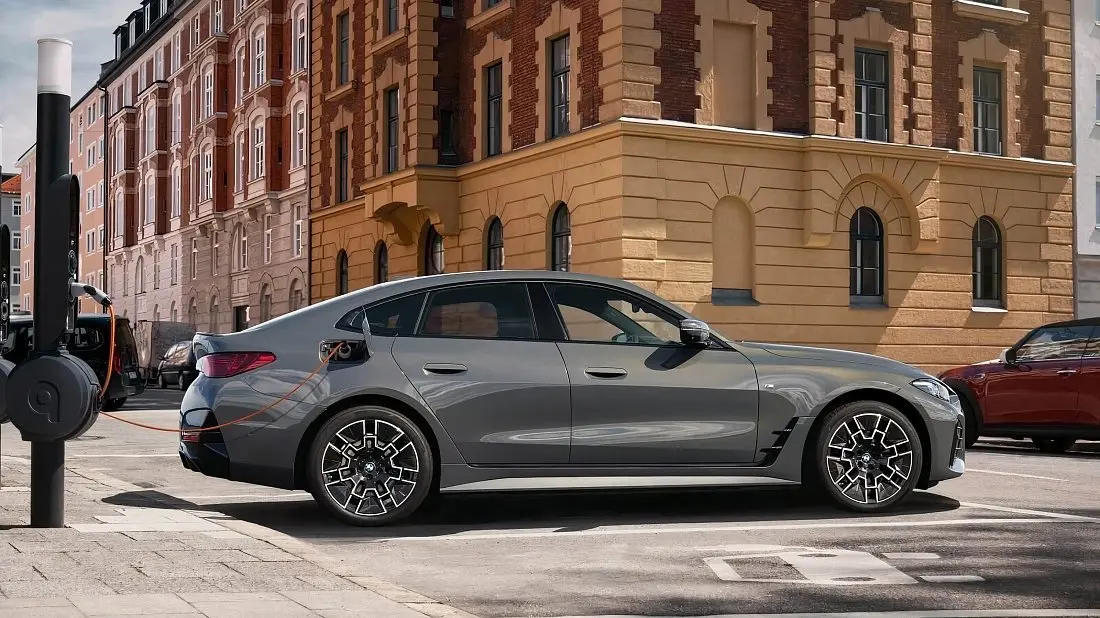
On AC, the i4 takes 11 kW and completes a full charge in 8 hours 15 minutes on a public point at that power. A 7.4 kW home wallbox takes about 13 hours. A domestic socket needs more than 43 hours — not a plan, just a backup.
On DC, the i4 accepts up to 205 kW and does 10–80% in around 31 minutes. L'Argus managed it in 20 minutes at best, with a 170 kW peak tapering to 58 kW by 78%. Ten minutes on a fast charger is worth roughly 160 km. On a Lisbon–Porto run that means one short stop, or none, depending on how fast you travel. Portugal's public network, MOBI.E, covers the main motorway corridors, and the high-power chargers on the A1 and A2 are where the i4's 205 kW peak pays off.
| Charging type | Time |
|---|---|
| Domestic socket (10 A) | more than 43 h |
| 7.4 kW wallbox | 13 h |
| 11 kW public AC | 8 h 15 min |
| 50 kW DC | 1 h 15 min |
| 205 kW DC (10–80%) | 31 min |
Wheels can cost you 85 km of range
This is the most underestimated decision on the whole options list. With 19-inch Pirelli P Zero tyres, range falls by 60 km. With the same tyres in 20-inch, it falls by 85 km. With low-rolling-resistance Hankooks, the penalty is minimal.
You pay more to travel less. One Automobile Propre test car carried €6,880 of options, €2,700 of that on wheels alone. If range is what you're buying, take the smaller aero wheels and spend the money elsewhere.
Working in the other direction, the 2026 model year brought silicon carbide inverters, which improve efficiency: the eDrive40 gains around 24 km on 18-inch wheels and around 19 km on 19-inch.
What the i4 gets wrong
The CLAR platform started life under combustion cars, and it shows in places it shouldn't. A now-pointless transmission tunnel survives, making the centre rear seat effectively unusable. The falling roofline steals headroom — getting in means ducking, and tall adults will rate the rear space as merely average.
There's no frunk, despite empty space under the bonnet. The boot holds 470 litres (1,290 litres with the seats folded), and the hatchback tailgate beats the Tesla Model 3's saloon opening, though the roofline limits how much of that volume you can actually stack.
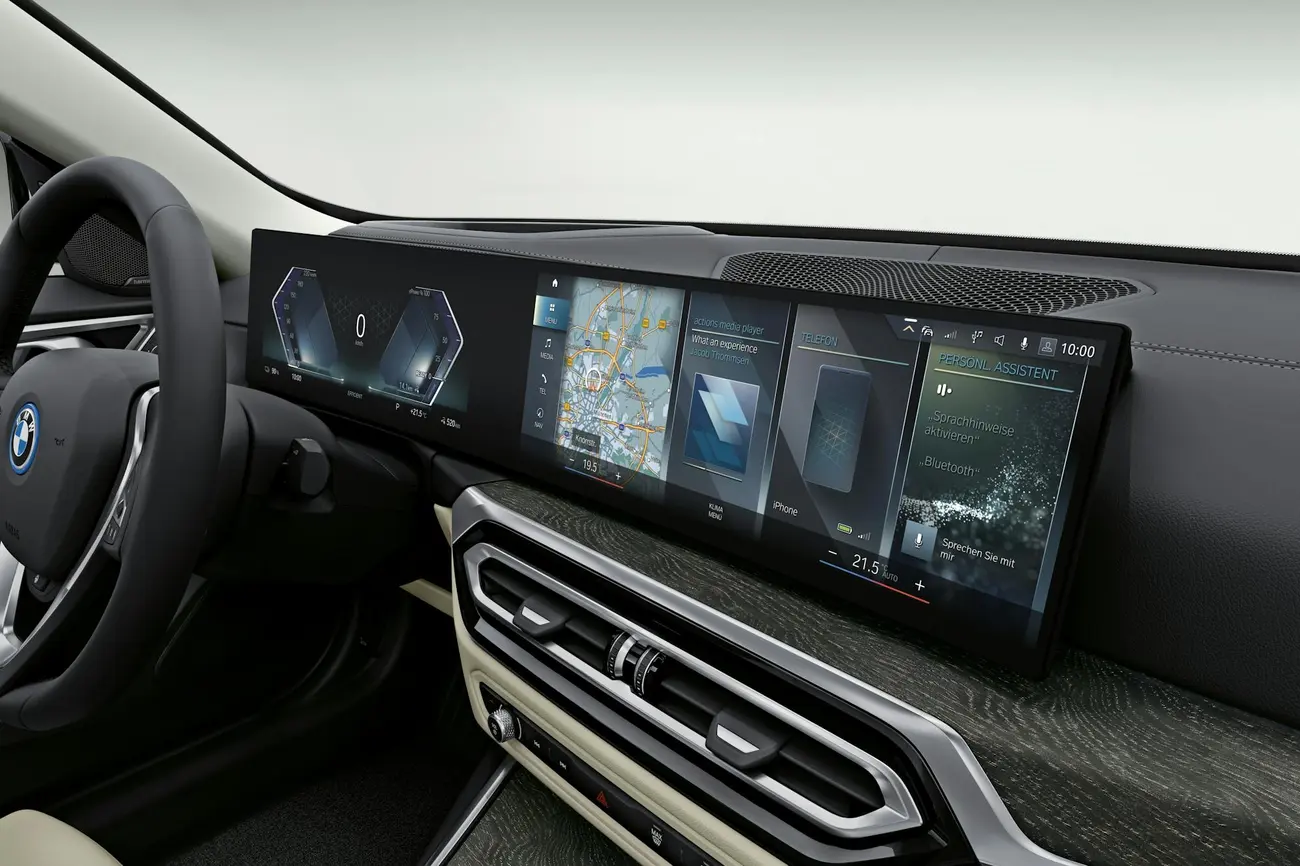
Smaller irritations that show up daily: iDrive spreads 48 app tiles across its menus, the piano-black switches under the vents feel cheap, the steering is accurate but artificial, and there's no true one-pedal driving and no paddles for adjusting regeneration.
On the credit side, noise isolation is genuinely good: 63 dB at 50 km/h, 72 dB at 110, 75 dB at 130. And performance holds up down to 20% battery — only below 10% does the punch fade noticeably (80–120 km/h goes from 3.62 s to 4.12 s).
What a BMW i4 eDrive40 costs in Portugal
European prices set the bracket: in France the eDrive40 starts at €67,300, in Belgium at €64,200. In the UK, the eDrive35 opens at £51,370 and the M60 at £71,525. In the US, the eDrive40 is $57,900, the xDrive40 $62,300 and the M60 $70,700 — no increase over 2025.
Portugal has one factor working in the buyer's favour. As a fully electric car, the i4 is exempt from ISV, the vehicle purchase tax that inflates combustion-car prices here, and pays a reduced IUC, the annual road tax. That pushes the local figure closer to the pre-tax base than you'd expect. Even so, this is a car sitting close to €65,000, on which options escalate quickly. The used market deserves a look: a 2022 or 2023 i4 carries the same 80.7 kWh battery and the same 335 bhp motor, minus the new inverters and the latest iDrive.
For context, at launch in 2022 the eDrive40 cost between €59,700 and €61,500 in France. Prices have drifted upward, but range came with them: WLTP went from 578–593 km to today's 612–613 km.
Frequently Asked Questions
For most drivers in Portugal it is the eDrive40: 335 bhp, an 80.7 kWh usable battery and up to 613 km WLTP, delivering around 80% of the M60's performance for considerably less money. The eDrive35 only makes sense for almost exclusively urban use, because its 67.1 kWh pack gives up more than 100 km of range. The xDrive40 and M60 are worth it only if you genuinely need all-wheel drive or 0–100 km/h in 3.6 s and accept the higher consumption.
At a measured 130 km/h consumption climbs to 23.8–24.4 kWh/100 km, which works out at 330 to 339 real kilometres between charges. At 110 km/h it settles at 17.4 kWh/100 km, or 464 km. Mixed-cycle testing recorded 16.9 kWh/100 km and 478 km. As a rule of thumb, expect around 80% of the WLTP figure in mixed use and around 55% at motorway speeds.
On DC the i4 accepts up to 205 kW and covers 10–80% in about 31 minutes (L'Argus measured 20 minutes at best, peaking at 170 kW). Ten minutes on a fast charger adds roughly 160 km. At home, an 11 kW wallbox fills the battery in 8 h 15 min and a 7.4 kW unit takes about 13 hours; a standard domestic socket needs more than 43 hours, so it is not a workable option.
As a battery electric car the i4 is exempt from ISV (vehicle tax) and pays only the reduced IUC road tax for EVs, which takes several thousand euros off the final price compared with a petrol or diesel 4 Series Gran Coupé. VAT still applies, and company cars get more favourable autonomous taxation treatment. On 2026 European pricing the eDrive40 starts at €64,200 in Belgium and €67,300 in France, and options add up fast — one test car carried €6,880 in extras, €2,700 of that on wheels alone.
Usually yes, because the hardware barely changed: a 2022 or 2023 eDrive40 already has the same 80.7 kWh battery and the same 335 bhp motor. What it misses are the silicon carbide inverters introduced for model year 2026 (worth roughly 24 km extra on 18-inch wheels and 19 km on 19-inch) and the latest iDrive software. When browsing listings, check the wheel size: 19-inch Pirelli P Zeros cost 60 km of range and 20-inch wheels cost 85 km compared with low-rolling-resistance tyres.
Is it worth it? It depends on the kind of kilometres you drive
If your driving is mostly urban and secondary roads, the eDrive40's range turns charging into a weekly errand rather than a daily one. If you cover motorway at 130 km/h regularly, plan on stopping every 300 km or so — still competitive in this class, but a long way from the 613 km on the brochure.
Against its direct rivals here — Tesla Model 3 Long Range, Hyundai Ioniq 6, Polestar 2, Kia EV6, Mercedes-Benz EQE — the i4 doesn't win on raw efficiency or rear-seat space. It wins on how it drives and how it feels. If that's what you're after, take the eDrive40, tick the small wheels, and skip the M60.