
Chinese Audi EVs in Europe: Real Prices, Range and Import Risks
Published: 26/08/2026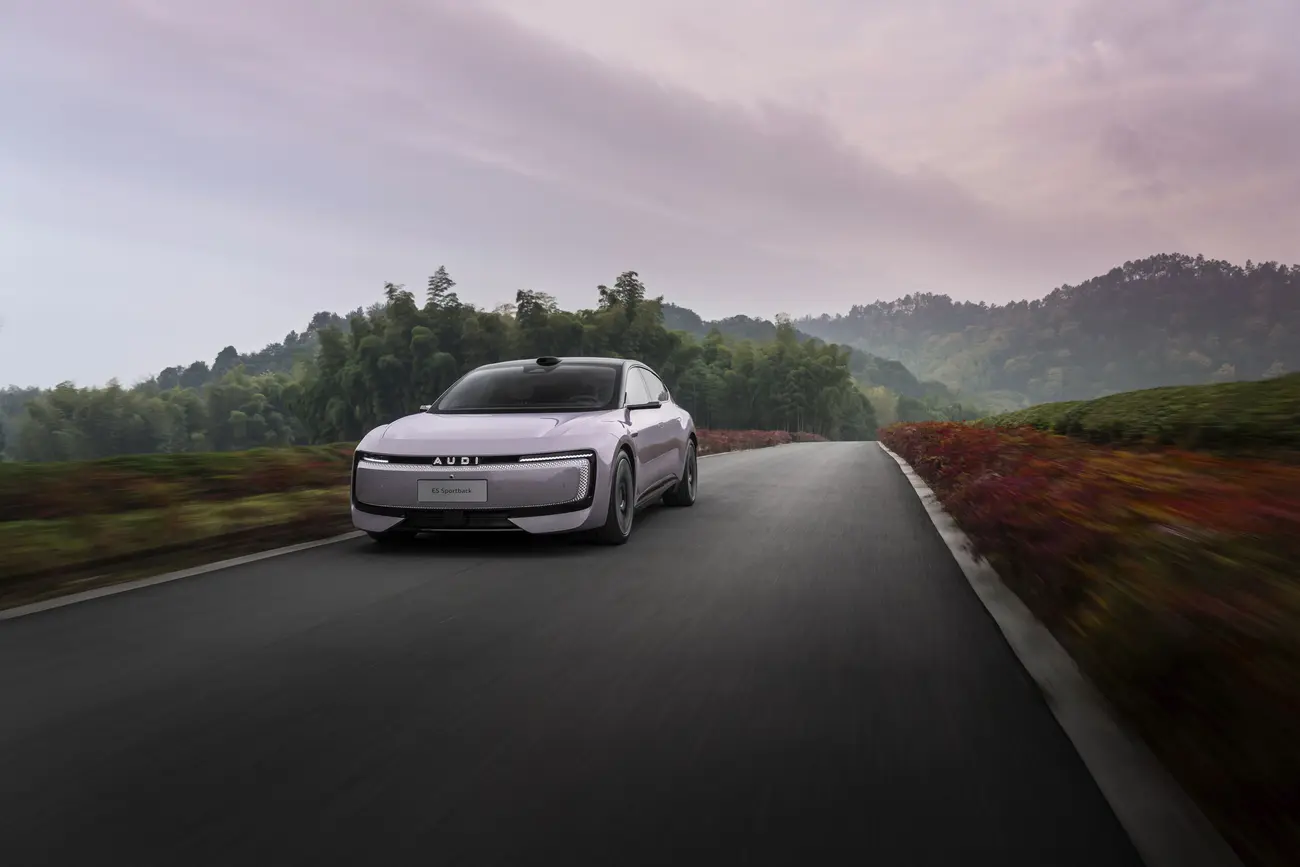
A 787 hp Audi for under €60,000 — and the small print
There is an electric Audi with 787 hp, a 100 kWh battery, 800-volt architecture, roof-mounted LiDAR and active air suspension on sale in Germany for €59,980. The official S6 Sportback e-tron, with 543 hp, costs €99,500. That is almost a €40,000 gap, and the listing is not a scam: the car exists, it really does arrive in Europe, and it already has buyers.
The catch sits elsewhere. This Audi is not sold by Audi. It is an AUDI — capital letters, no four rings — built in China by the SAIC-Audi joint venture and brought into Europe by a parallel importer. None of these cars is officially sold in Portugal, and the list price is nowhere near the final price.
What the AUDI E5 Sportback and E7X actually are
The AUDI brand launched in 2024–2025 as a China-only sub-brand, developed with SAIC on a jointly engineered Advanced Digitized Platform (ADP). It shares nothing with the European A6 e-tron beyond the name. The four rings were deliberately dropped from the bonnet and replaced by the capitalised wordmark.
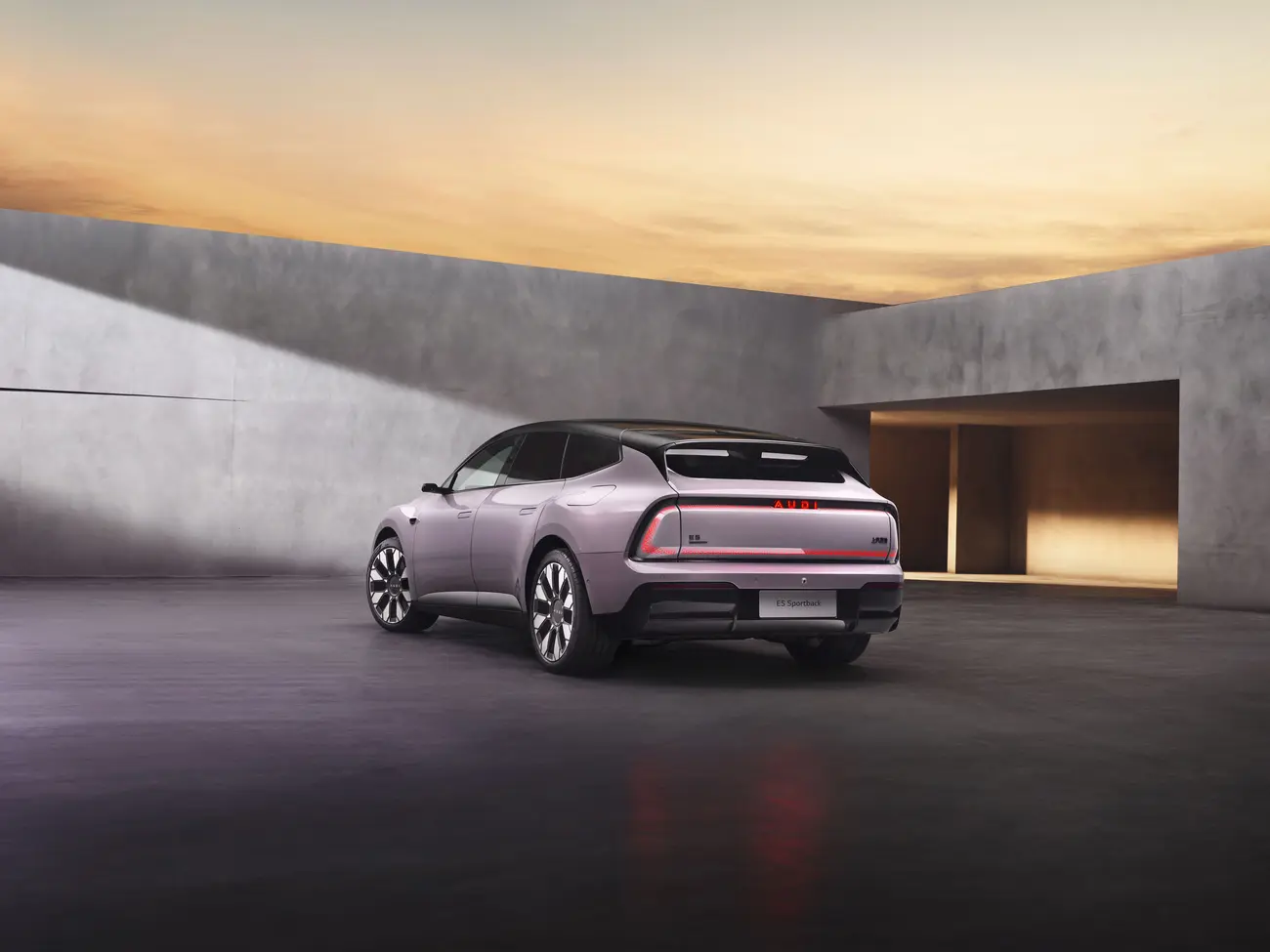
There are two models. The E5 Sportback is a 4,881 mm hatch-saloon with a 2,950 mm wheelbase, four powertrains (220 kW/299 hp, 300 kW/408 hp, 386 kW/525 hp and 579 kW/776–787 hp) and three batteries (76 kWh LFP, 83 kWh NCM, and a 100 kWh NCM pack from CATL). The flagship quattro does 0–100 km/h in 3.4 seconds. The E7X is the SUV: 5.05 metres long, 680 hp, 900-volt architecture, LiDAR as standard.
Equipment is the selling point. A pillar-to-pillar screen running Audi OS on a Snapdragon 8295 chip, digital door mirrors, active air suspension with ±45 mm of travel and CDC damping, and an ADAS package built around roof LiDAR, three long-range radars, 12 ultrasonic sensors, 11 cameras, Nvidia Orin-X processing and Momenta software. The E5 was named 2026 China Car of the Year.
Chinese Audi EV prices in Europe, and what the sticker leaves out
Importer Auto China buys the cars in China, ships them to Europe and homologates them locally, claiming it obtains EU certification and valid registration papers. It sells in Germany, Austria, Switzerland and Spain. Not in Portugal. Which is why the Chinese Audi EV price you read in Europe is one number, and the number you pay is another.
That is the first reading trap. The €59,980 for the E5 and €72,900 for the E7X are pre-tax list figures. Add import, homologation and accessories — roughly €8,750 — plus VAT, and the real delivered-and-registered figures land between €72,488 and €81,800 for the E5 and between €86,800 and €88,209 for the E7X.
| Model | China price | Importer list (DE) | All-in with VAT and registration | Official Audi rival |
|---|---|---|---|---|
| AUDI E5 Sportback | 205,900–319,900 yuan | €59,980 | €72,488–81,800 | A6 e-tron Sportback €62,800 / S6 e-tron €99,500 |
| AUDI E7X | 269,800 yuan | €72,900 | €86,800–88,209 | SQ6 e-tron €93,800 |
Against Chinese pricing — the E5 starts at roughly €25,500 to €30,000 in China after the February 2026 discounts — the European figure is about double. A mark-up close to 130%.
Against the official European range, a discount does survive: the E7X lands around €7,000 below an SQ6 e-tron that is smaller, less powerful and has no LiDAR. But set against a €62,800 A6 e-tron Sportback, the all-in E5 is more expensive, not cheaper. The bargain only really exists when you line it up against the sporting S and SQ models.
CLTC vs WLTP range: 773 km is not 773 km
Every range figure published for the E5 and E7X comes from China's CLTC cycle: 618 km with the 76 kWh LFP pack, 623 km with the 83 kWh, 773 km for the rear-drive 100 kWh version, and 647 km for the 100 kWh quattro. The E7X claims 660 km.
CLTC is considerably more generous than Europe's WLTP — lower average speeds, a shorter cycle, kinder conditions. A car rated at 773 km CLTC should not be read as a WLTP equivalent, let alone as real-world range on the A1 motorway at 120 km/h in January. And because these cars never went through manufacturer-published WLTP consumption testing, buyers have no European reference number to compare against an A6 e-tron or a Tesla Model 3. Charging claims follow the same logic: the "10 minutes for another 370 km" figure is CLTC too.
Warranty, parts and service: what happens when something breaks
There is no Audi factory warranty. No official dealer will take the car in. What you get is a two-year warranty from the importer, honoured through independent workshops.
In practice that means:
- No access to the brand's repair history, technical bulletins or training for these specific models.
- Uncertain parts supply — components come from China and sit outside Audi's European distribution network.
- Software and connected services designed for the Chinese ecosystem. Audi itself says these cars are "deeply integrated into China's digital ecosystem" and were "developed exclusively for the Chinese market".
- ADAS calibrated for Chinese roads and road markings. LiDAR plus 11 cameras looks formidable on paper; how it behaves on a faded Portuguese roundabout is another matter.
Then there is the question of who stands behind that warranty. Auto China LLC is registered in Saint Kitts and Nevis, an offshore jurisdiction, and its German contact address is shared by 214 registered companies. A warranty is only worth as much as the entity issuing it, for the two years it is meant to run.
Grey imports: warranty gaps are only the start
The legal risk is not hypothetical. In 2023 Volkswagen won a German court case against a dealer who had imported around 20 Chinese-market ID.6s. The cars were ordered destroyed, and reported storage costs came to roughly €500,000.
If the manufacturer does not explicitly consent to the import, the importer is exposed to trademark and design-right infringement. Ansgar Klein, president of Germany's independent dealer association BVfK, puts it plainly: "Even if lawyers give the green light, factually a residual risk remains." And: "As a dealer, I would not import vehicles from China."
Audi has not commented directly on the imports. It has only stressed that the SAIC joint-venture models were designed for Chinese customers and intended exclusively for that market — which is precisely the ground it would need to act on.
The warning sign coming out of China: residual value
One data point matters more to a buyer than any legal analysis. The E5 flopped in its home market. It took 10,153 pre-orders in 30 minutes at launch, but delivered only 7,070 cars by January 2026 — and just 420 in January itself.
The response was price cuts. In February 2026 the brand stacked a purchase-tax exemption, a cash discount and a trade-in bonus into a package worth around €3,700. Local analysts blame the same thing: dropping the four rings stripped away the prestige that justified the price.
Put the three pieces together. A car being discounted in the market it was built for, with no official European presence, no manufacturer warranty and no service network. Who is the second owner? And what does a Portuguese dealer value a parallel-imported AUDI E5 at in three years' time, with no Eurotax reference and no trading history? That is the calculation that turns the upfront saving into a loss.
Frequently Asked Questions
There is no date. The E5 Sportback and E7X are SAIC-Audi joint venture models sold officially only in China, and Audi has not type-approved them for Europe. The independent importer Auto China currently delivers to Germany, Austria, Switzerland and Spain — Portugal is not on the list. Anyone wanting one in 2026 has to bring in a car already registered in another EU member state and put it through the Portuguese admission process.
As a full EV, the E5 is exempt from ISV and pays reduced IUC road tax — that is the good half of the equation. The rest is not: on top of the importer's €59,980 list price come roughly €8,750 in import, homologation and accessory fees, plus VAT, pushing the delivered and registered figure into the €72,488–€81,800 range. For the E7X, the €72,900 list price becomes around €86,800–€88,209 all-in. That is close to double the Chinese price, where the E5 starts at ¥205,900 (about €25,500–€30,000 after the February 2026 cuts).
There is no Audi factory warranty and no access to the official dealer network. What you get is a two-year warranty from the importer itself, honoured through independent workshops — and Auto China LLC is registered in Saint Kitts and Nevis, with a German contact address shared by 214 companies. Before paying any deposit, get in writing which legal entity stands behind the warranty, which workshops in Portugal will accept the car, and what the lead times are for parts shipped from China.
No WLTP figure has been published. The quoted 618 km (76 kWh LFP), 623 km (83 kWh), 773 km (100 kWh RWD) and 647 km (100 kWh quattro) all come from China's CLTC cycle, which is considerably more optimistic than the European one because it uses lower average speeds and a shorter test. In practice, a European buyer has no comparable reference number to hold against an A6 e-tron or a Tesla Model 3. The same caveat applies to fast charging: the 10 minutes for another 370 km is also a CLTC figure.
On paper the maths is tempting: the E5 quattro offers 787 hp, a 100 kWh battery, 800 V architecture, 0–100 km/h in 3.4 s and roof LiDAR, against 543 hp and €99,500 for the official S6 Sportback e-tron. The problem starts after the purchase. The E5 flopped in its home market — 7,070 deliveries by January 2026, just 420 of them that month — and was discounted by around €3,700 in February. With no valuation tables, no official network and no European market history, the resale value in three years is the variable that can swallow the entire upfront saving.
What if you genuinely want one in Portugal?
Right now there is no easy route. The importer does not sell into Portugal, and bringing over a car already registered in Spain or Germany means going through the vehicle admission process, paying ISV (Portugal's registration tax — pure EVs are exempt, and IUC annual road tax is reduced, which helps) and producing a Certificate of Conformity that Audi never issued.
Before any deposit changes hands, three checks are non-negotiable:
- Paperwork. Insist on seeing the COC or the national type approval actually issued for that specific VIN, not a generic promise of "European certification".
- Written warranty. Who is the guarantor, which legal entity is it, which workshops in Portugal will accept the car, and what happens if the importer folds inside those two years.
- Parts. Ask for concrete lead times on a battery, a LiDAR module, a bumper. A car sitting immobilised for three months waiting on a part from China costs more than the purchase saved.
For most buyers here, the useful takeaway from this episode is not an opportunity. It is a signal: cutting-edge electric technology at low prices is being built in China, and European manufacturers will have to answer with cars sold locally, with warranty and a network behind them. Until then, an Audi that Audi does not sell is a car with nobody to answer for it.