
EV Air Conditioning and Range Loss in Portugal: What August Really Costs
Published: 21/08/2026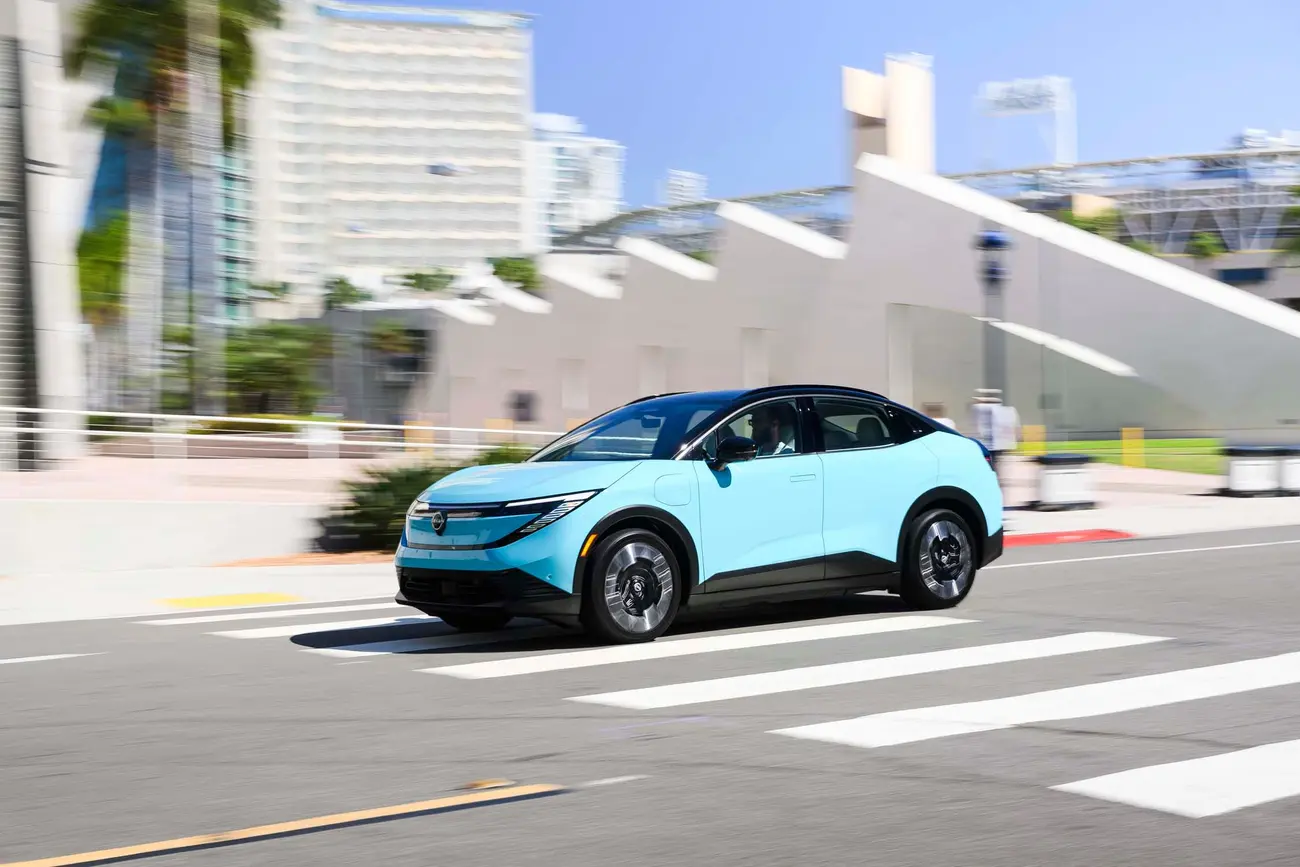
EV air conditioning and range loss in Portugal: what August really costs
Sixty degrees Celsius inside the cabin. That is what a car parked in full sun at solar noon reaches on a Portuguese heatwave day — and it is the starting point of a French test by Automobile Propre that measured, minute by minute, how long and how much energy an electric car needs to make that liveable. The answer matters to anyone driving here between June and September.
The short version: in summer, air conditioning costs an EV far less range than most people fear. Winter heating is the real range killer. But there are caveats — and some models are clearly better than others at handling 35 or 40 °C.
How much range does air conditioning use in an electric car
The protocol is simple and repeatable. Car parked on flat ground in full sun, climate control in automatic mode set to 20 °C with a mid fan setting, for one hour. Outside temperature 36.3 °C. Cabin already heat-soaked at roughly 60 °C. Probes placed outside, at the vent outlet, between the front headrests and under the steering column.
On the new-generation Nissan Leaf, the system drew 2.3 kWh over one hour. That is around 4 kW at the start, while it attacks the 60 °C cabin, dropping to a minimum of about 0.9 kW once things stabilise. On a 75 kWh battery, a full hour of stationary cooling is a little over 3 % of the charge.
Stuck in traffic: about 8 km per hour
Germany's ADAC ran the longer, inverse experiment: a Tesla Model Y in the lab simulating an eight-hour traffic jam, 35 °C outside, 20 °C inside. The result was 1.3 to 1.5 kW of cooling power, roughly 2 % of battery per hour, and about 8 km of range lost per hour. After eight hours: 64 km and 16 % of the battery.
Compare that with a combustion car in the same scenario — 1 to 1.5 litres per hour idling, the equivalent of 10 to 15 kWh. In a stationary queue on the A2 on an August Sunday, the EV is the car that suffers least, and the only one that does not need an engine running to deliver cold air.
Real-world summer range loss
A Recurrent study covering 29,716 electric vehicles gives the practical scale. At 32 °C, cars keep about 95 % of their range. At 37 °C, losses jump to 17–18 %, leaving 82 to 83 %. Below 30 °C the effect is close to irrelevant — around 2.8 % at 27 °C.
So the enemy is not the A/C switch, it is extreme heat. On days when the Alentejo pushes past 40 °C, expect to lose close to a fifth of the quoted range. On every other day, the difference sits inside the trip computer's margin of error.
The Nissan Leaf dropped 36 °C in an hour
Back to the cabin test. The new Leaf posted the largest absolute cool-down the outlet has ever recorded: 59.9 °C down to 23.6 °C, a 36.3 °C drop. Air leaving the vents got down to 4–5 °C.
The pace matters more than the final figure. In the first ten minutes the cabin fell from 59.9 °C to 29.2 °C. By 30 minutes it read 25.6 °C, and from 50 minutes onwards it settled at 23.6 °C. Average over the full hour: 27.8 °C — 31.1 °C across the first half hour, 24.6 °C across the second.
| Time | Cabin | Vent air | Outside |
|---|---|---|---|
| 0 min | 59.9 °C | 49.2 °C | 36.3 °C |
| 10 min | 29.2 °C | 9.4 °C | 37.6 °C |
| 20 min | 28.1 °C | 7.8 °C | 36.9 °C |
| 30 min | 25.6 °C | 6.5 °C | 34.8 °C |
| 40 min | 25.8 °C | 4.2 °C | 31.2 °C |
| 50 min | 23.6 °C | 5.3 °C | 32.1 °C |
| 60 min | 23.6 °C | 5.2 °C | 33.5 °C |
Best at cooling, not the most efficient
There is a catch. Efficiency is measured in degrees gained per kWh spent, and there the Leaf lands mid-table: 15.8 °C/kWh, behind the Tesla Model 3 (22 °C/kWh) and Renault Scenic E-Tech (16.3 °C/kWh), ahead of the Volkswagen ID.7 (13.2 °C/kWh). The Leaf cools harder and faster, and pays for it.
| Model | Cabin at 60 min | Hour average | Efficiency |
|---|---|---|---|
| Nissan Leaf | 23.6 °C | 27.8 °C | 15.8 °C/kWh |
| Skoda Elroq | 27.3 °C | 29.0 °C | n/a |
| Volkswagen ID.7 | 27.7 °C | 30.4 °C | 13.2 °C/kWh |
| Renault Scenic E-Tech | n/a | n/a | 16.3 °C/kWh |
| Tesla Model 3 | n/a | n/a | 22.0 °C/kWh |
For short urban trips, speed of cooling is what counts — arriving before the cabin gets comfortable helps nobody. For long motorway runs with sun on the windscreen, efficiency matters more.
Does a panoramic roof make an EV hotter inside?
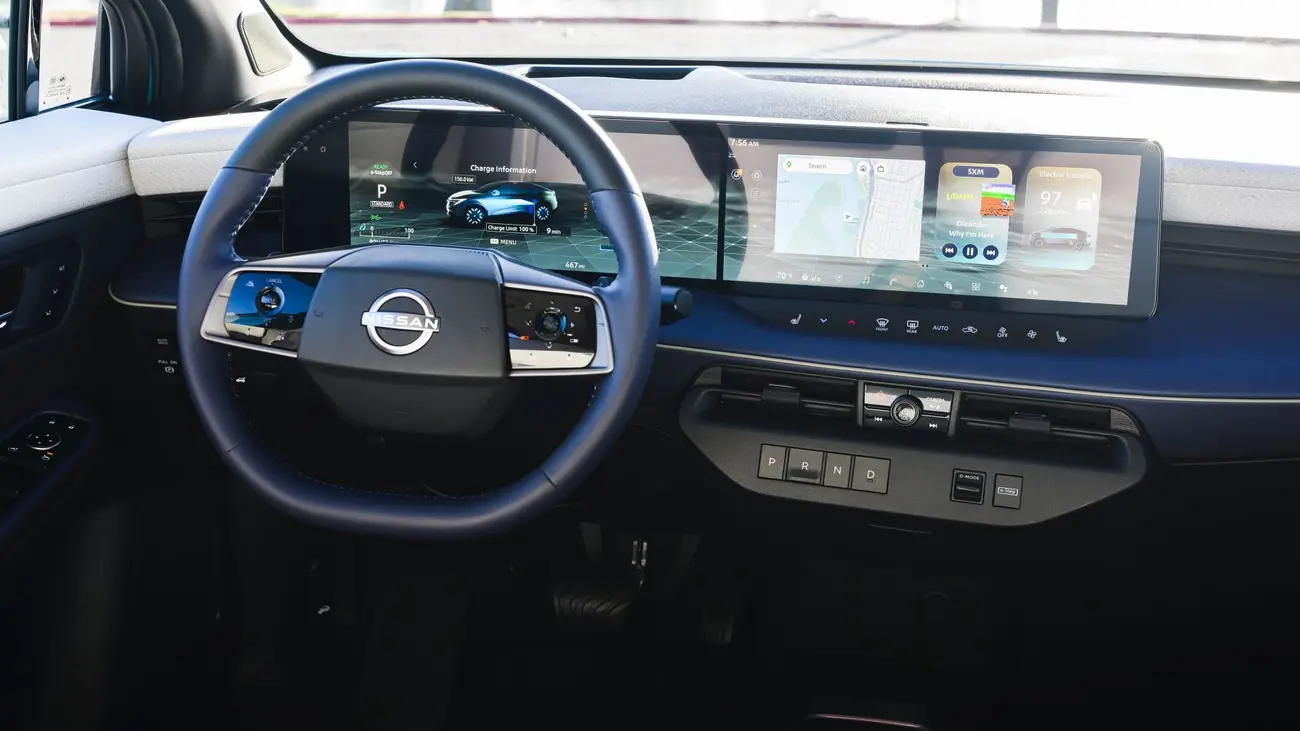
The most interesting detail of the test: the Leaf managed this with an electrochromic panoramic roof developed by Saint-Gobain, glass that dims on demand, working on the same principle as Renault's Solar Bay. A glass roof is normally a thermal penalty. The ID.7, worst in the efficiency table, also has a panoramic roof; the Scenic, with a solid roof, was among the best.
If you are choosing options on an EV and live inland or in the south of Portugal, ask the dealer whether the panoramic roof has a physical blind or dimmable glass. An unprotected glass roof is the difference between climbing into a 55 °C car and a 45 °C one.
The heat pump will not save you in summer
This is the most common misunderstanding. An EV heat pump is a winter component: it replaces resistive heating and can be worth serious mileage in January. In summer it works no magic.
The Recurrent data is almost counter-intuitive. At 32 °C, heat-pump cars retained 93 % of range against 97 % for cars without one; at 37 °C, 85 % against 87 %. Much of that gap comes down to which models and use cases sit in each group, but the message stands — nobody should pay for a heat pump because of the heat.
On the new Leaf, the heat pump is standard from Engage trim on the 75 kWh versions and appears as a roughly €1,000 option (VAT included) on the 52 kWh in continental Europe. Buy it for the cold months, not for August.
How to cool an electric car faster in summer
The test produced one more figure that should change how you use pre-conditioning. With the system switched off, the cabin climbed back to 43 °C after 5 minutes, 50 °C after 15 minutes and 54 °C after 30 minutes. Cold air evaporates fast in a car sitting in the sun.
Which leads to a short set of rules:
- Pre-cool shortly before you leave, not half an hour ahead. Five to ten minutes is enough; anything more is energy thrown away.
- Do it while plugged in. The cost shifts to the grid instead of the battery — the one moment when air conditioning is genuinely free in range terms.
- Park in the shade whenever you can. A cabin starting at 45 °C instead of 60 °C asks less than half the work of the compressor.
- Do not leave the car in the sun on a low charge. Keep it above 50 %, or plugged in with an 80 % limit — battery thermal management needs energy to protect itself.
- Open the windows for 30 seconds before you set off, then switch to recirculation. Push the 60 °C air out rather than paying to cool it.
Frequently Asked Questions
Far less than most drivers fear. In ADAC's lab test, a Tesla Model Y holding the cabin at 20 °C with 35 °C outside drew only 1.3 to 1.5 kW — roughly 2 % of battery and about 8 km of range per hour. On the road, Recurrent's study of 29,716 EVs found cars keep around 95 % of their range at 32 °C. It is extreme heat rather than the compressor that hurts: at 37 °C the loss climbs to 17-18 %.
Yes, but for winter rather than summer. A heat pump replaces resistive heating and is where it pays back real kilometres. Recurrent's data shows heat-pump cars retained 93 % of range at 32 °C versus 97 % for cars without one, so there is no summer benefit. On the new Nissan Leaf it is standard from Engage trim on the 75 kWh versions and costs around €1,000 as an option on the 52 kWh in continental Europe.
Considerably better. In ADAC's eight-hour stationary test at 35 °C, the EV used 16 % of its battery and 64 km of range in total. A combustion car idling in the same conditions burns 1 to 1.5 litres per hour, the equivalent of 10 to 15 kWh per hour. The EV also needs no running engine to produce cold air, so there is no idling noise or exhaust while stuck in traffic.
Occasional use does not — thermal management actively cools the cells — but prolonged extreme heat does accelerate degradation. In Portugal the sensible habits are parking in the shade, not leaving the car in full sun with a very low state of charge, and keeping it above 50 % or plugged in with an 80 % limit. Expect slower DC fast charging during heatwaves too, since the car protects the battery before accepting full power.
Keep it short and do it while plugged in. In Automobile Propre's test the cabin climbed back to 43 °C just 5 minutes after the climate control was switched off, and 54 °C after 30 minutes, so pre-cooling half an hour ahead is wasted energy. Five to ten minutes immediately before leaving is enough, and doing it on the charger shifts the cost to the grid instead of the battery. The new Leaf showed the first phase does most of the work: 59.9 °C down to 29.2 °C in ten minutes.
What this means if you are buying an EV in Portugal
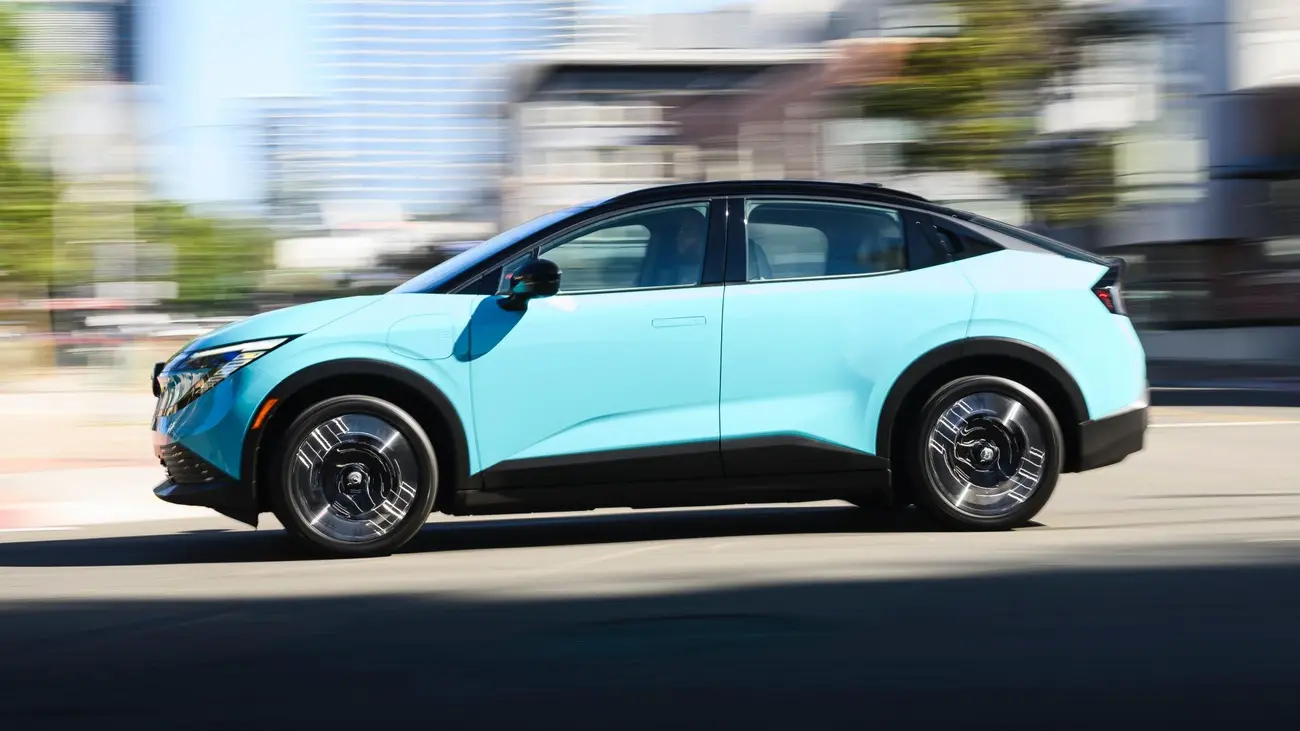
The new Leaf, now a compact crossover built in Sunderland, comes with two batteries. The 52 kWh claims up to 271–280 miles WLTP (roughly 436–450 km), 105 kW DC charging and 174 to 213 hp depending on the market quote. The 75 kWh moves to 386 miles WLTP (close to 622 km), 215 hp and 150 kW DC, with 20 to 80 % in about 30 minutes. At a steady 70 mph the realistic figures drop to 306 km and 433 km respectively. UK prices start at £28,849 and £32,249 with the £3,750 grant applied; Portuguese pricing is not confirmed yet, though ISV exemption (Portugal's vehicle registration tax) and reduced IUC road tax still do most of the work on the final bill.
For a buyer here, the useful takeaway is not which badge won. It is that in a country where the thermometer clears 40 °C every summer, climate system performance and cabin sun protection are as concrete a buying criterion as WLTP range — and they almost never appear on a spec sheet. Next time you take a test drive in August, leave the car in the sun for ten minutes before you get in. It is the most revealing test you can run.